

Key Takeaways
- Quiet is the headline: one client could hear the controller only a little, even while the air pouches were pumping up.
- Plan on a cord, because it plugs into a wall (the cord is about 5 feet), the product photos hint at a battery, and both legs must be plugged in for it to run.
- Keep the thigh straps loose and start on the low level, since two clients warn the sleeves tighten a lot once they inflate.
- The heat mentioned in the manual and on the product page isn't there: three reviewers say the unit has no heat function.
- The evidence is thin, with 6 client reviews, 3 usable buyer reviews and one group post about this set, so how long the pump and pouches last is unproven.
Brandon, a longtime client, gave this Quinear 3-in-1 leg massager 4 out of 5 and then listed four complaints: it was cumbersome to put on, the carrying bag was a little small, there was no heat, and the plug wasn't shown in the photos. Brandon called them fairly minor, since the unit did what it was supposed to.
That sums up where it sits: a quiet, thigh-high compression set that works, but not quite the way the listing frames it. This Quinear 3-in-1 leg massager with compression review is for someone who wants foot-to-thigh air compression at a mid-range price and doesn't mind being plugged into a wall.
My bottom line: the pressure is real and the pump is quiet, but the missing heat, the cord and the fit quirks keep it from being the no-brainer it looks like. I've read 6 client reviews, 4 buyer reviews and one post from a member of our Facebook group, which is less than I'd like.
What Do You Get for $159.99?
| Spec | What it means for you |
|---|---|
| Price | $159.99, mid-range (checked October 2026); the listing showed as unavailable, and one reviewer mentioned paying about $180 |
| Type | Corded air compression sleeves covering foot, calf and thigh |
| Chambers, modes, strengths | 3 chambers per the listing; 3 modes (sequence, circulation, combination) and 3 strengths |
| Timer | 20, 25 or 30 minutes; starts on combination, minimum, 20 minutes |
| Heat | None, per three reviewers |
| Control | Wired control unit with an LCD and 4 large buttons; both legs plug into it |
| Weight and size | 1,500 g; 16.14" by 7.48" by 9.05" |
| Carrying case | Zippered bag included; one client found it a little small |
| Noise | Very quiet per one client; no dB figure in the listing |
| Warranty, FSA/HSA | Not stated in the listing |
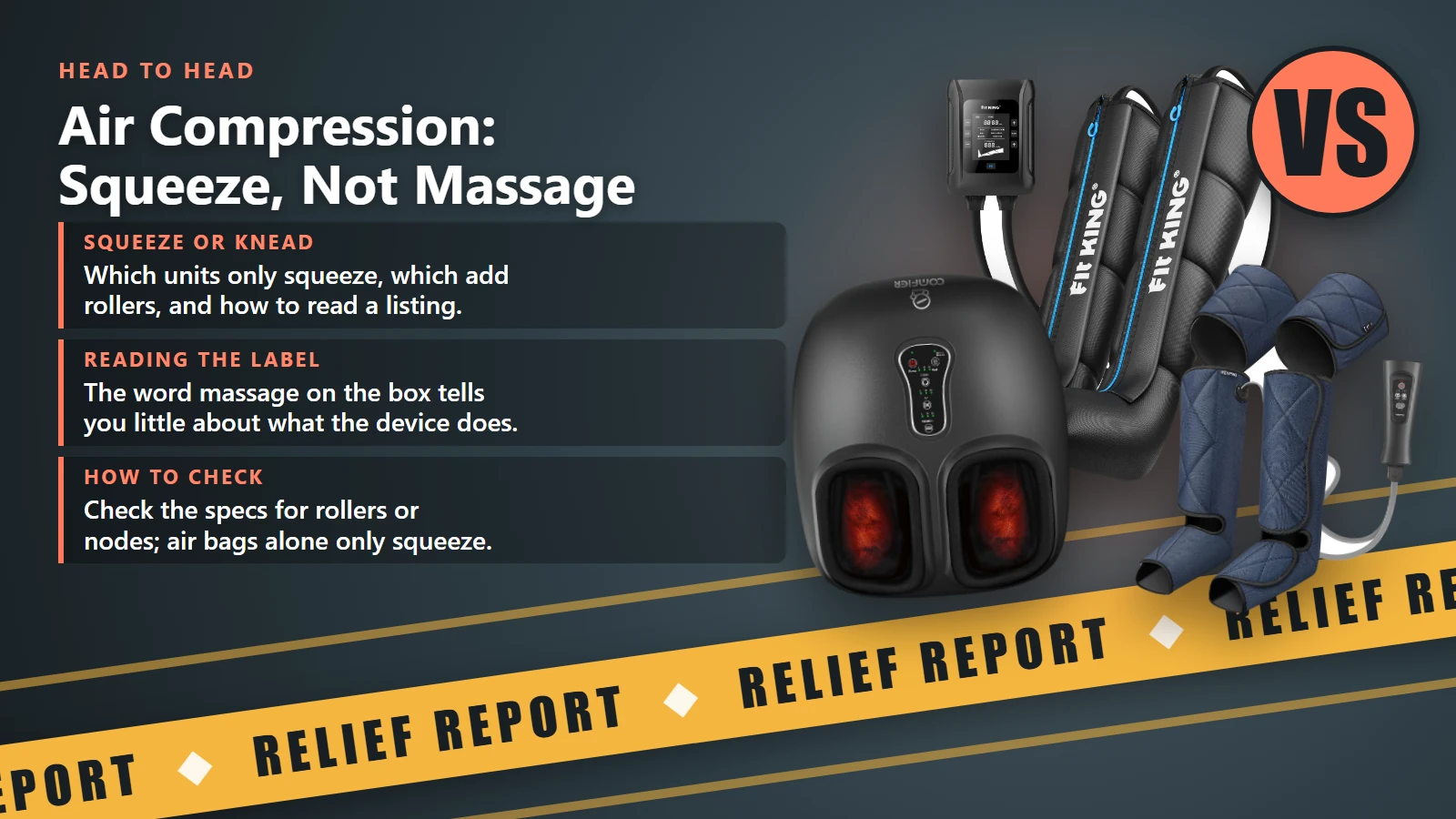
The brand also claims 10 massage programs and "acupressure, kneading and vibration" techniques. Clients found three modes and plain alternating compression.
Who Should Buy It, and Who Should Skip It?
It suits:
- People who want foot-to-thigh compression, since two reviewers preferred it to boots that stop below the knee.
- Evening sitters with an outlet within reach of the chair who like to read or watch TV during a session.
- Anyone who wants a quiet pump.
- Buyers who value storage, because everything fits in a zippered bag.
Skip it if:
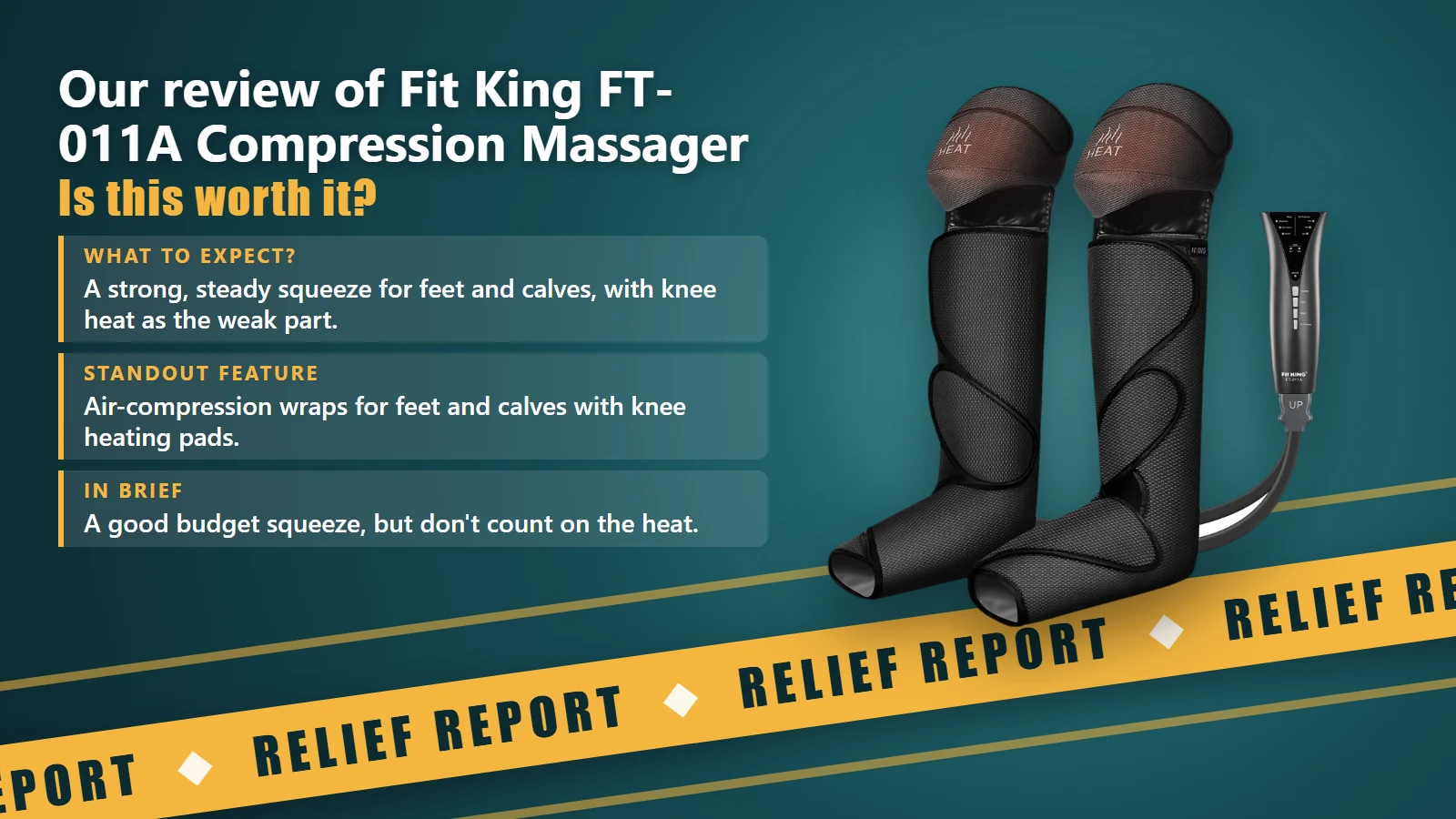
- You need heat, which this unit does not have despite the hints in the manual.
- You want cordless portability or to use it across rooms.
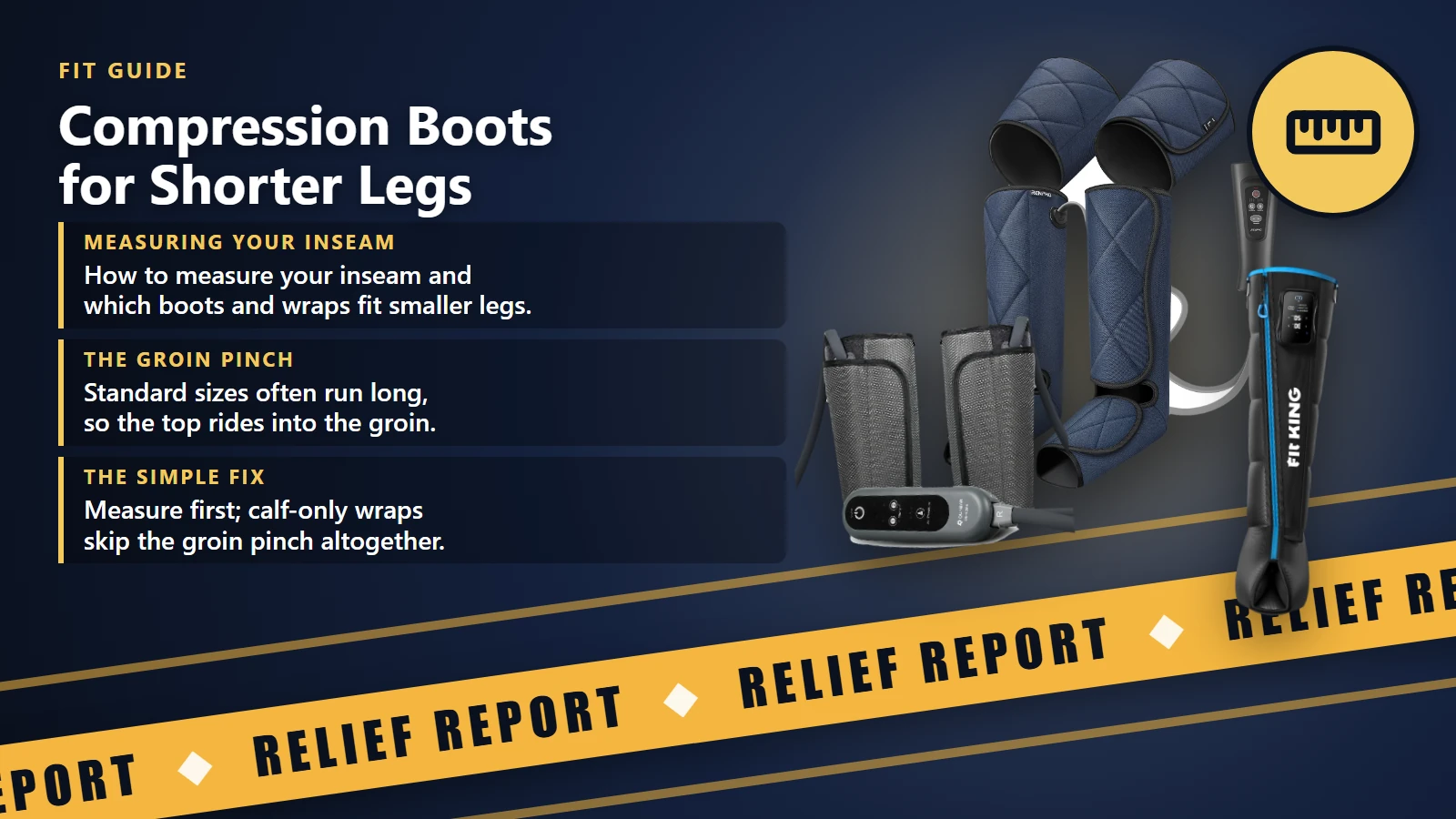
- You have short legs and are worried about fit, since a short-legged buyer found it too large and slow to inflate, although a 4'11" client said it covered nearly the whole leg.
- You have large thighs, as a larger client and a 6'3" buyer both barely closed the thigh straps.
- You want a true massage feel, since several reviewers call it alternating compression.
What Happened When Six of Our Clients Tried It?
Each row maps one real client review to a person I work with or advise. The 6 reviews split 3 and 3 across 4 and 5 stars, so none rated it below a 4.
| Client | Why they bought it | How they used it | What worked |
|---|---|---|---|
| Brandon, a longtime client | Full-leg compression | Plugged into a wall outlet, tried all three modes | Very quiet pump; easy remote; readable display |
| A client who wanted to understand heat and massage settings | Tired legs, wanted a clear picture of the settings | Sat down to put it on; tried circulation and sequence modes | Felt good on tired legs; plenty of room in the foot; Velcro held |
| A client who wanted a no-fuss alternative to complicated recovery gear | Wanted a simple kit that is easy to store | Up to 30 minutes of alternating compression | Easy to carry and store; relaxed tired legs; third strength is strong |
| Marcus, a close friend who plays recreational basketball | Whole-leg coverage instead of small bands | Lowest and middle strengths near a 5 ft cord | Well made; covers most of the leg |
| David, a runner who asked about post-run massage | Calming jumpy legs | Adjusted once, then slid the lower legs in each time | Calmed jumpy legs; powerful even on the lowest setting; easy to clean |
| Scott, a client who spends hours driving for work | Aching legs after long days | Started on low, as advised | Powerful; felt good on aching legs |
| Client | What didn't | Their verdict |
|---|---|---|
| Brandon, a longtime client | No heat despite manual hints; cord not shown in photos; modes felt alike | 4/5 |
| A client who wanted to understand heat and massage settings | Circulation mode left the feet compressed while the calves deflated; no heat | 4/5 |
| A client who wanted a no-fuss alternative to complicated recovery gear | Doesn't feel much like a massage | 4/5 |
| Marcus, a close friend who plays recreational basketball | Toes squeezed on the strongest setting; both legs must be plugged in; slow, long pauses | 5/5 |
| David, a runner who asked about post-run massage | Tricky to put on at first; tethered to a cord | 5/5 |
| Scott, a client who spends hours driving for work | Made the thigh strap too tight at first | 5/5 |
Brandon is a larger guy and barely got the thigh straps velcroed. The manual also describes the first two modes in the same words, which left Brandon doubting the "10 massage programs" claim.
The client who wanted to understand the settings tested the modes closely. On circulation mode the feet stay compressed through part of the cycle while the calves and thighs deflate, and on sequence mode the problem goes away, so I'd start on sequence.
The client who wanted no fuss found it well packaged and easy to carry, and said it relaxes tired legs for up to 30 minutes at a time. It takes a bit of time to put on and take off, and the client wished it felt more like a massage.
Marcus had tried a similar set that squeezed only small bands of the leg, and prefers this one for covering nearly the whole leg with just a gap at the knee. The strongest setting is about the most compression Marcus would use, but it squeezes the sides of the feet and pushes the toes together, so Marcus stays on the lower settings.
David is 4'11" and says the sleeves cover nearly the entire leg, which is a useful counterpoint to the short-legged buyer who found them too large. Even the lowest setting is powerful, and David's jumpy legs calm down.
Scott made the thigh strap super tight on the first session and found it very uncomfortable once the pouches inflated, then loosened it to firm but comfortable. Scott found it great at the end of an aching day and good on puffy lower legs, similar to a device a physical therapist once used, and advises starting on low because it is powerful.
Puffy or swollen lower legs that don't settle are a job for your doctor, not for a gadget. Scott's note about puffy lower legs is a comfort report, not a promise of anything more.
The pattern across the six: once the sleeves were fitted, every client found them comfortable. The sticking points were fit trial and error, a cord some didn't expect, and modes that are hard to tell apart.
Other Observations From Friends, Relatives and Other User Reviews
- A reviewer who trains early in the morning saves these for the evenings with a TV show or a book, likes the zippers on the lower legs and keeps the thigh straps loose (5/5).
- Another reviewer tried it with and without pants and found both work, said it works better with the legs stretched out than bent, and likes sequence mode best, which squeezes from the foot up through the calf to the thigh and then holds (5/5).
What Members of Our Facebook Group Reported
One member has posted about this exact set. The rest of the table draws on their experience with Quinear boots in general and with comparable corded systems.
| Member | Device | Experience | Takeaway |
|---|---|---|---|
| A cashier on 8-hour shifts, 5 days a week | This Quinear set | Uses it 3 times a week at home, alongside a foot soak and a foot massage | Says it relaxes the legs; tied to plantar fasciitis comfort |
| A runner doing double-digit long runs | Quinear boots, model not stated | Paid about $200; 20-30 minutes after long runs | Felt like much less soreness |
| A member using up FSA funds | Quinear boots, model not stated | Paid $280 | Likes the feel, unsure of real benefit |
| A member with small legs | Budget knockoff boots | No difference from Normatec or Therabody | Fit small legs better |
| A member comparing with a brother's Normatec | Quinear vs Normatec | Normatec slightly better, but barely | Not worth the price gap for them |
| A strength coach | Fit King FT 082A (corded), then FT 130A (cordless) | Upgraded after tiring of plugging in | Went cordless and used the boots far more |
The cashier's post matches what my clients say about quiet relaxation after a long day on the feet. For plantar fasciitis, a foot or leg massager is a comfort habit, and a podiatrist should handle the condition itself.
Members who paid $200 to $280 for Quinear boots are split on whether the price was justified, and the group raises something my clients rarely mention: how long they last. Members reported broken zippers at 4 months and burst chambers at 5 months on budget boots, though not on this model.
What the Listing Promises vs. What Users Found
| What the listing promises | What users actually found |
|---|---|
| "Acupressure, kneading and vibration techniques" | Alternating air compression, with no kneading or vibration |
| 10 massage programs | 3 modes; the manual describes two of them in the same words |
| Heat hinted at in the manual and on the product page | No heat; three reviewers confirm it |
| Product photos suggest a rechargeable unit | Corded only; both legs must plug into the controller |
| One size fits more people | Too large for one short-legged buyer; thigh straps tight on larger users |
| Swelling, lymphedema and DVT claims in the brand's extra text | Reviewers described comfort only |
What Breaks, and How Solid Is the Evidence?
The evidence is thin, and I want to be plain about that. The listing shows only 31 ratings, with about 1 in 10 at one star, and I could use 6 client reviews and 3 of the 4 buyer reviews (the fourth was written about placemats).
No one has reported a pump, pouch or zipper failure on this set, but the reviews are few and the listing was unavailable when I checked. Absence of failure reports is not proof of durability.
- 2 of the 3 usable buyer reviews mention fit at the size extremes: one short-legged buyer and one 6'3" buyer at 220 lbs who barely closed the thigh straps.
- The missing heat comes up in 3 reviews.
- No battery to degrade, since it's corded.
- No reports of air chamber failure, zipper breakage or pump death for this model.
- Brand support: nothing reported in the data.
Our full write-up on how the Quinear QN-072A Full-Leg Compression held up covers a sibling model with heat and extenders, which may give a sense of the brand's build quality.
How Does It Compare to the Alternatives?
| Product | Price tier | Key difference | What users liked |
|---|---|---|---|
| Quinear 3-in-1 (this set) | $159.99, mid-range | Thigh-high, corded, no heat | Quiet; simple controller; full-leg coverage |
| Quinear QN-072A | $129.99, mid-range | Adds heat and extenders | Heat; extra fit adjustment |
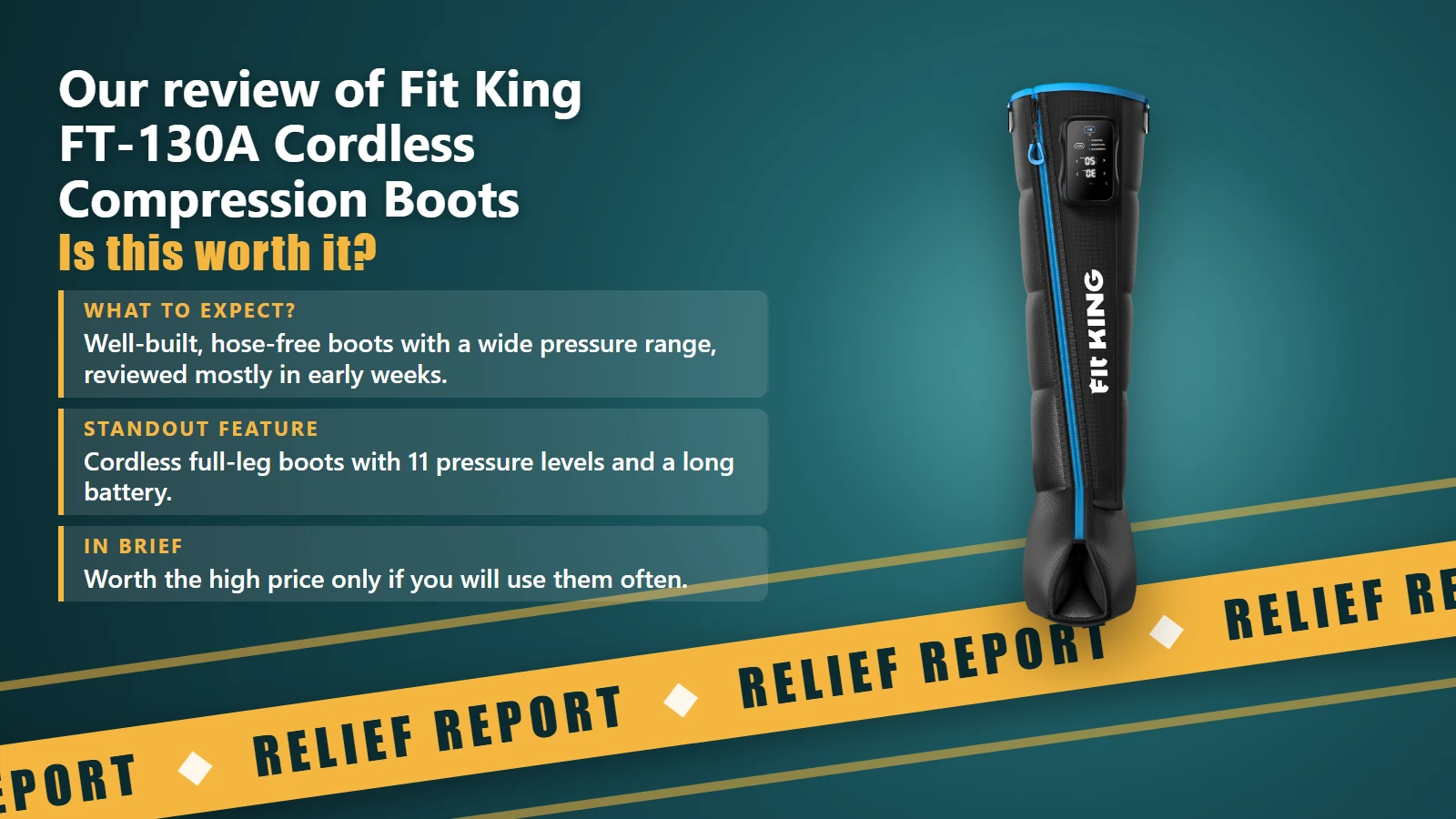
| Fit King FT-130A | $699.99, premium | Cordless, 5 chambers, 11 levels | No hoses; one-button sync; used more often |
| Normatec Elite | About $999, per group members | 5 zones, app control, battery | Medical-grade build; sequential flow |
| Product | What users disliked | Best for |
|---|---|---|
| Quinear 3-in-1 (this set) | Corded; no heat; fit quirks | Budget buyers with an outlet nearby |
| Quinear QN-072A | Still corded | Anyone who wants heat with compression |
| Fit King FT-130A | Thick fabric runs warm | Serious athletes who value convenience |
| Normatec Elite | Price; medium runs tall under a 33-inch inseam | Those with FSA money and high usage |
For someone who will use compression most days, I'd point them to save for a cordless boot like the Fit King FT-130A Cordless Compression Boots if the budget stretches. The cord is the thing that quietly kills a habit.
If heat matters, the QN-072A in the table is the one to look at, and for sore hands instead of legs, what our clients found with the Quinear QN-086H Cordless Hand Massager covers the brand's hand model. If your budget is firm at about $160 and you have a chair with an outlet, this set works.
What to Look for When Buying an Air Compression Leg Massager
This list is based on what group members returned, kept and upgraded to. Under each factor I say how this set does.
- Pressure range: Members use between 70 and 120 mmHg (the same unit as a blood pressure cuff) for regular sessions, and caps below that feel weak. This set publishes no mmHg figure, though clients found its max strong.
- Sequential inflation: Members prefer chambers that squeeze one after another from the foot up. This set offers it in sequence mode, and circulation mode holds the feet compressed.
- Fit and coverage: Members measure their inseam, since standard sizes often run long for 5'3" to 5'8" users. Here, short legs and big thighs both had trouble.
- Corded or cordless: Members say cords and controllers discourage daily use, and that cordless boots get used more. The cord is this set's biggest lifestyle limit.
- Heat: Fine for evening relaxation, but members say it isn't ideal for fresh inflammation. This set has none.
- One leg or two: Check whether both legs must be plugged in. Here they must, and the controller sets both legs together.
- Durability and warranty: Members reported zipper failures at 4 months and burst chambers at 5 months on budget boots. This set's warranty isn't stated and its long-term record is unknown.
- Price tier: Members put budget boots at $49 to $200, mid-tier at $200 to $500 and premium at $800 and up.
Write down your inseam and thigh size before you order. If the thigh straps barely close on a larger client, there's no extender mentioned in the listing.
How Do You Use It, and for How Long?
The timer offers 20, 25 or 30 minutes, and it starts on combination mode, minimum strength and 20 minutes. Members typically run compression for 15 to 30 minutes, so the default is a sensible start.
Plug the remote in before you put the sleeves on, then sit down, because the material is slick on wood floors and carpet. Left and right are labeled, and one reviewer points the toes slightly to pull on the lower part and then closes the thigh strap to firm, not tight.
Start on low and move up slowly, since members say ramping up too fast can bring on nausea or lightheadedness. Wear thin pants if you get skin marks, although one reviewer found it works fine both with and without pants.
Anyone with a history of blood clots or DVT, peripheral artery disease, heart failure, open wounds, leg infections or recent leg surgery must check with their doctor before using air compression. The listing says not to use it near water, during bathing or on injured or sensitive areas, but it states no contraindications for pregnancy, pacemakers or DVT, so check the manual and a clinician.
Do not use this device as a treatment for lymphedema, DVT, edema or circulation disease. The listing does not state FDA clearance, so I don't call it cleared, and I'd stop for pain, tingling or numbness.
Verdict: Is the Quinear 3-in-1 Leg Massager Worth $159.99?
Buy it if you want quiet, thigh-high air compression and have a fixed seat near an outlet. Skip it if you need heat, want cordless portability, have very short legs or very large thighs, or expect a true massage beyond squeezing air pouches.
For those readers I'd save for a cordless Fit King or look at the heated QN-072A. The cord is the decision point more than the compression quality, and if it doesn't bother you, the price is fair.
If that fits you, check the current price of the 3-in-1 (if you buy through this link we may earn a small commission, which doesn't change what our clients and group members reported). Keep in mind that the evidence is thin, with 6 client reviews, 3 usable buyer reviews and one group post, and the listing showed as unavailable when I checked.