

Key Takeaways
- Neck wraps and under-desk foot pads fit a desk day best because they run without you leaving your chair, but both come with fit and pressure catches you should know about.
- Four of the six clients who tried the Bob and Brad iNeck Go had a pressure complaint, since the only dial is how tightly you pull the straps.
- Chair pads and lumbar cushions are warmth gear, not massage gear, and 4 of 6 clients still rated the Snailax SL-242-A at 4 or 5 stars once they stopped expecting kneading.
- A mini massage gun works when it is part of a break; our one long-term client has used the Renpho Mini Thermal Deluxe for 3 to 5 minutes a day since January 2026.
- Stop if a neck device brings dizziness, numbness or pain running down an arm, and check with a clinician before a lumbar cushion if you are pregnant or have osteoporosis.
Desk workers buy a lot of recovery gear and use only some of it. This guide ranks five types of gear, using six products we reviewed, by how our clients and Facebook group members described using them day to day.
I am James Giese, a licensed massage therapist, and I have no stopwatch on anyone's desk drawer. The ranking comes from what clients and members told us, plus the patterns group members report across each category.
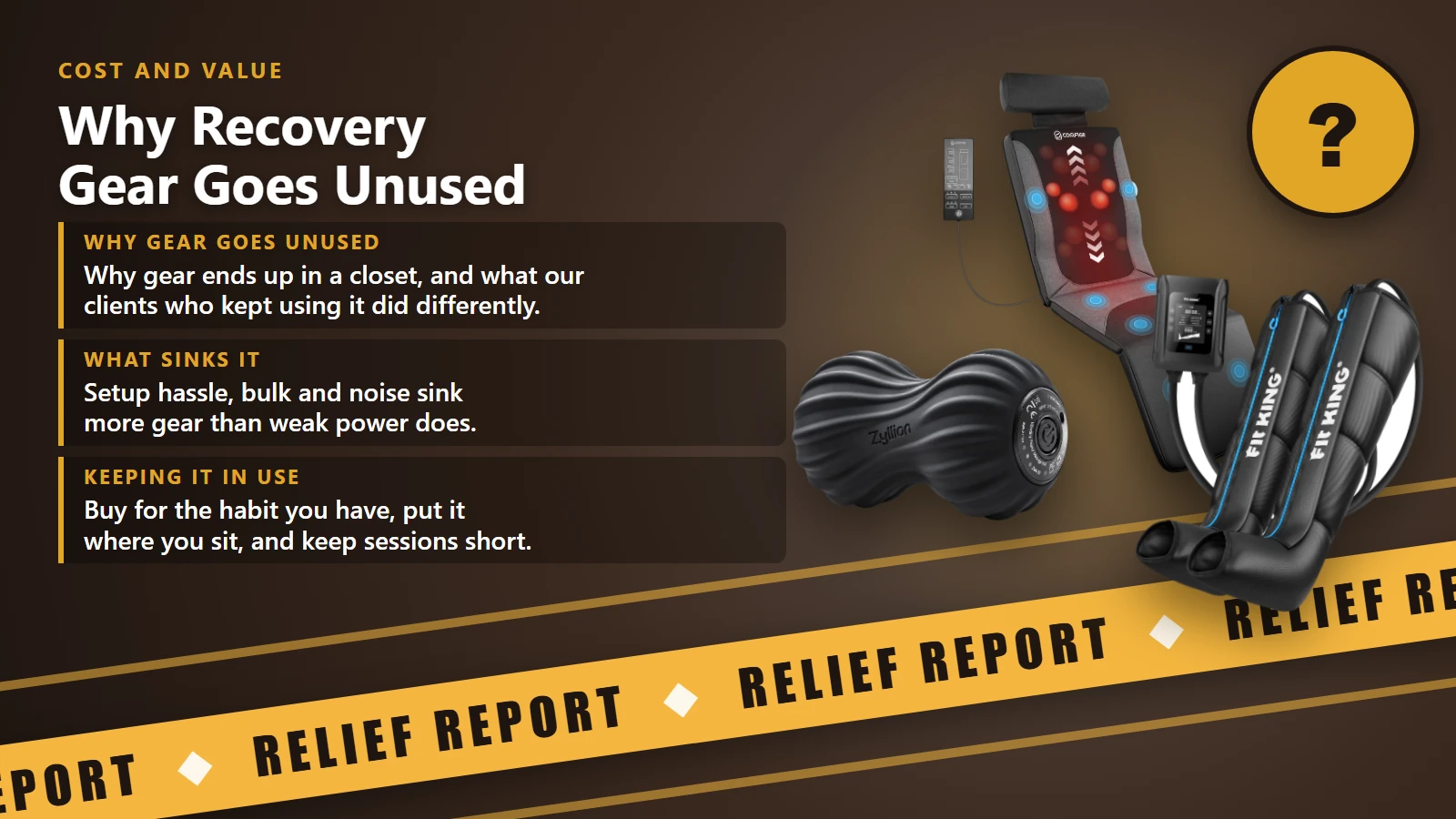
Why Your Desk Gear Ends Up Unused
People buy a device for a problem, feel good for a few days, and then it drifts away from the desk. Members of our group tell us they use their massagers at three moments: first thing in the morning, on mid-day breaks, and right after getting home.
A device that fits one of those moments tends to stay in rotation. One that needs a different room, an outlet you cannot reach, or straps that do not fit your chair is easy to skip.
We wrote a full guide on this pattern, why recovery gear goes unused and how owners avoid it. Here is how the desk kit ranks, with the evidence behind each line.
| Device type | Use during work? | Kept using it? | Example we reviewed |
|---|---|---|---|
| Neck kneader | Yes, hands-free while seated | Still like new at 5 months for one client | Bob and Brad iNeck Go; Zyllion ZMA-36 |
| Under-desk foot pad | Yes, feet on it while you work | Clients ran 1 to 2 rounds daily | Snailax SL-591 |
| Chair pad | Yes, on the seat | 4 of 6 clients rated it 4 or 5 stars | Snailax SL-242-A |
| Lumbar pillow | Yes, behind the back | 4 of 6 clients gave it 5 stars | Snailax SL-15A3 |
| Mini massage gun | On a short break | One client daily since January 2026 | Renpho Mini Thermal Deluxe |
Neck kneaders rank first because they target the spot desk workers complain about most and run hands-free. The mini gun ranks last only because we have the least evidence on it, a single long-term client.
Neck First: The Gear That Gets Reached For Most
Desk and remote workers in our group report the most relief from neck stiffness and tension from leaning over a laptop all day. Most of them cannot book a hands-on massage every day, so a home device fills the gap.
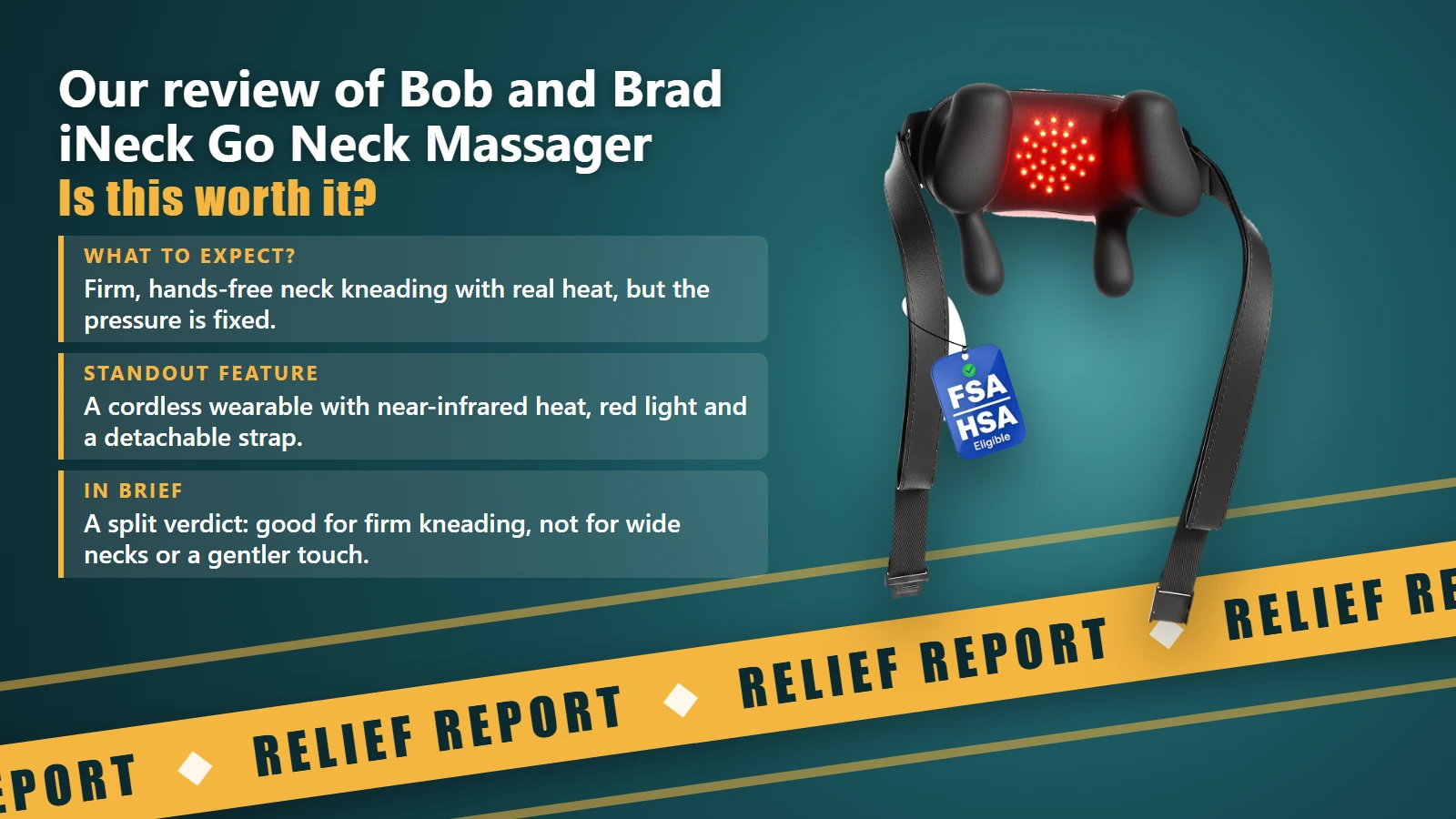
The Bob and Brad iNeck Go costs $69.97 and is a cordless wrap with firm shiatsu (rotating nodes that press and knead into the muscle) and real heat. Our rating is 3.5/5, and four of the six clients who tried it raised pressure as a problem: two said it was too hard, and two said it cannot be adjusted.
The only control is how tightly you pull the straps. One client strapped it on after six hours at a spreadsheet, gave it 4/5, and said the higher heat loosened things up.
Another client found it painful in every position and rated it 3/5, while a client who bought it as a gift for an active family member gave it 5/5. Buy it for firm, hands-free kneading, and skip it if you want a gentler setting or have a neck wider than 3.94 inches at the top.
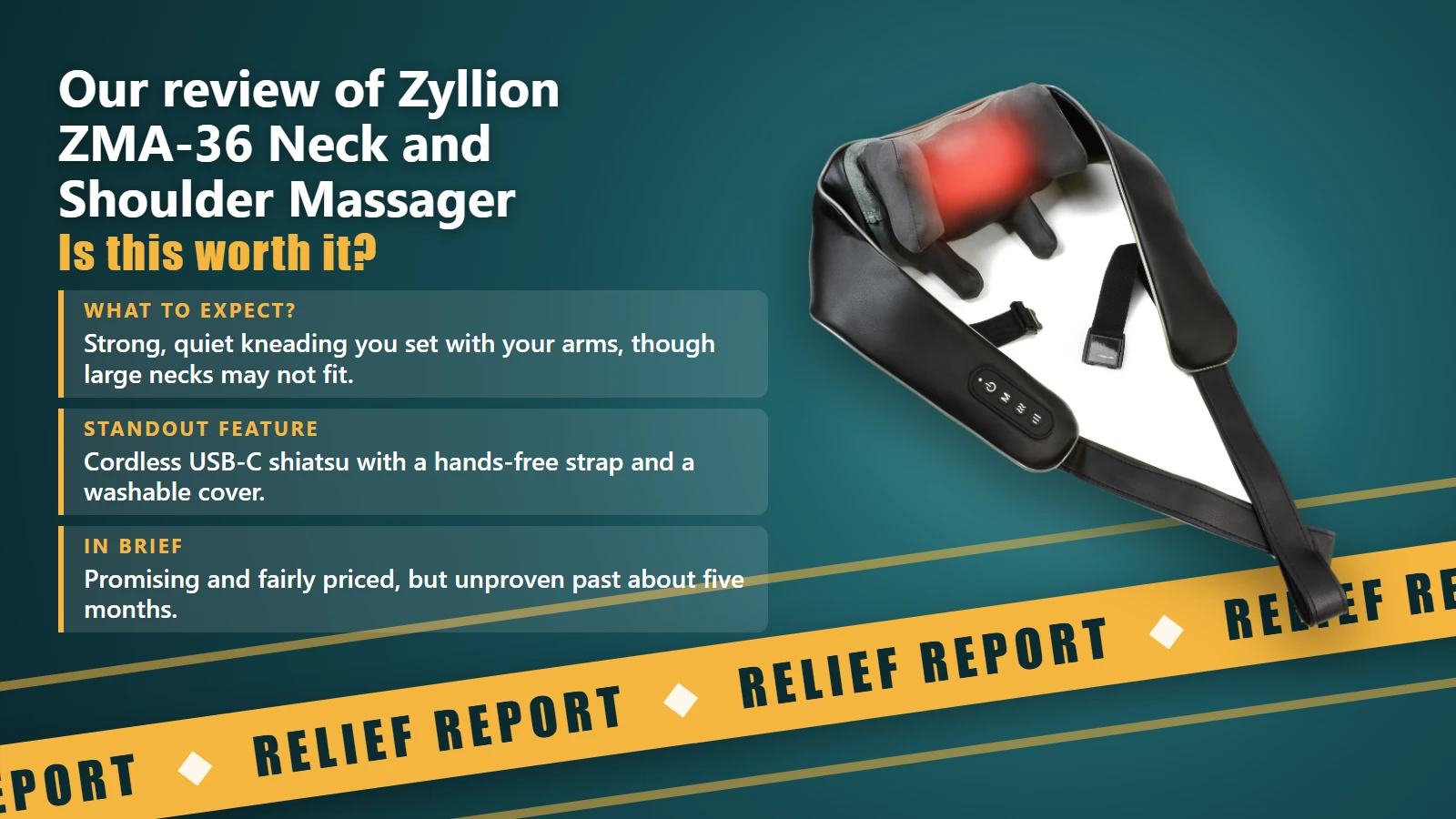
The Zyllion ZMA-36 costs $79.95 and is also cordless, with eight nodes that rotate and move up and down. The brand calls that "4D kneading", which just means the nodes press in and release as they turn, a bit like a thumb working a knot.
Three of the 7 buyer reviews said the nodes pinched or hurt, so measure your neck before you order. A client's 17.5-inch neck found the nodes too rough, and there is no way to change the spacing.
A 27-year-old former college athlete called it one of the most intense massagers they had used and gave it 5/5. After five months they said it still worked like new, and no buyer reported a motor failure.
The back strap barely went around a client's 220-pound husband, so check the fit before you commit. One unit also would not power on until it was charged on a separate charger for 3.5 hours.
If you never need to move from your chair, the corded Zyllion ZMA-13 at $79.95 is a member favorite for heat and chair-mounted kneading. A daily user in our group got almost two years of use before replacing it, and one of our clients keeps theirs strapped to an office chair for the small of the back.
The Snailax Cordless Neck Pillow ($99.99) takes a different route, using (a pad that slowly inflates and deflates to lift and stretch the neck) air traction instead of kneading. Four of six clients gave it 5/5 for relaxation, but keep it on the muscles at the back of your neck, never the front or sides of your throat.
Chair Pads and Lumbar Pillows: Warmth Yes, Deep Work No
These are the products most likely to disappoint a buyer who wants kneading. They do warmth and comfort well, and muscle work badly.
The Snailax SL-242-A costs $59.99 and is a foldable seat pad with 10-motor vibration and heat. Our rating is 3/5, and 4 of 6 clients rated it 4 or 5 stars, while the 2-star review came from a client who hoped for real muscle work.
Start with heat-only mode, because the vibration alone is a light buzz that will not convince anyone they got their money's worth. A client who bought it mainly as a big heating pad after multiple back surgeries found the massage a pleasant extra.
The straps do not fit most recliners, though one client said the pad stayed put anyway. On a leather recliner another client found it rubbed the finish off, so a cover went on the chair.
One client's heat has given out at about 16 months on every Snailax unit they have owned, so plan on a replacement around that mark. Group members add that very long runs of 1 to 4 hours wear on the motors.
The Snailax SL-15A3 costs $99.99 and is a cordless lumbar cushion that lifts the lower back with two airbags, plus mild heat and a light buzz. Our rating is 3.5/5.
Four of six clients gave it 5/5, and both 2-star clients wanted firm, deep pressure and said to look elsewhere. A pilates teacher liked the soft cover and 15-minute timer at work and in bed, and a 52-year-old nurse used it in an office chair and recliner after long shifts and found the adjustable lift gave good lower-back support.
It has four lift heights and three levels each of heat and vibration, and at 2.93 pounds it travels well. One client who expected more for the money thought it was worth far less than its price.
It will not dig into a stubborn knot. It can lift your back into a gentle arch with mild warmth and a light buzz, which can help tired muscles feel looser during a long sit.
Check with a clinician first if you are pregnant, have osteoporosis, had recent spine surgery, or cannot feel heat well on your skin. This is comfort gear, not a medical device.
Feet Under the Desk: Quiet Help for Tired Legs
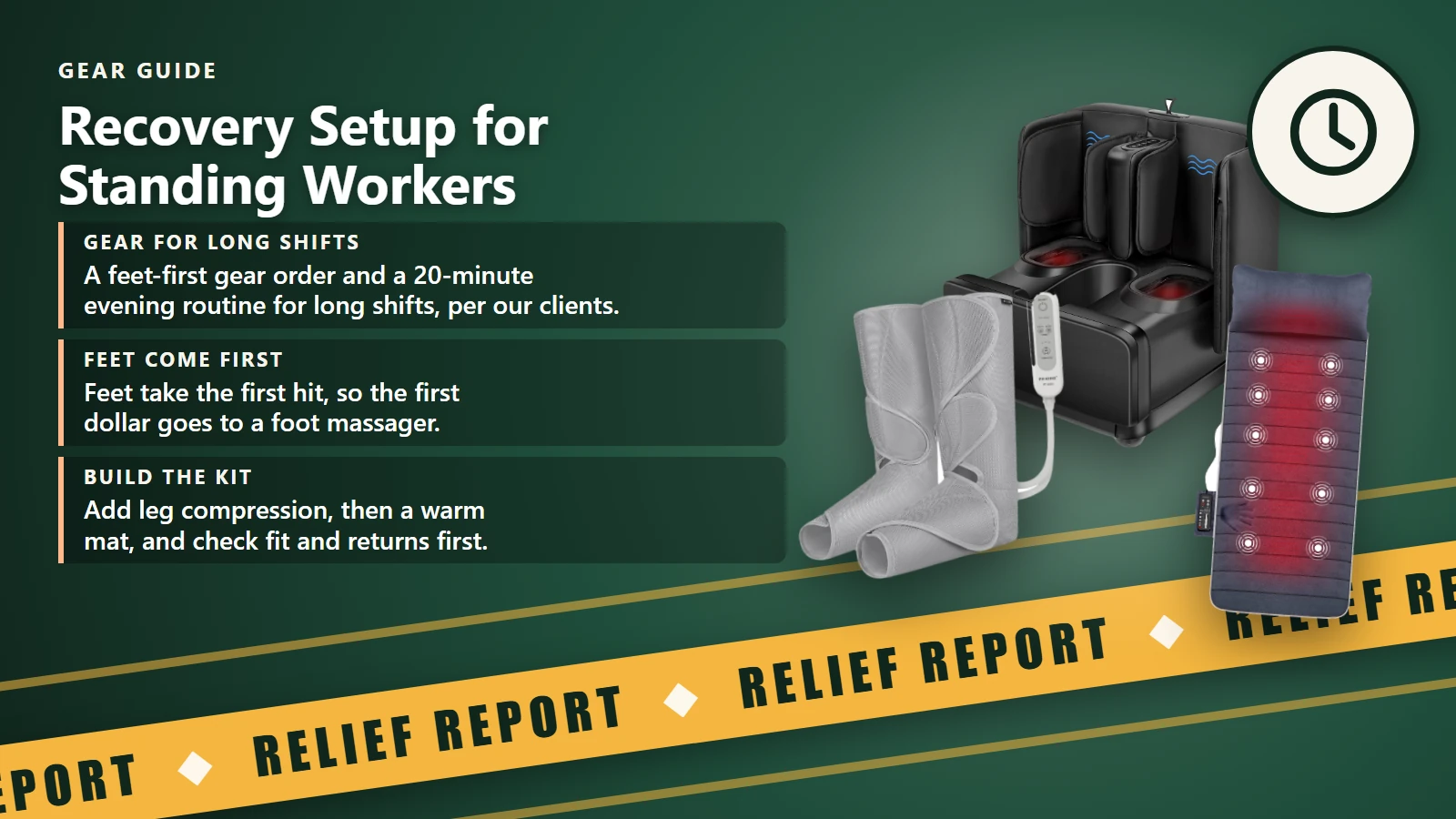
Under-desk foot massagers earn their spot because they run while you work. The Snailax SL-591 costs $89.99 and is a stand-on unit that gives vibration and a little warmth, not kneading.
Our rating is 3/5. Four of five clients gave it 4 or 5 stars, yet 10 of the 24 buyers said it was not strong enough, so what you expect decides the score.
One client puts their feet on it at the desk and their calves on it in a recliner. A 27-year-old former college athlete used it three times a day and liked the 15-minute cut-off and magnetic remote, though the plug got pretty hot.
A client on a budget stood on it after work, shifting weight to hit the spots that hurt, and gave it 5/5 despite lukewarm heat. A weekend runner returned it because it was louder than expected for a quiet desk.
What I cannot tell you yet is how it holds up. One client's unit broke twice, one buyer's quit after 12 months, and 3 of the 24 buyers had remote trouble.
After the 15-minute cut-off the unit restarts on the highest vibration, so a stronger round than you meant is one press away. Members suggest keeping daily time to 15 to 30 minutes, and one member who stacked four rounds of 20 to 40 minutes on a different machine hobbled for hours.
Use it for comfort after a long day, not as a plan for a foot condition. Members describe gentle vibration as easier on an inflamed heel than hard rollers, but it does not change the underlying problem, so check with a doctor first if you have plantar fasciitis, neuropathy or arthritis.
Mini Guns for Breaks: Good If You Build the Habit
A mini massage gun works only if it becomes part of a break. The Renpho Mini Thermal Deluxe costs $64.97 and is a pocket-size gun with a heated head and a tidy case. Our rating is 3.5/5.
What sets it apart from a plain buzzer is the heat, not its 6 mm stroke (how far the head travels in and out). That stroke is short, which is why one reviewer called it a casual gun.
Our long-term client has used it 3 to 5 minutes a day since January 2026 and gave it 5/5. They praised the power, the heat and USB-C charging, with days to weeks per charge.
A reviewer who bought two units had to send both back because the on/off switch was bad straight out of the box. The replacements work, but a 50% failure rate is why they rated it 2/5.
The heat only works with the silicone casing off, and one buyer could not work out how to turn it on without an instruction booklet. Try the heat the same day you get it by double-pressing and waiting about 30 seconds, so you know it works while a return is easy.
The listing gives no stall force (how hard you can press before the head stops moving), and four speeds change pace and force but not depth. Buy it for casual soreness from a bad night's sleep or a computer desk, and skip it if you want deep pressure.
At 1.1 pounds and about 7 inches tall it drops into a gym bag or purse. Charging from empty takes about 3 hours.
A Desk-Day Routine That Keeps Gear in Use
The gear that gets used fits a moment that already exists in your day. Morning, a mid-day break and the hour after work are the three slots members use.
For a neck wrap, sit upright in an office chair, slip your arms through the loops and pull downward to set the pressure. During longer sessions, members shift the unit every 20 to 30 minutes, working from the base of the skull down the neck, shoulders and mid-back.
For the feet, one or two 15-minute rounds at the desk is enough for most people. For the mini gun, 3 to 5 minutes on tight spots is what our long-term client does.
Keep daily time to 15 to 30 minutes and never stack rounds until you are sore. If you stand as much as you sit, our guide to recovery gear for nurses and anyone on their feet all day covers gear that targets the legs and feet.
Questions People Ask
Can a neck massager make tension worse?
Yes, if the pressure is too hard or you park it on one spot too long. A client ran a shiatsu pillow on the lower back until sore and felt it for a couple of days. Start on the lightest setting, move the unit every few minutes, and stop if pain increases.
How long should I use a chair pad each day?
Our data does not give a safe daily maximum for a chair pad. Members use theirs on mid-day breaks or after work, and they warn that very long runs of 1 to 4 hours wear on the motors. Keep sessions to about 30 minutes, and use heat-only mode if the vibration feels pointless.
Is vibration enough for sore feet?
It can take the edge off tired feet and legs, and members say a vibration-only pad can ease fatigue during a long sit. It will not work out a knot, though. Four of five clients liked the SL-591, but 10 of 24 buyers found it too weak, so look elsewhere if you want kneading.
When should I see a massage therapist instead?
Use a device for comfort between professional sessions, not as a replacement for hands-on or medical care. If pain runs down an arm, you feel numbness or dizziness, or a sore spot does not improve after a week of home use, see a therapist or a doctor.
The Bottom Line
If you sit at a desk all day and want one piece of gear, start with a neck massager. It targets the area that bothers desk workers most, and the Bob and Brad iNeck Go and the Zyllion ZMA-36 both earned their place, with the same catch: the pressure is firm and mostly fixed, so check your neck size first.
If your feet are the problem, an under-desk vibration pad is the second pick because it runs while you work. Expect a gentle buzz, not kneading, and treat its lifespan as an open question.
A warm cushion like the Snailax SL-242-A or SL-15A3 is for comfort and nothing deeper. A mini gun like the Renpho is worth it only if you will build a 5-minute break around it.
Pick the device that fits a moment you already have, keep sessions short, and stop if something hurts. When home gear is not enough, book a hands-on session or check with a doctor.