

Key Takeaways
- A strength coach in our Facebook group went cordless and now uses their boots four or more times a week, yet still recommends corded for people who use boots once or twice a month.
- Members expect about 3 years from a built-in battery, and 9 of the 15 buyer reviews on one cordless neck massager mention battery or charging trouble.
- Corded models give the same pressure every minute and cost less, like the Quinear QN-005A at $58.99 against $159.99 for the cordless Quinear wraps.
- Test any cordless unit hard inside the return window by running it until it dies and timing it.
- Keep neck massagers on the back of the neck, never the front or sides of the throat, and ask a clinician first if your feet tingle or go numb.
A strength coach in our Facebook group told us they upgraded from corded boots to cordless after six months. Suddenly they were using them four or more times a week instead of letting them sit in the closet.
That single move sums up the corded-versus-cordless debate better than any spec sheet. The marketing for a cordless massager always pitches freedom, with no hoses, no wall outlet and no controller box.
What the copy never mentions is that the battery inside has a clock on it from day one. This guide pulls together what our clients reported across our product reviews, what members of our group posted about their gear, and what buyers said in their own reviews.
The Trade-Off in One Paragraph
Cordless massagers win on convenience and lose on longevity. The battery that lets you skip the outlet is the same battery that can fade or die after a year or two.
Corded models deliver steady power every time you plug them in. They tie you to an outlet, though, and our group members say the setup quietly kills the habit of using the thing.
What Cordless Gets You
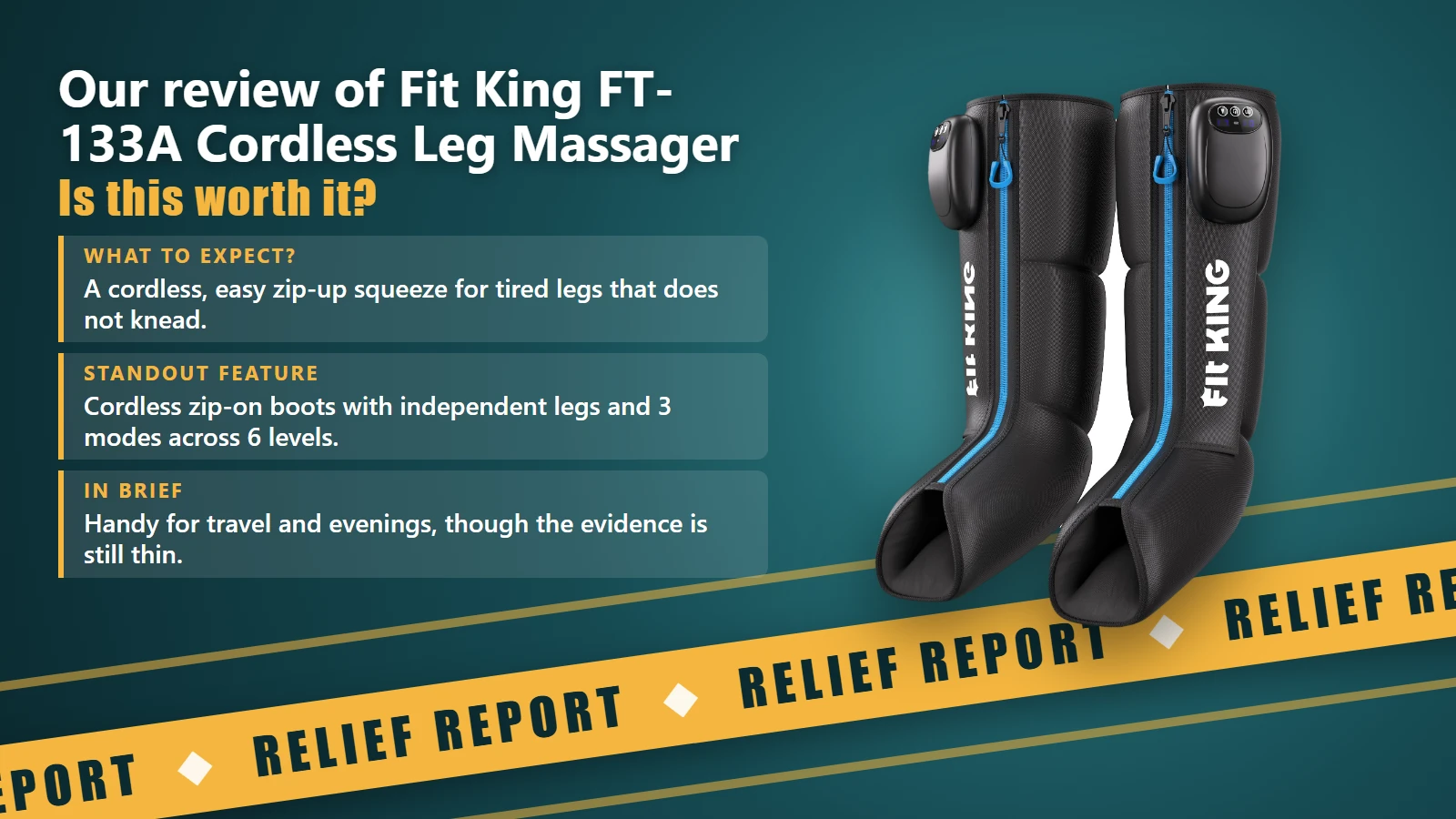
The most mentioned feature across our cordless reviews was freedom from cords. Five of the six clients who tried the Fit King FT-133A cordless boots talked about being free of hoses and outlets.
One client used them in a cruise cabin with no outlet near the bed. Another, who drives long distances, wanted no hoses or controller after owning a corded full-leg pair.
That convenience shows up in how often people actually use the device. Members of our group who went cordless reported using their boots four or more times a week, and the strength coach said less setup means more use.
The pattern held across categories. A reviewer who owns full-size back massagers still reached for a cordless neck pillow for its portability, and the Snailax Cordless Neck Pillow weighs about 1 kg with no cord.
A shorter reviewer liked that a cordless back pillow can be aimed at sore spots on a bed, sofa or chair. For people in small spaces, or anyone who wants to use a massager in different rooms, that matters more than any spec on the box.
What It Costs You Later
The battery is the trade-off nobody mentions on the product page. Members say built-in batteries on cordless models carry an expected lifespan of about 3 years, and that is the best case.
The worst case shows up much sooner. Nine of the 15 buyer reviews I went through for one cordless neck massager mention the battery, charging or the unit dying, and six say it stopped working or stopped holding a charge, some within a month.
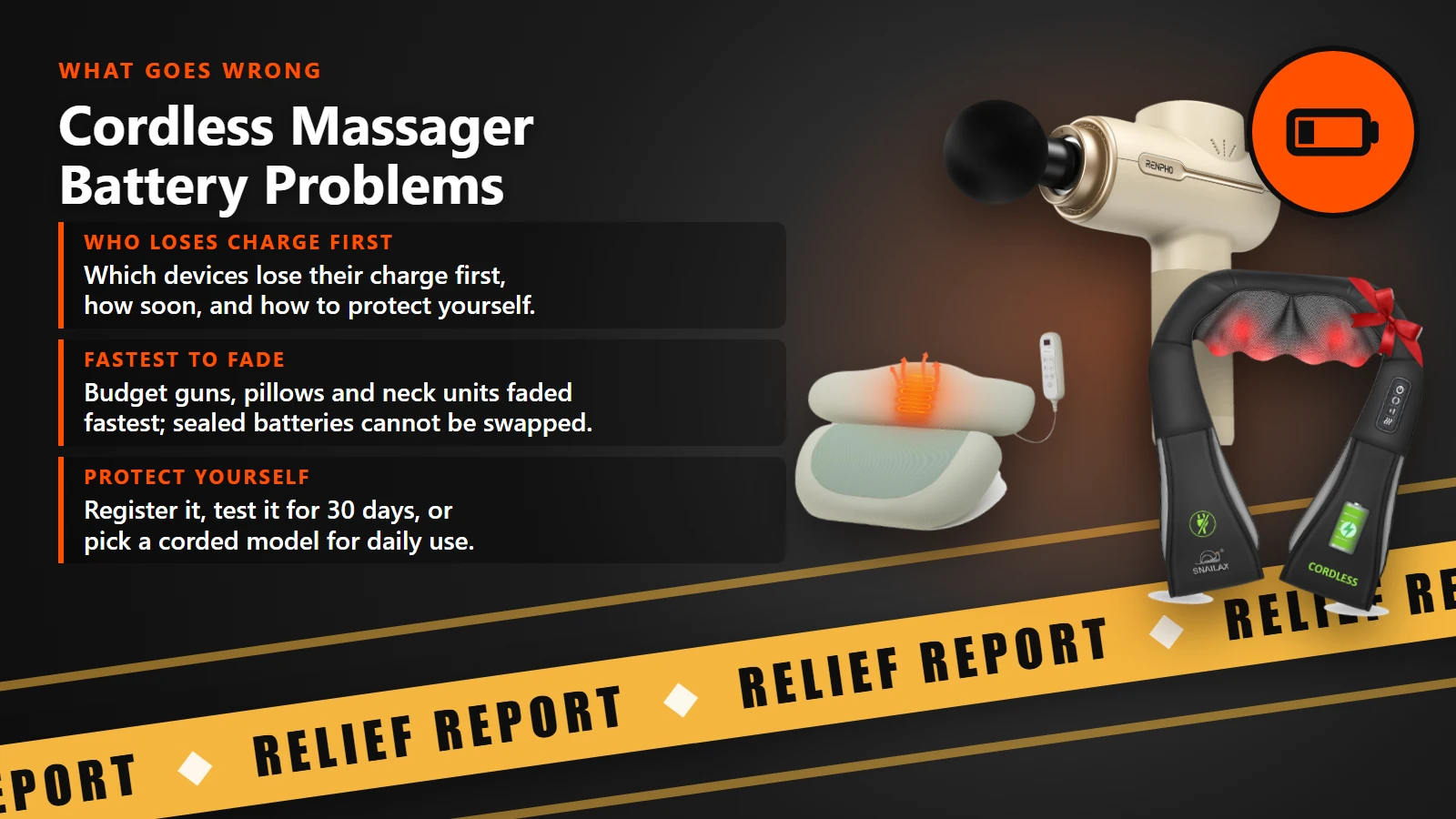
Our guide to cordless massager battery problems lays out the pattern in more detail. A client's cordless back pillow dropped from a healthy number of sessions per charge to 3 or 4 within 7 weeks, and by month six they had stopped using it.
Battery reports vary wildly even for the same product. On the Fit King FT-133A, one client got two uses off a charge, another got multiple 15-minute sessions, a buyer used them 10 times without recharging, and one reviewer reported about six days of two 20-minute sessions a day.
That spread tells you the battery experience is a gamble. Charging is the other pain point, because several cordless models cannot run while charging.
The Comfier CF-6419 shuts off after 10 minutes and cannot be used while it charges. One client said a full charge on a cordless back pillow takes about 4 hours, and members note cheaper cordless models often degrade to 5 to 10 minutes of run time.
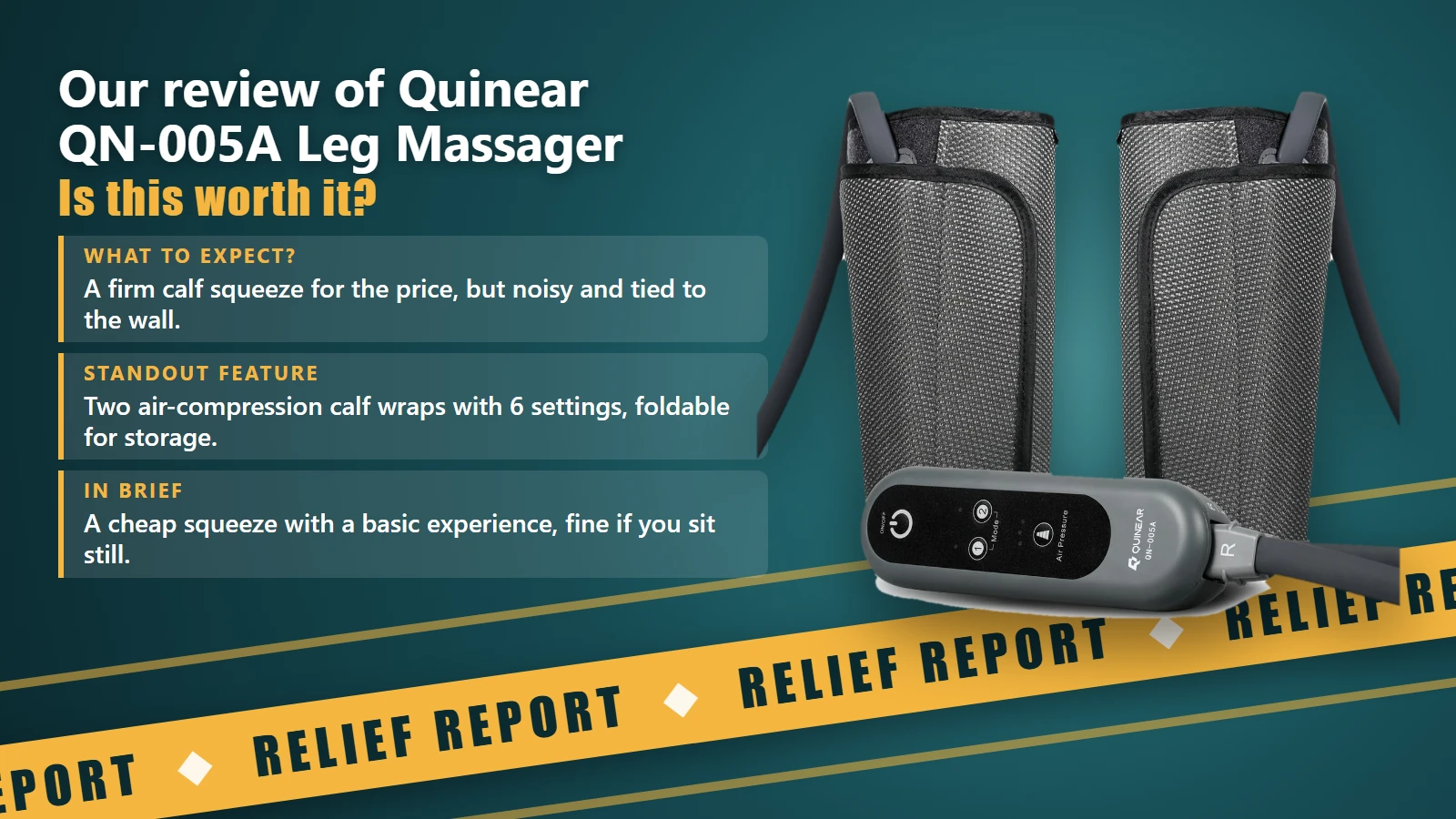
The other cost is money. In the boot pairs we compared, the corded Quinear QN-005A calf wraps cost $58.99 and the cordless Quinear leg wraps cost $159.99.
The corded Fit King FT-082A boots cost $319.99 per a group member, while the cordless Fit King FT-130A boots cost $699.99. You are paying a premium for the battery and the pump that has to fit inside the device.
Where Corded Wins
Corded massagers deliver the same pressure on the first minute and the thousandth. There is no battery to fade and no charge to wait for.
The Quinear QN-005A at $58.99 is corded, and our client who tried it after surgery got a strong, steady squeeze once the controller was replaced. The first controller made a horrible noise and ran warm to hot, so the seller sent an identical replacement.
Corded models also cost less per bit of coverage. The corded Quinear 3-in-1 leg set at $159.99 covers foot, calf and thigh, while the cordless Quinear wraps at the same price stop at the calf.
The My Bob and Brad EZBack Pro at $79.98 is corded with a 6-foot cord, and the brand rates it under 45 dB (decibels, a sound-level unit where lower is quieter). Clients called the build solid and the remote easy to follow.
One client, a retired contractor, plugged it in beside their recliner and found the cord reach ample. A desk worker who sits for long hours gave it 5 stars and liked that the cord reached a favorite chair.
The honest downside of corded is that the cord and setup can kill the habit. Members say hoses and a separate controller often decide whether boots get used daily or stay in the closet.
The strength coach tired of plugging in the controller and tubes on their corded pair. The same coach still recommends corded for people who use boots once or twice a month, because the hassle is easier to tolerate when you use it rarely.
Corded also limits where you can sit. Our QN-005A client gave it 4 out of 5 but knocked off a star for being stuck near the outlet, and a buyer of the EZBack Pro charged it fully before learning it still has to be plugged in.
Keep in mind that the QN-005A has a fixed 20-minute auto-off, so plan to restart a session by hand, and please do not fall asleep in any corded compression wrap. This table sums up how the two types compare.
| Factor | Corded | Cordless |
|---|---|---|
| Price | Lower: Quinear QN-005A $58.99 | Higher: Quinear cordless wraps $159.99 |
| Setup | Outlet, hoses or controller to arrange | Grab it and go; no hoses or outlet |
| Habit | Setup can quietly kill daily use | Members report 4 or more uses a week |
| Power | Same pressure every minute | Can fade as the battery drains |
| Battery | None to wear out | About 3 years expected; cheap ones fade sooner |
| Charging | Not needed | Several models cannot run while charging |
| Best for | Occasional use, tight budgets, one fixed seat | Frequent use, travel, small spaces |
The table boils down to how often you will actually sit down with the device. Frequent use favors cordless, and occasional use favors corded.
By Category: What Our Reviews Show
Leg Compression Boots
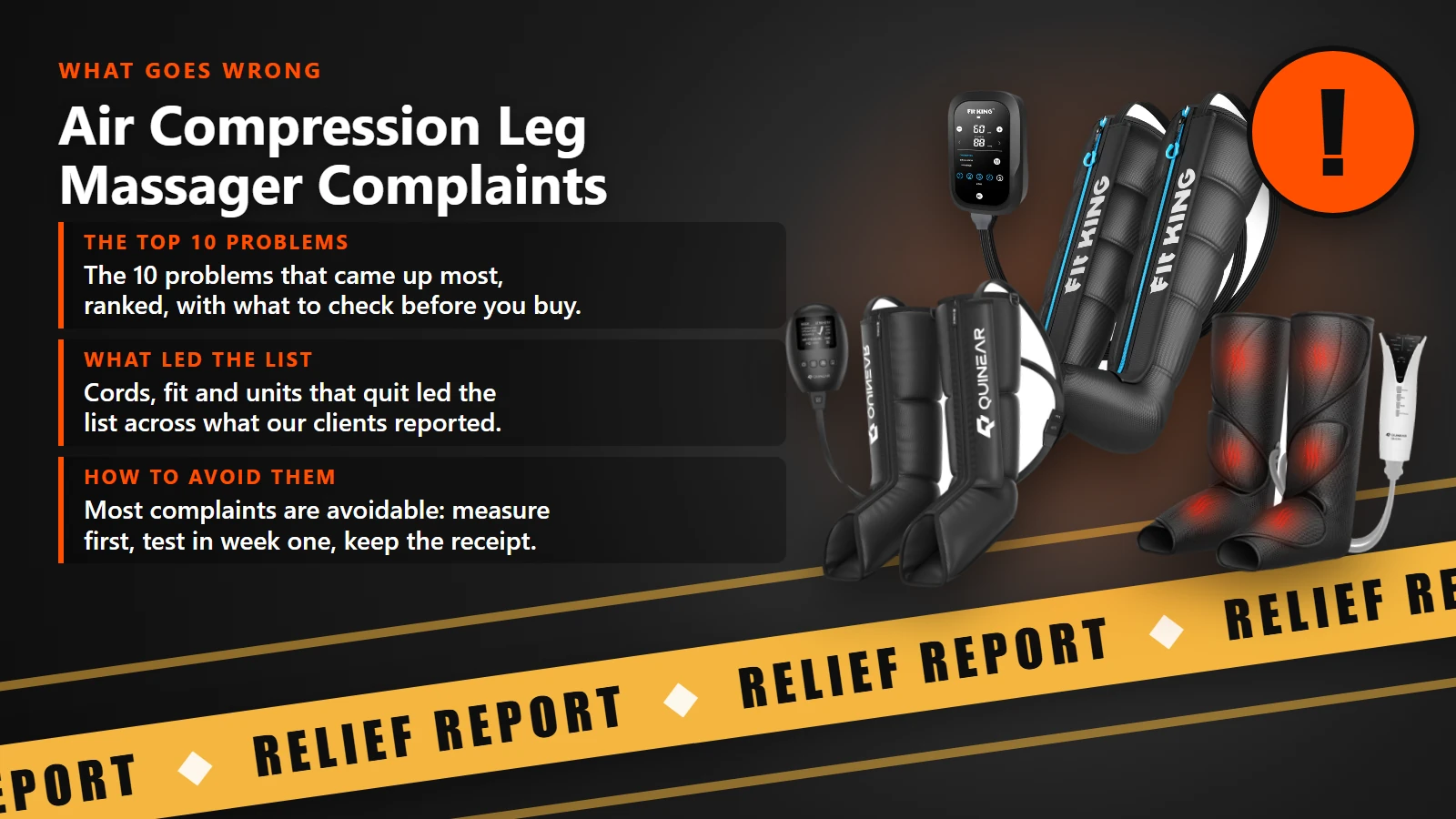
Leg boots have the widest price gap between corded and cordless, and the widest gap in how often people use them. The corded QN-005A gives you air compression (squeezing the limb with inflated air pockets to help tired legs feel lighter) at a budget price, but the controller is loud and the cord keeps you near the outlet.
The cordless FT-133A at $149.99 drops the hoses and the wall outlet entirely, and each boot has its own battery. Clients used them in a cruise cabin, after long drives and on the couch with legs raised on a pillow.
Battery reports ranged from two uses to about six days per charge. These boots squeeze rather than knead, and the three clients who rated them 4 out of 5 wanted something closer to a real massage.
The Quinear Cordless Leg Massager at $159.99 offers the same no-cord idea with foot and calf coverage. One reviewer's first charge took about an hour and 20 minutes, and a buyer got around 8 max-level sessions per leg.
The wraps stop at the calf, so a 5'8" reviewer got compression on only the lower part of the muscle. Durability is the open question, with one client's pump weakening after a couple of weeks of twice-a-day use.
Members say 3 to 4 hours of use per charge is what makes travel easy. The FT-133A's runtime is not stated by the maker, and members who train four or more days a week say a cordless pair is worth the upgrade.
Neck Massagers
Cordless neck massagers are built for the couch, the bed and the hotel room. The Snailax pillow at $99.99 offers heat and air traction (a gentle stretch from slow air inflation, not a forceful pull) with up to 100 minutes per charge.
Four of six clients gave it 5 out of 5, and every one of them used it for relaxation and gentle stretch. Keep it on the muscles at the back of your neck, never on the front or sides of your throat, and stop if you feel dizziness, numbness or pain running down an arm.
The battery is the open question here. One buyer said it does not hold a charge for long, and members warn that cheap cordless units often drop to 5 to 10 minutes of run time.
One member paid $199 for a neck massager whose battery died after three months, so a 100-minute claim is only worth what the second year shows.
At a lower price, the Snailax SL-681 at $58.99 offers 4D shiatsu (finger-like heads that grip and knead the muscle, rather than balls that simply spin) and two heat levels. But 9 of the 15 buyer reviews mention the battery, charging or the unit dying.
The longest dated use any reviewer described was about four months. Plan around the 10-minute shut-off and buy from a seller with a return policy you can actually use.
Back Massagers
The corded EZBack Pro delivers firm rolling nodes that you press into by leaning back. Three of six clients found the rollers hard or painful and one sent the pad back, while the client who leaned in slowly felt looser after 2 days of twice-daily use.
The pad shuts off after 15 minutes and restarts at the bottom of the track. Two clients felt almost none of the 109F warmth through clothes, though one group member said the heat works well.
The cordless Comfier CF-6419 at $86.99 does back kneading with heat on the couch or in bed. Reviewers got about 1 to 1.5 hours per charge, with about 90 minutes to recharge.
Our client bruised the tailbone area lying flat on it and the unit shut itself off, so put a towel or blankets between you and the nodes. In a lounge chair it gave a very nice lower back massage.
Members note that for cordless back models, actual runtimes are often optimistic, with only 30 to 45 minutes on higher settings before a 60-minute recharge. A 10-minute auto shut-off means getting up to restart, which breaks the relaxation.
Which Should You Pick?
Pick cordless if you will use the device several times a week and plugging in hoses or finding an outlet stops you from starting a session. That is the pattern our clients and group members reported again and again.
Pick corded if you use a massager occasionally, want steady pressure without fade, or have a tight budget. The QN-005A at $58.99 gives you a firm squeeze for well under half the price of cordless boots, and the EZBack Pro at $79.98 gives you solid build without a battery to worry about.
If you go cordless, test the battery hard within the return window. Run it until it dies and time it, then charge it fully and do it again, and send it back if the runtime drops sharply.
Battery quality varies even within the same model, so do not assume yours is fine just because the reviews are good. If you have a medical condition like peripheral neuropathy (nerve damage that causes tingling, numbness or pain, often in the feet and legs), speak to a clinician before buying any compression device.
One buyer said cordless leg wraps made their tingling worse, and a client with the same condition planned to run the device by a doctor first.
Questions People Ask
Do cordless massagers have less power than corded ones?
Not at first, since a fresh battery can deliver full pressure. The issue is that power can drop as the battery drains during a session, and the pump or motor can weaken over weeks, as one client's cordless leg wraps did after a couple of weeks of twice-a-day use. Corded models deliver the same pressure every time.
How long do cordless massager batteries last?
Members say to expect about 3 years from a built-in battery on cordless boots. Cheaper neck and back models can fade much faster, and one member paid $199 for a neck massager whose battery died after three months.
Can I use a cordless massager while it is charging?
Many cannot. The Comfier CF-6419 and the Bob and Brad EZBack Go block use during charging, while the listings for the Snailax pillow and the Quinear cordless wraps say they work while plugged in, so check before you buy.
Are cordless massagers worth the extra money?
For frequent users, yes, because members who train four or more days a week say they actually use the device. For occasional users, a corded model at a fraction of the price delivers the same pressure without a battery to degrade.
Bottom Line: What to Do Next
If you train hard several times a week and know that hoses and cords are what stop you from recovering properly, go cordless. Accept the battery risk, test the device within the return window, and plan for the battery to need replacing in about 3 years.
If you want a massager for occasional use, or you sit near an outlet and do not mind a cord, go corded. You will spend less and get steady pressure, and the QN-005A and the EZBack Pro are both corded picks that our clients used and rated well.
If you are buying for someone else, think about their routine. Would they plug in hoses, or use something they can grab off the couch and turn on with one button?