

Key Takeaways
- How far the head travels with each hit explains more of a gun's feel than any other number, and members put real percussion at 12 mm or more.
- Many people never use the top end of a gun's power: two of our four Power+ clients stayed at level 1 or rarely went above it, so a huge stall force often goes unused.
- A short stroke is fine for forearms, calves and travel; for quads and glutes, look for 12 mm or more.
- Quiet when new is the safe way to read a noise claim: one Q2 Mini reviewer had to check their hearing aids were in, yet other units got loud with wear.
- Battery trouble showed up on the Power+ (6 of 20 buyers) and the Q2 Mini (2 of 4 clients), so register any gun on day one.
A 6 mm stroke and a 16 mm stroke are not close cousins. One feels like a phone buzzing against your leg, and the other feels like a fist sinking into a tight quad.
That single number, amplitude, does more to explain the gap between a $65 mini and a $300 heavy-duty gun than any other spec on the box. I have watched clients and members of our Facebook recovery-gear group use massage guns long enough to know that the numbers on the listing rarely match what you feel.
This guide decodes the five specs that matter, explains what each one feels like in your hand, and points you to the right gun for your situation using what our clients and group members reported.
What Are the Five Numbers That Matter?
The five specs that change how a gun feels are amplitude, stall force, speed, noise, and weight. Battery life and the number of heads matter too, but they are secondary to these five.
Amplitude (how far the head travels with each hit, also called the stroke; a longer stroke reaches deeper into thick muscle) sets the depth. Stall force (how much pressure the motor takes before it slows or stops; a higher number holds up better when you press into a big muscle) sets how hard you can lean in.
Speed, measured in PPM (percussions per minute, the number of hits the head delivers each minute) or RPM (revolutions per minute, the motor speed that drives the head), sets the pace. Noise, measured in dB (decibels, a unit of sound loudness), decides whether you can use it on the couch next to someone.
Weight decides whether your arm gets tired before your muscle does. The rest of this guide takes each one apart, using the guns our clients and members have tested.
Amplitude: Why 16 mm Gets All the Attention
Amplitude is the number that separates a real percussion gun (one that hits in and out of the muscle, instead of only buzzing) from a vibrating toy. Members of our Facebook group put the minimum for real percussion at 12 mm, with 16 mm at the top end for deep work on dense muscle.
Members list 16 mm on the Theragun Elite and Pro, the Bob and Brad D6 Pro and the Achedaway Pro, so it is the long-stroke end of the market. Strokes of 4 to 5 mm or 8 mm feel like a vibrating phone that tickles rather than punches, and members called cheap guns in that range surface vibrators, not percussion tools.
That is why a 10.5 mm gun sits in an awkward spot: members say 12 mm and up is where a gun starts to feel like real percussion, so it falls just under the line. The Bob and Brad X6 Pro lists 10.5 mm, and clients found it strong for the price, though two of them said a Theragun goes deeper in dense muscle.
The Renpho Mini Thermal Deluxe lists a 6 mm stroke, so it falls well short of that 12 mm line, as our full write-up explains. One reviewer called it a casual gun, and the numbers back that up.
At 1.1 lb and about 7 inches tall, it drops into a gym bag, but it will not dig into a tight quad the way a longer-stroke gun does. The heated head is what sets it apart from a plain buzzer, and several reviewers, including our client, singled out the heat as the feature worth paying for.
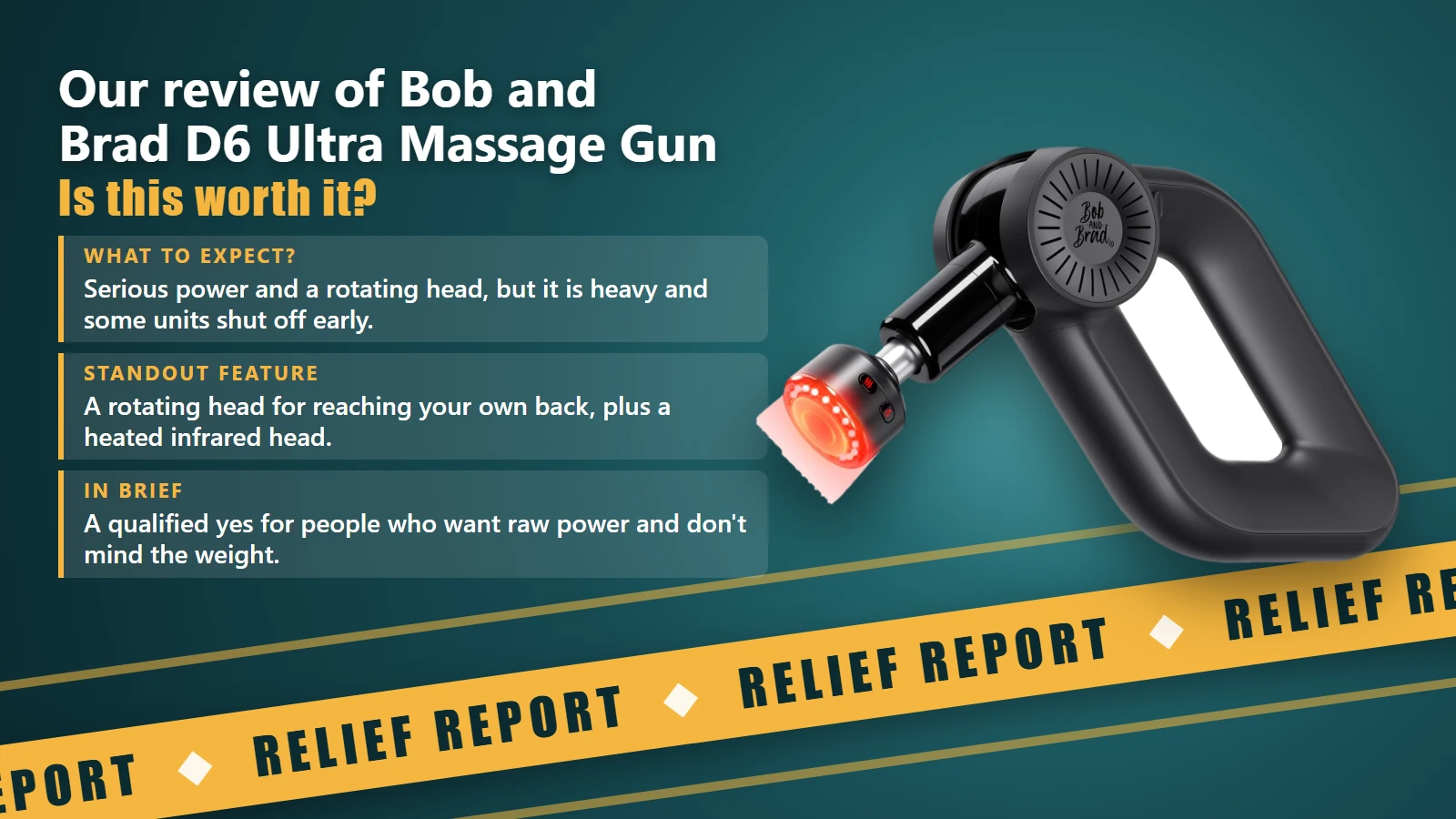
At the other end, the Bob and Brad D6 Ultra carries a 16 mm stroke, which our review of the D6 Ultra at $299.99 describes as deep, firm percussion. A client loved its 90-degree head and the eight soft attachments, which are not jarring on joints or bones.
The trade-off is weight, which a client suspects comes from the big battery. The rotating head and the handle with several grip angles are what make that weight tolerable on your own back.
The practical takeaway: if you want to work large muscles like quads and glutes, look for 12 mm or more. If you want something for forearms, calves, or travel, a shorter stroke is fine and keeps the gun light.
Stall Force: How Hard Can You Press?
Stall force tells you how much pressure the motor can take before it slows down or stops. Members highlight that cheap units stall easily when pressed into dense areas like quads or glutes.
Usable forces range from 20 to 35 lb on compact units up to 85 lb on heavy-duty guns. For general use, members put the floor at 35 lb, because below that, weak motors stall on quads and glutes.
The Bob and Brad Q2 Mini lists 35 lb, which is fine for small muscles but less so for big ones. A large user and a buyer both found it stalled when pressed into larger muscle groups.
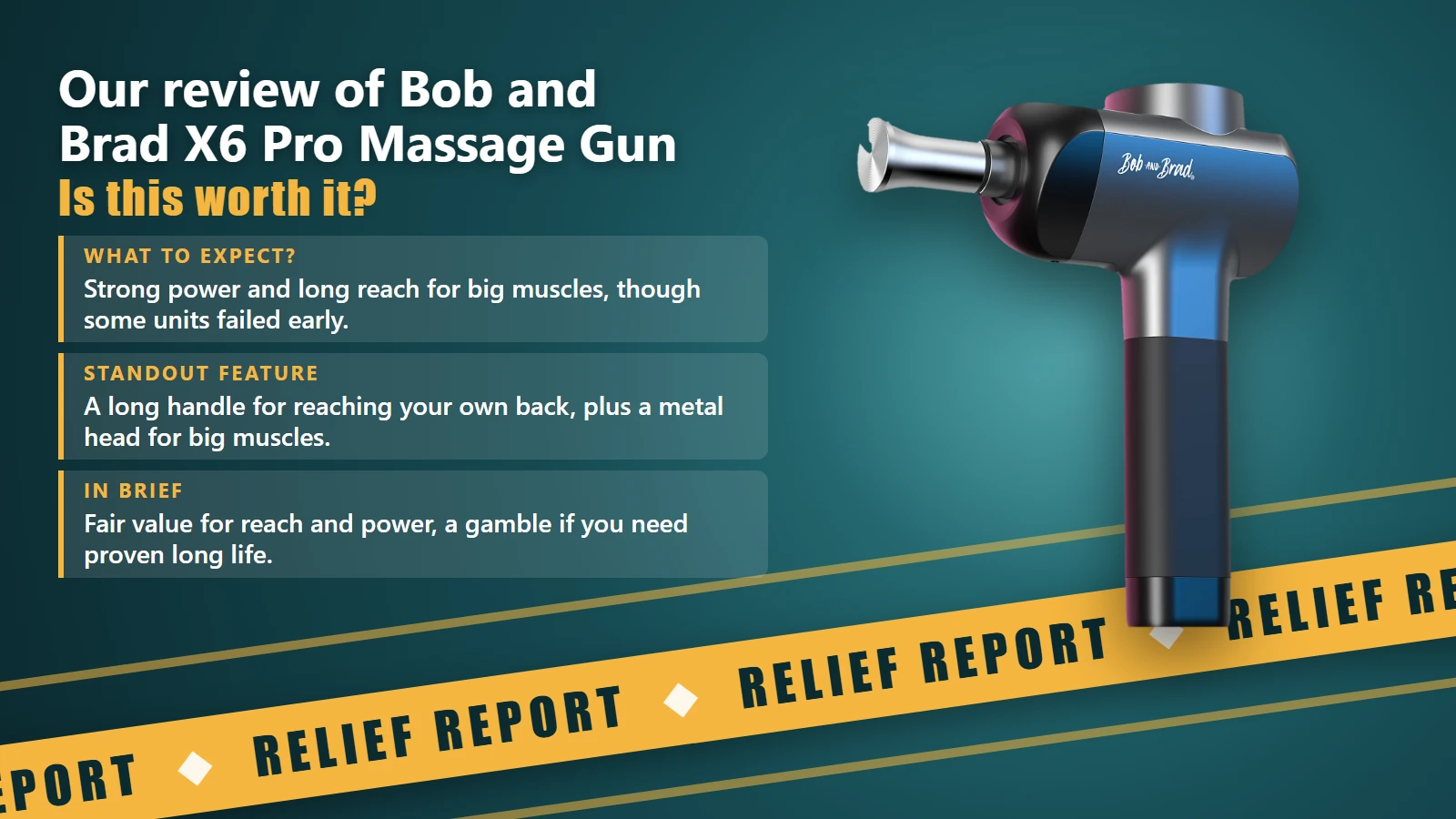
The X6 Pro lists 55 lb, and what our clients found was that the power was strong for the price at $138.99. The long handle, not the stall force, was what made clients reach for this gun.
Stroke and stall force are separate numbers, and a long stroke does not guarantee a strong motor. The Theragun Prime Plus lists 16 mm but under 40 lb of stall force, and a member found it gave out under heavy quad and glute pressure.
At the top, the D6 Ultra claims 85 lb on the box. A client who has tried three guns watched it shut off under firm pressure, and a member who owns over 70 massagers measured the sibling D6 Pro nearer 60 lb.
Brand figures are not tested here, so read the 85 lb as a claim, not a guarantee. The Hypervolt 3 Pro, which members put at $250 to $350, lists 70 lb and was the quietest of the three in a member comparison.
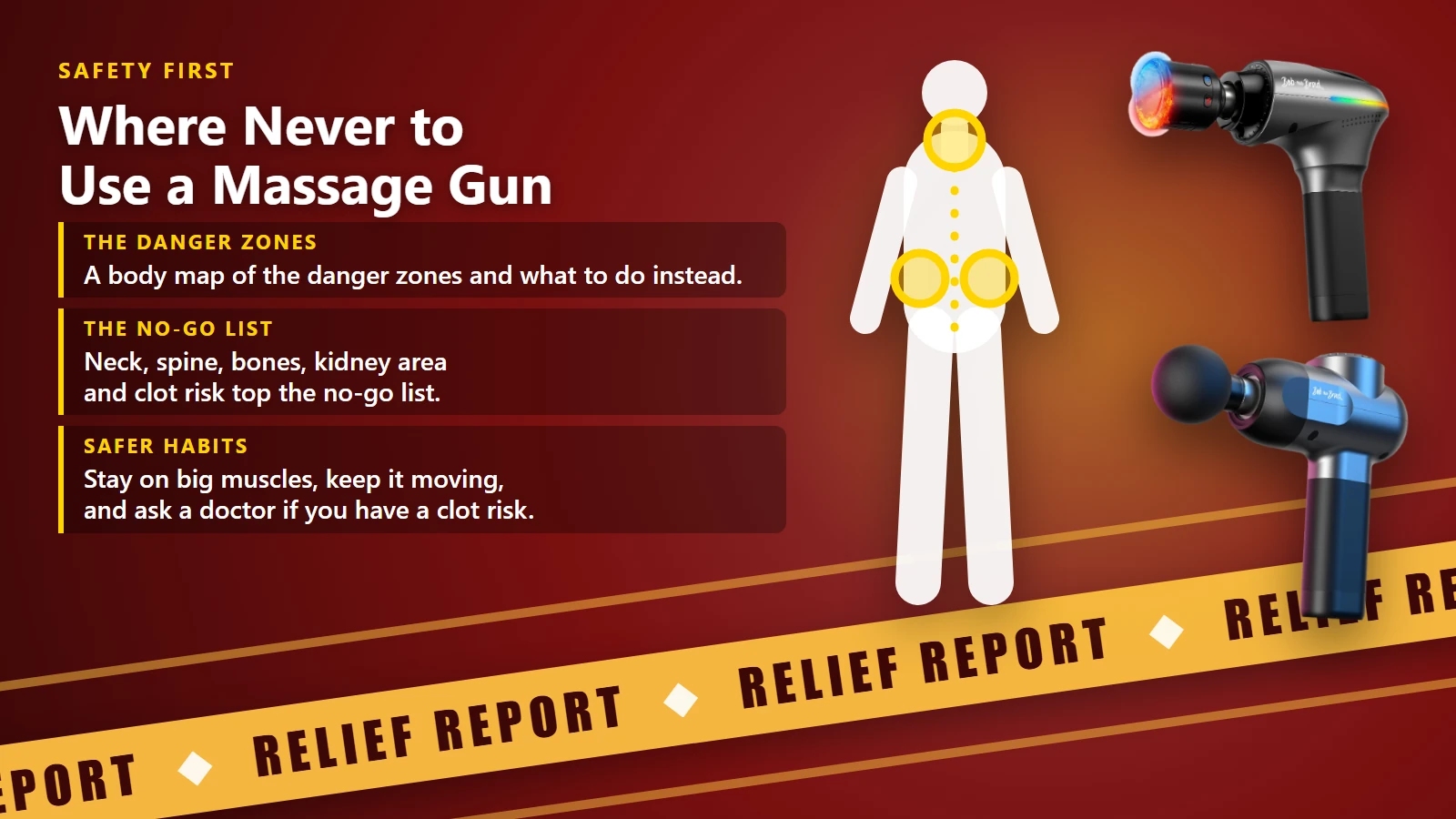
Safety matters here. Sharp or lingering pain, as opposed to firm, dull pressure, is the cue to stop, and the neck, bones, and spine are off limits on the D6 Ultra. Our guide to where never to use a massage gun covers the danger zones in detail.
Speed, Noise and Weight: What Do They Feel Like?
Speed ranges from about 1,400 to 3,200 PPM across the guns our members use. The Renpho Mini Thermal Deluxe runs 1,800 to 3,000 RPM across four speeds, and the Q2 Mini runs the same range across five speeds.
Speed changes pace and force, not depth, so a faster setting on a short-stroke gun still feels shallow. Most clients start on the lowest speed and add speed only after they know how the muscle responds.
One of our Power+ clients stayed at level 1, and another found even that too strong. A member softened the intensity by folding a towel over the leg and using a crescent-shaped head with bumps.
Noise is where brand claims and real life diverge. The Q2 Mini claims below 45 dB, and one reviewer heard nothing at first and had to check that their hearing aids were in.
Another said it stayed quiet even on the top speed. The Q2 Mini review at $69.98 found that quiet when new is the safer way to read the claim.
Wear changes the story fast. A client's Q2 Mini units got loud once something worked loose, and another reviewer found the noise unbearable after a stretch of heavy use.
The X6 Pro lists 40 to 55 dB, but one client said it was loud or got louder over time, while another called it quiet. Two units of the same model can sound very different, so test it at your usual speed and listen again after a few months.
Weight decides whether you actually use the gun. At 0.95 lb, the Q2 Mini is light enough that clients pack it for trips.
One reviewer pulled it from a backpack to work a spouse's lower back on a plane, where it stayed quiet at top speed. Another packed it for two Disney trips, which is the whole point of a mini.
The D6 Ultra sits at the other extreme, so skip it if you want a light gun.
Battery and Heads: Which Extras Pay Off?
Battery life specs range from 30 minutes of continuous runtime on small compacts to up to 8 hours on premium models. The real question is not the listed runtime but how long the battery lasts before it fails.
The Renpho Power+ is the cautionary tale here. Our review of the Power+ at $129 found that one client's gun was dead at 6 months, even though it was used only every 1 to 2 weeks.
A softball player had one quit before a year was up. Six of 20 buyers hit charging or power failures, and one reviewer called the Bluetooth app that the extra money buys a gimmick or pointless.
The Q2 Mini had 2 of 4 clients report charging or battery failures, though support often sent replacements. A gun used about once a month, or about ten times in two years, still ended up not charging.
USB-C charging is a plus for travel, but one reviewer found the Q2 Mini charged only from an older USB-A power source, and another said the box itself states three hours, not the 1.5 hours the listing claims. Proprietary chargers (a charger only that brand makes), like the one the Hypervolt 3 Pro uses, are a drawback if you travel and forget the brick.
On heads, the essentials are a ball, flat, bullet, and fork or U-shape. Softer silicone air-cushion or dampener heads are necessary for bony or tender spots.
Members say ten or more heads are mostly redundant, and one client who tried the Power+ used only two of the six it shipped with. Metal heads transmit direct force, but one reviewer warned that the X6 Pro's flat head has an edge that can pinch bare skin, and the metal head has no heating or cooling element.
The D6 Ultra's rubber-coated heads grab a shirt when you massage someone else, which is a small annoyance if you work on a partner. Heat is a bonus, not a dealbreaker: the D6 Ultra's infrared (light just past visible red; here it simply warms the head) head heats up quickly, but one member found it lacking, and another picked the Hypervolt 3 Pro for a warmer one.
The Mini Thermal Deluxe's heated head reaches 115°F (46°C). A buyer whose box had no instruction booklet struggled to find the double-press that switches the heat on, so read the manual before your first session.
Which Specs Matter for You?
The right specs depend on what you are trying to do. Here is how the numbers line up side by side.
| Spec | What it means | Good range | Who needs more |
|---|---|---|---|
| Amplitude (stroke) | How far the head travels with each hit | 12 mm or more is real percussion; 16 mm is the top | People working quads and glutes |
| Stall force | How hard you can press before the motor slows | 35 lb floor; up to 85 lb on heavy guns | Anyone who leans into big muscles |
| Speed (PPM or RPM) | How many hits per minute; sets pace, not depth | About 1,400 to 3,200 PPM | Few people; start on the lowest speed |
| Noise (dB) | How loud the motor runs | Under 55 dB counts as quiet; Q2 Mini claims below 45 | Shared homes and couch users |
| Weight | How soon your arm tires | 0.95 lb mini up to heavy full-size guns | Travelers want light; deep-work users accept heavy |
| Battery life | How long it runs before a recharge | 30 minutes on compacts to 8 hours on premium | Daily users |
For deep work on dense muscle, the D6 Ultra at $299.99 gives you 16 mm of stroke and serious power, but it is heavy and a few units failed early. Three of five buyer reviews describe a gun that broke, turned noisy, or stopped working within about six months.
For reach on your own back, the X6 Pro at $138.99 has a long handle that clients liked, but 2 of 4 lost a unit or watched one fade, so register it on day one. The 10.5 mm stroke is just under the 12 mm line.
For quiet daily use on legs, the Hypervolt 3 Pro at $250 to $350 was the quietest of the three in a member comparison, with 14 mm of stroke and 70 lb of stall force. The proprietary charger is the main drawback.
For travel and small muscles, the Q2 Mini at $69.98 is whisper-light at 0.95 lb, but 2 of 4 clients had battery trouble. The 7 mm stroke keeps it gentle on big muscles, which is the point for a travel gun.
For casual soreness with warmth, the Mini Thermal Deluxe at $64.97 has a heated head that works well, but the 6 mm stroke keeps it shallow. The Power+ at $129 is quiet and strong, but 6 of 20 buyers hit charging or power failures.
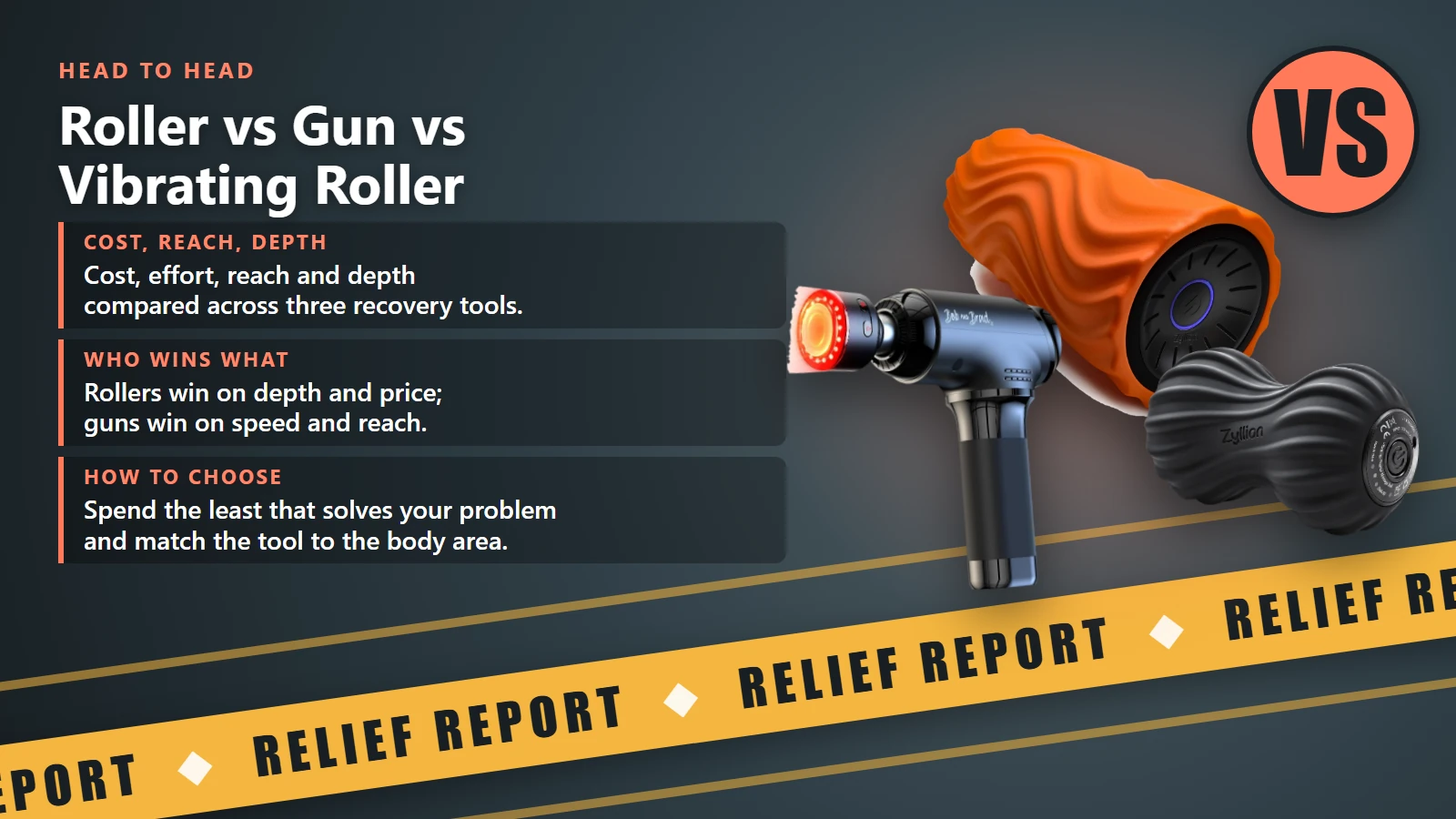
If you are not sure a massage gun is the right tool for your soreness, our comparison of foam rollers, massage guns, and vibrating rollers walks through which does more for less.
Questions People Ask
Is a higher stall force always better?
No. Stall force only matters when you lean hard into big muscles, and members put the floor for general use at 35 lb. The 85 lb D6 Ultra is also the gun where a client's only complaint was weight, so pick stall force by your muscle size and what you can comfortably hold, not the biggest number on the box.
Can I use a massage gun on my neck?
Keep it off the throat and the sides of the neck, as our Power+ review advises, and off the bones and spine, as the D6 Ultra review says. If your neck feels tense, keep the gun on the shoulder muscles with a soft head on the lowest speed, and see a doctor about chronic problems rather than pressing harder.
Do more heads mean a better gun?
No. The essentials are a ball, flat, bullet, and fork head, plus a soft air-cushion head for bony spots. One client who tried a six-head gun used only two of them, and members call ten or more heads mostly redundant, so a tidy case matters more than a pile of attachments.
How long should each session last?
Members suggest 10 to 30 seconds on sensitive trigger spots, 1 minute on small muscle groups, and 2 minutes per large muscle group, with 5 to 10 minutes maximum per session. Several of the guns we reviewed shut off on their own after 10 minutes, and if you want longer than that, you may be pressing too hard or using the wrong head.
The Bottom Line
If you want deep work on large muscles, look for 12 mm or more of amplitude and at least 35 lb of stall force. The D6 Ultra and the Hypervolt 3 Pro sit at the top of that range, with different trade-offs in weight and noise.
If you want something for travel, forearms, or calves, a mini like the Q2 Mini or the Mini Thermal Deluxe is lighter and cheaper, but expect a shorter stroke and watch the battery. Register any gun you buy on day one, because the failure reports in our reviews tended to come in the first few months.
Start on the lowest speed with a soft head, keep sessions short, and stay off bones and joints. A massage gun can help sore muscles feel looser, but it is not a treatment for a medical condition, and if pain persists, see a doctor before you press harder.