

Key Takeaways
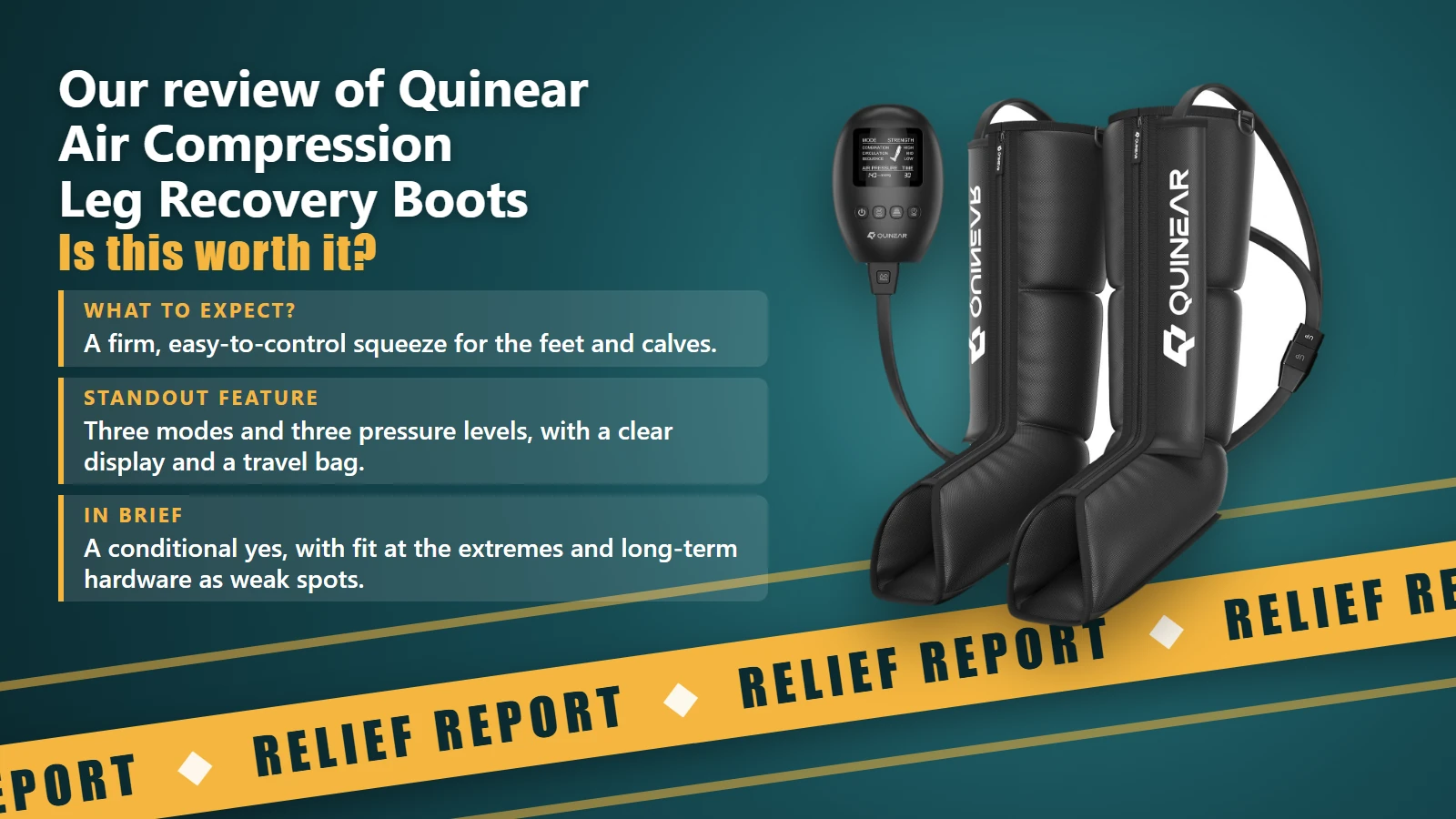
- The Quinear QN-073A earns its $169.99 if your legs fall in the middle of its size range; if you are petite, tall or have much bigger thighs than calves, a smaller boot saves you a return.
- Beyond our 3 client reviews, one user review I read ended in a return, because of fit.
- Expect a whole-leg squeeze that tightens and lets go; the kneading in the listing never showed up for clients, and the heat is warm air from the controller.
- Measure your inseam and widest calf first, because fit was the problem that came up most: one reviewer's 19.5-inch calf needed about 3 more inches to close the zipper.
- It runs quiet enough to watch a movie over, but I can't say how it ages: the group posts I have are about other Quinear boots, not this one.
A client who was 32 weeks pregnant had been using a massage gun every night for restless legs, then switched to the Quinear QN-073A for 40 minutes before bed. Her restless legs stopped at night, although her legs still swelled during the workday.
In the user reviews I read, another person, who is 5 feet tall, sent the same boots back because the calf section rode up over the knee. The two legs were different lengths, and that turned out to be the whole story.
This Quinear QN-073A review is for anyone weighing full-leg air compression at home. My short answer: it is a fair mid-priced cuff system if your legs fit it and you want a squeeze, not a massage.
That split showed up across the 3 client reviews I went through. Fit and what the buyer expected decided almost every score, far more than any spec on the listing.
What Do You Get for $169.99?
The listing calls it a 3-in-1 full-leg compression massager with heat. Here is what each line means for you.
| Spec | What it means for you |
|---|---|
| Price | $169.99, mid-range for full-leg boots |
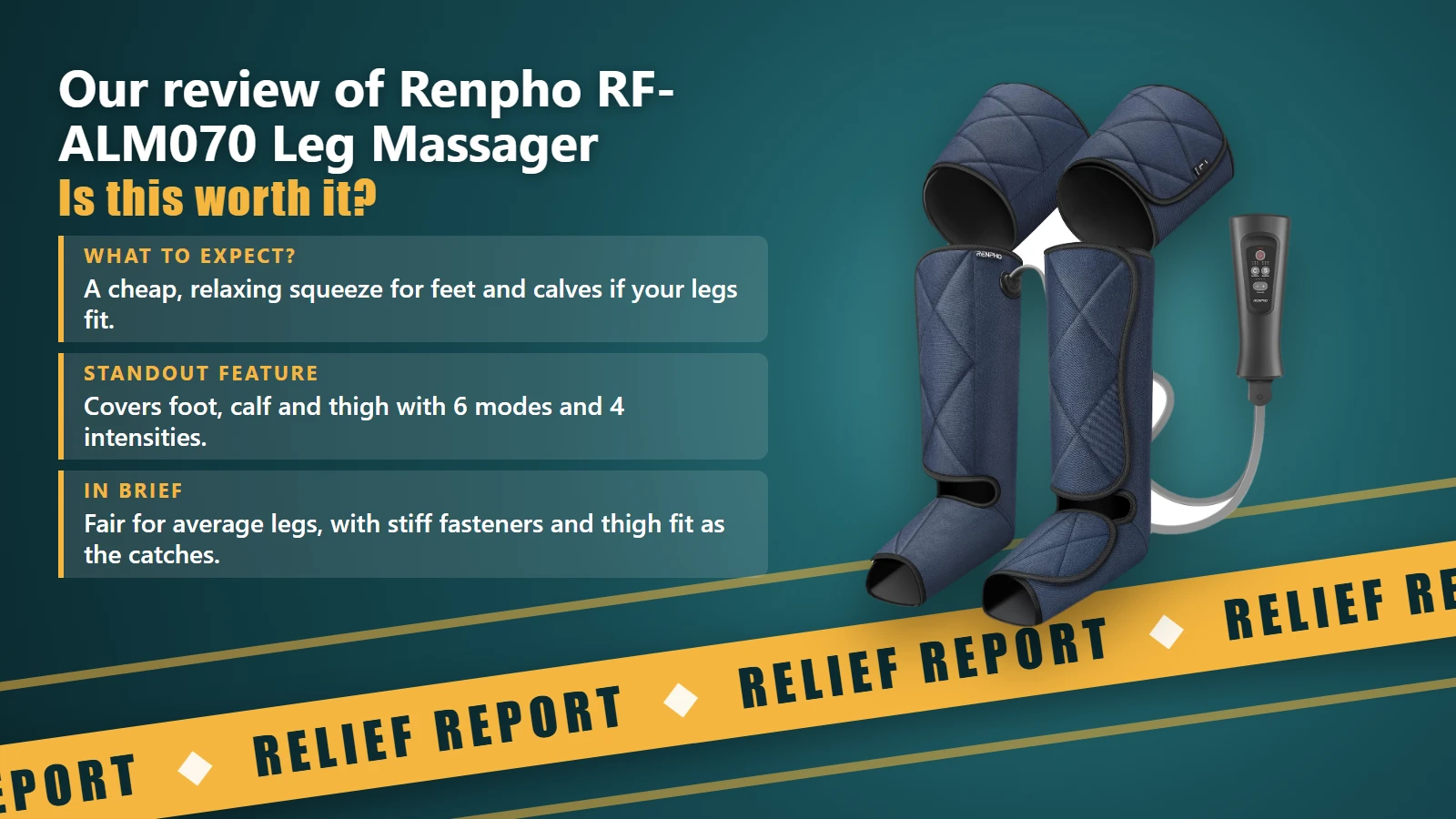
| Coverage | Foot, calf and thigh, with 4 air chambers |
| Modes and levels | 3 modes (sequence, circulation, combination) and 3 pressure levels |
| Heat | 3 levels of warm air from the controller, no heating elements in the legs |
| Power | Corded; both legs plug into the controller |
| Controls | LCD and 4 buttons; zippers on the lower sections, Velcro on the thigh |
| Timer | One reviewer reports it shuts off after about 20 minutes |
| Noise | Quiet for most clients; one buyer review mentions noise |
| Weight and size | 2.2 lb, 16.1" by 7.5" by 9" (listing) |
| Fit | Mixed; runs long for petite users, short for tall ones |
| Warranty | Not reported |
The cord is the first thing that either suits your setup or ruins it. You need a couch or bed within reach of an outlet, and one client said the cord needs to be at least a foot longer to reach comfortably with both legs plugged in.
Who Is It For, and Who Should Skip It?
Some clients loved it from the first night and others returned it. These two lists show which group you are likely to land in.
It suits:
- People with average leg proportions who want foot-to-thigh compression at home.
- People whose tired or restless legs flare in the evening and who can sit still for 20 minutes or more.
- Buyers who are happy with compress-and-release and do not expect kneading or deep heat.
- Anyone who wants a quiet unit to run while watching TV.
Skip it if:
- You are 5'3" or under, because the calf section may ride over your knee.
- You are over about 6 feet, since the thigh section stops short on tall users.
- Your thighs are noticeably larger than your calves, because one reviewer found the thigh cuff small while the lower-leg cuffs ran large.
- You expect a true massage, real heating elements, or strong pressure on the feet.
- You want cordless freedom or a quick on-and-off between tasks.
Will It Fit Your Legs? What I Noticed in the User Reviews About Height, Calves and Thighs
Fit is where this boot wins or loses. I would measure before ordering, because the listing gave no sizing chart that helped the reviewers below.
- Petite: a 5-foot reviewer with a 26 to 27.5 inch inseam found the calf section went over the knee, and sliding it under the knee left the foot squeezed in the wrong spot.
- Wide calves: the listing said it would fit up to a 22-inch calf, yet a reviewer with a 19.5-inch calf needed about 3 more inches to close the zipper. Two of the 12 buyer reviews say the boot would not zip or fit around the lower leg.
- Large thighs: a 135-pound reviewer whose right thigh is larger than the left found the cuff too small, and a petite bodybuilder friend of hers said the same.
- Tall: a 6-foot reviewer found the foot and calf lengths right but the thigh wrap a bit short, and a 6'2" reviewer said the thigh section "doesn't offer much" even though the rest worked well.
- Wide feet: one reviewer said pressure was good unless you have wide feet, and another with size 12 feet felt little pressure on them even on the top level.
One reviewer with lipedema and chronic venous insufficiency could not zip the boots past the ankle and is being referred for a medical-grade system. She mentioned an extender exists, but you have to write to the seller and pay extra for it.
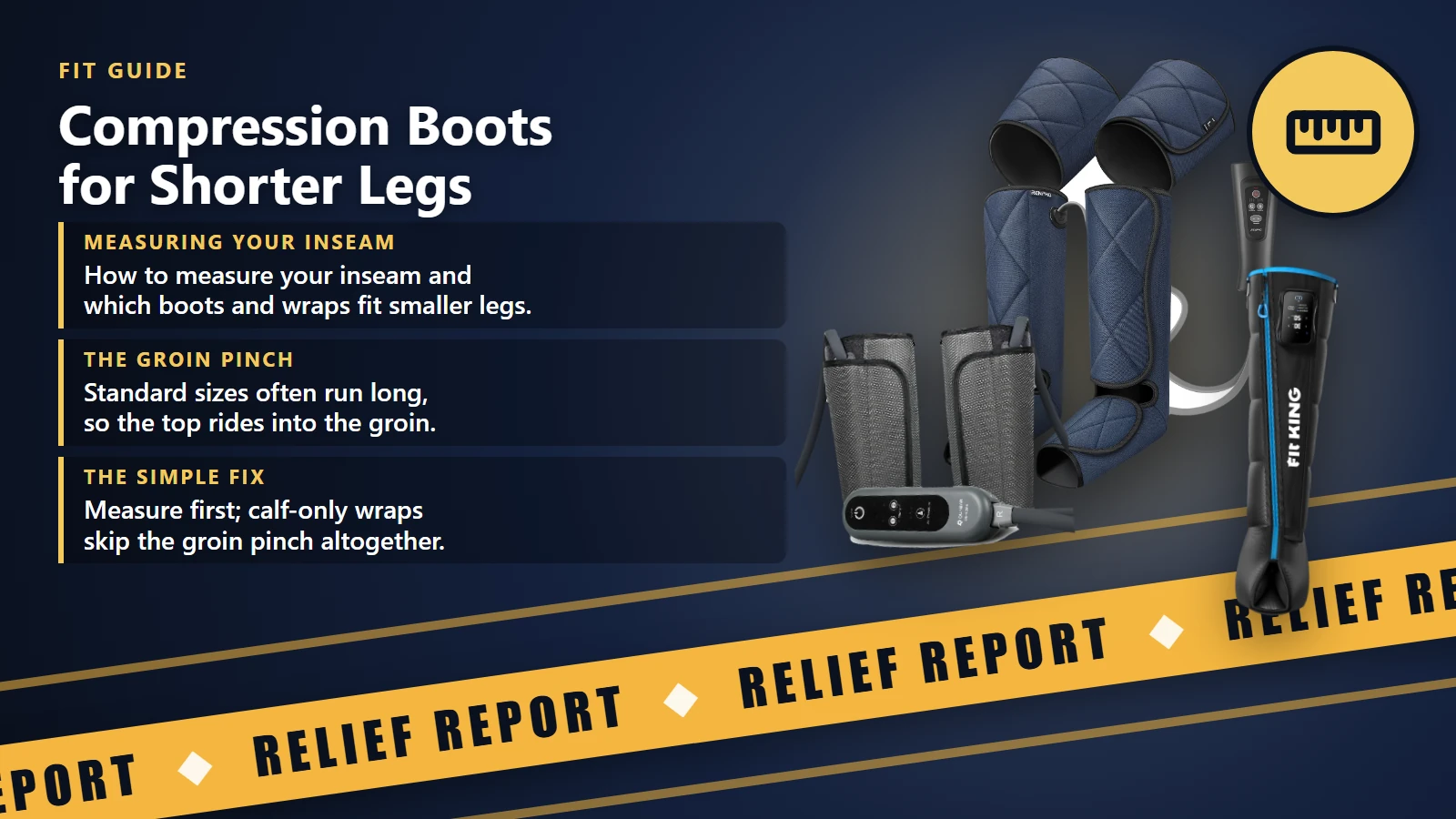
Measure your inseam from crotch to floor, your widest calf and your thigh, and compare them to the numbers above. If you land near a limit, I would pick a different boot rather than gamble on the zipper.
What Happened When Three of Our Clients Tried It?
Each row maps one real client review to a person I work with or advise. The 3 reviews on file split 1, 1 and 1 across 2, 3 and 5 stars, so the table below is a fair sample and not a sweep.
| Client | Why they bought it | How they used it | What worked |
|---|---|---|---|
| Mark, a client who spends most of the day standing | Edema and neuropathy, on feet all day | Plugged in at the wall, put on and off each time | Gentle compression felt good |
| Paul, a client who wanted a practical home recovery setup | Soreness and minor swelling | Heat plus compression, boots adjusted each time | Eased soreness and minor swelling |
| A client who wanted to compare handheld massagers with seated options | Swollen legs and restless legs at 32 weeks pregnant | 40 minutes before bed, mostly level 2 | Restless legs stopped at night; legs felt better later |
| Client | What didn't | Their verdict |
|---|---|---|
| Mark, a client who spends most of the day standing | Not strong enough; a hassle to put on and take off | 2/5 |
| Paul, a client who wanted a practical home recovery setup | Pressure weaker than hoped; fiddly to put on and take off | 3/5 |
| A client who wanted to compare handheld massagers with seated options | Level 3 was torture; boots take effort to get on | 5/5 |
Mark stands for most of a working day and deals with edema and neuropathy. The compression felt good but it wasn't strong enough for what Mark needed, and getting in and out of it was enough of a hassle that Mark wished it were cordless.
Paul wanted a home setup for soreness and minor swelling, and the heat and compression did take the edge off both. The pressure was gentler than hoped and the boots took a lot of adjusting to get on and off, so Paul landed on a lukewarm 3 out of 5.
A client who was 32 weeks pregnant had been using a massage gun each night for restless legs and swollen ankles before she switched to the Quinear. Forty minutes before bed, mostly on level 2, and the restless legs went away at night, though her feet still swell during the day.
She called level 3 torture and says getting the boots on takes a process, so she does it with her legs up on the bed or couch. Pregnancy is one to clear with your own doctor or midwife first.
The 5 went to the client whose legs fit the sleeves and who wanted a squeeze rather than a massage. The 2 and 3 came from people who wanted kneading or more pressure.
Other Observations From Friends, Relatives and Other User Reviews
- A reviewer who wanted a massage device with little setup expected kneading from the listing but got a squeeze that tightens and lets go, and found the manual's pictures for Mode 1 and Mode 2 word for word the same (2/5).
- A reviewer who spends close to four hours a day in the car has restless legs in the thighs, not the calves, found the pressure almost relaxing and the reach high enough on a 32-inch inseam, but the bag is bulky and the boots tie them to an outlet (4/5).
- A reviewer with plantar fasciitis that comes and goes ran level 2 for 20 minutes after the treadmill and felt better, found level 3 cramped the lower calves and the heat only warm air from the controller, and at 6 feet found the thigh wrap a little short (4/5).
What Members of Our Facebook Group Reported
No one in our Facebook group has posted about the exact QN-073A yet, so the table below draws on members' experience with Quinear boots in general and with air compression gear. Because nobody has owned this exact model, I can't tell you whether its hose connectors hold up past six months or whether the thigh Velcro frays.
| Member | Device | Experience | Takeaway |
|---|---|---|---|
| A runner | Quinear boots, model not stated | 20-30 minutes after double-digit long runs, paid about $200 | Felt like less soreness afterward |
| A member using up end-of-year FSA funds | Quinear boots, model not stated | Paid $280, unsure of any real benefit | Likes how the legs feel during use |
| A member comparing with family gear | Quinear boots vs Normatec | Owns Quinear, tried a brother's Normatec | Normatec slightly better, not worth the gap |
| A member with smaller legs | Budget knockoff boots | Saw no difference from Normatec or Therabody | Fit small legs better than the big brands |
| A strength coach | Fit King FT 082A and FT 130A | Used the corded 082A for 6 months, then upgraded | Went cordless because plugging in wore on them |
| A marathon runner with a 30-inch inseam | Normatec 3 | Medium was too tall for 5'3" | Measure your inseam before buying full-leg boots |
Members who own Quinear boots call them close to a Normatec, while Mark and Paul both found this model's pressure too light. Our group cares most about cordless convenience and inseam fit, and my clients' complaints cluster around whether it feels like a massage and how warm the heat gets.
What the Listing Promises vs. What Users Found
This is where marketing meets the living room.
| What the listing promises | What users actually found |
|---|---|
| "Simulating human hands kneading" and 10 programs | Only 3 compress-and-release modes; manual repeats text |
| 3 levels of heat therapy | Warm air from the controller only; no elements in the legs |
| Recovery and circulation support, with DVT and lymphedema mentioned | Subjective comfort only; not a verified medical treatment |
| Wraparound design fits different leg sizes | Petite calf rides over knee; thigh short for tall; some calves won't zip |
| Portable and quiet for home use | Corded, so placement is limited; most say quiet |
| Full-leg coverage with four chambers | Four zones inflate, but users wanted separate zone control |
What Do the Three Modes and Three Pressure Levels Feel Like?
Two reviewers I read described it as a giant blood pressure cuff for the legs. It uses (sequential compression - chambers that squeeze one after another, starting at the feet) in one of its three modes.
- Sequence: squeezes the foot and lower calf first, then the upper calf and thigh.
- Circulation: fills every chamber at once and lets go at once.
- Combination: alternates between the other two.
- Level 1: firm already, but relaxing; one reviewer said it was very comfortable.
- Level 2: noticeably more pressure; it was the pregnant client's main setting.
- Level 3: a lot. One reviewer with a high pain tolerance could handle it, but it left cramps or tightness in the lower calves.
That same reviewer warned that anyone with a bone problem should skip level 3. Another reviewer liked level 3, and a 6'2" reviewer said high is a little too much but preferred too much over too little.
When you start a session, it takes a couple of minutes to inflate enough to feel pressure. Between squeezes it lets go but does not fully deflate the chambers, so the squeezing phase feels shorter than you might expect.
The foot chamber presses harder than the calf on some people. One buyer wrapped a hand towel around the calf to feel the squeeze there.
Does the heat actually get warm?
Mostly no. One reviewer pointed out that there are no heating elements in the legs and the heat is warm air from the controller, noticeable mainly at compression level 3.
Another reviewer barely felt the heat even on high, and one buyer said it never got warm at all. The pregnant client found level 1 enough, and the 6'2" reviewer said the thigh wrap is the part that is heated, so expect a mild glow rather than a heating pad.
How loud is it?
Quiet, according to most of the people I asked. One reviewer watched a movie over it two nights in a row without noticing the controller, and another said the noise level isn't loud at all.
The counterpoint is one buyer review that mentions noise, and one reviewer whose unit tripped off when the heat options were switched on. If your partner is a light sleeper, try it for an evening before you make it a bedtime habit.
How Long Should a Session Be, and How Often?
Most people I read landed on 15 to 40 minutes: one reviewer found it hard to stop at 20 minutes, a husband used 15 to 25 minutes over four nights, and our pregnant client used 40. In our Facebook group, typical sessions with air compression run 15 to 30 minutes, with some members going to 45 or 60.
The timer on this one shuts off after about 20 minutes, and one reviewer was annoyed about it because they wanted to wear it for two hours. I would not stretch it that far; start on level 1 for 15 to 20 minutes and build only if your legs feel fine the next morning.
Members use boots like these daily or four to six times a week during hard training, and two or three times a week for maintenance. Wearing lightweight capris, pajama bottoms or thin sweatpants under the sleeves keeps the skin marks down.
Getting the boots on
The zippers on the lower sections make them easy to get on and off, and only the thigh uses Velcro. Even so, one reviewer's right thigh section is finicky and has to be adjusted several times, and another found the whole job a lot of adjusting.
Plan on sitting with your legs up, as the pregnant client does, and expect a minute or two of fiddling at first. One buyer also said the controller needs both legs hooked up even when only one leg needs it.
Which Uses Does It Suit: Restless Legs, Swollen Evenings or Post-Run Soreness?
The data supports some uses better than others. Here is how each held up.
- Restless legs at night: The pregnant client and one buyer said it helped, while a husband's relief lasted only two of four nights and the couple returned it. People who can't stand the feeling of trapped legs may like it less.
- Heavy, swollen evenings: Paul and the pregnant client felt lighter afterward, but Mark found it too gentle. Swelling that doesn't go down overnight is one to raise with a doctor.
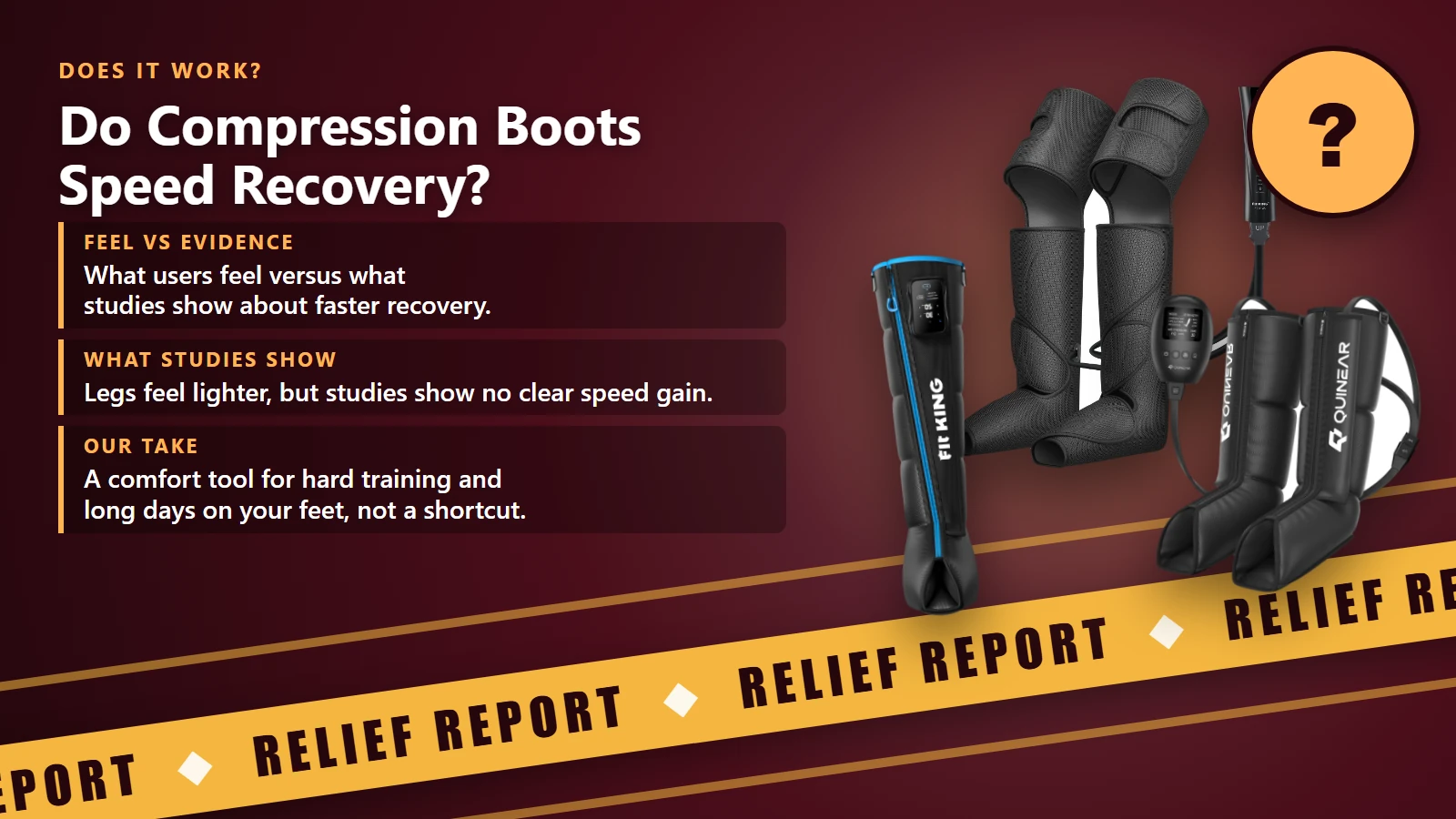
- After a run or workout: a member runner and my brother both use it this way, as a comfort habit. The small trials I've read say compression mostly changes how fresh the legs feel, not how fast they recover.
- Foot comfort: mixed. One reviewer loved level 3 on the feet while another with size 12 feet felt little pressure there even on max.
How Long Until It Helps, and How Long Until It Breaks?
Most people feel something in the first session or two. The harder question is longevity, and for this exact model I only have what buyers and clients reported.
- First night or two: the pregnant client noticed her restless legs settle, and a husband's relief faded after two nights.
- After several uses: one reviewer's left thigh and upper calf chambers stopped working, and the boots went back.
- About six weeks: one buyer's hoses seemed to stop working until the seller helped them seat the connections tighter.
- About a year: one buyer said the motor went bad.
- Past six months: nobody in our group has told me, so I can't say.
Durability, Support and the Complaints That Keep Coming Up
I read through the buyer reviews and client notes looking for patterns, not one-off rants.
- 2 of the 12 buyer reviews say the fit was so poor they could not zip the boots at all, and a third said even the lowest setting squeezed too tight.
- 1 buyer says the motor died after one year, which is the only long-term failure in the buyer pool.
- 1 buyer says the heat mode never gets warm, and several reviewers describe it as warm air only.
- 1 reviewer had air hoses stop working after about six weeks, and the seller helped sort it out by reseating the connections.
- Another reviewer had the left thigh and upper calf chambers fail after several uses and returned the unit.
- 1 buyer received a unit with someone's pet hair on the Velcro, which suggests a used return had been resold as new.
- Support was uneven: one reviewer got helpful troubleshooting, while another says customer service promised a refund that never arrived.
How It Compares to Normatec and Fit King
These boots sit at different price points, and the differences are concrete.
| Product | Price | Key difference | What users liked |
|---|---|---|---|
| Quinear QN-073A | $169.99, mid-range | Corded, 4 chambers, warm-air heat | Full-leg zipper coverage, quiet controller |
| Fit King FT 082A | $319.99, per a group member | Corded controller, tubing, 8 levels, 50-120 mmHg | Lasted 6 months of use |
| Fit King FT-130A | $699.99, premium | Cordless, built-in controls, 5 chambers, 50-150 mmHg | No hoses, higher pressure, single-boot use |
| Normatec Elite | About $999, per group members | 5 zones, cordless battery, app control | Sequential flow, medical-grade build |
| Product | What users disliked | Best for |
|---|---|---|
| Quinear QN-073A | Weak heat, no kneading, sizing quirks | Full-leg compression on a budget |
| Fit King FT 082A | Plugging in hoses and controller | People fine with a cord who want more pressure range |
| Fit King FT-130A | Thicker material traps heat | Daily users tired of cords |
| Normatec Elite | Price; medium runs tall under a 33-inch inseam | Athletes who want wireless recovery |
If you are deciding between Quinear models, the full write-up on that unit covers how it held up, including whether its heat is any stronger. For knee-only trouble, what we learned from the Quinear QN-031KS Knee Massager may steer you to a simpler wrap that skips thigh sizing entirely.
Budget buyers who only need foot and calf relief can start with the Quinear Air Compression Recovery Boots, since they skip the thigh complication. If cordless convenience and a wider pressure range matter more, the Fit King FT-130A review covers the cordless route, and my Fit King FT-091A Recovery Boots review looks at a cheaper tubeless pair.
Is it worth $169.99 next to a Normatec?
For most people I talk to, the useful question is how often you will use it, not how it stacks up on paper. One member who owns both a Quinear and a brother's Normatec says the Normatec is slightly better, but barely, and not enough to justify the price gap.
Members who shop in the budget tier ($49 to $200) say the compression strength is comparable to premium units, while build quality is hit or miss. Zipper and air-chamber failures are the regret I hear about most.
What to Look for When Buying an Air Compression Leg Massager
This checklist comes from our Facebook group and from the returns my clients regretted. The third column shows how this model does on each point.
| Factor | What members and clients say | How the QN-073A does |
|---|---|---|
| Pressure range | Members mostly run 70 to 120 mmHg; weak caps disappoint strong users | 3 levels, no mmHg figure given; Mark and Paul found it light |
| Sequential inflation | Foot-to-thigh beats whole-leg balloon inflation | Has a sequence mode plus all-at-once circulation |
| Cordless vs corded | Cordless gets used more; corded needs an outlet and hoses | Corded; Mark wanted cordless, a reviewer wanted a longer cord |
| Sizing and inseam | Standard sizes often run long for 5'3" to 5'8" | Long on petite legs, short on tall ones |
| Zone control | Members like turning off foot or thigh chambers | Not available; one reviewer wished for it |
| Heat quality | Heat isn't ideal for fresh inflammation | Warm air only, not heated elements |
| Closure type | Zippers hold better than Velcro under pressure | Zippers on lower sections, Velcro on thigh |
| Noise and storage | Pumps can hum; boots without a deflate cycle take about 3 minutes a leg to roll out | Quiet for most; one buyer couldn't get it back in the bag |
Measure your inseam from crotch to floor and your calf at its widest point before you order. Pressure is measured in (mmHg - the same unit as a blood pressure cuff), and members say 70 to 120 is where most sessions sit.
Using It Safely and Getting the Most From It
Start on level 1, especially if you are new to compression, because level 3 can feel like a full-leg blood pressure cuff and may leave your calves tight. Drink water, since members say pushing fluid around too fast can bring on nausea or lightheadedness.
Wear thin pants or capris inside the sleeves to prevent deep skin marks that can last for hours. Stop immediately if you feel tingling, numbness, nausea or pain, and do not use level 3 over bare skin if you bruise easily.
The warm air is mild, but if your feet are numb from neuropathy or diabetes, check your skin afterward because you may not feel heat. Anyone with bone problems should skip level 3.
Anyone with a history of blood clots or DVT, peripheral artery disease, heart failure, open wounds, leg infections or recent leg surgery must check with their doctor before using air compression. Do not use this device as a treatment for lymphedema, DVT, edema or circulation disease; sudden one-sided calf swelling, pain or shortness of breath needs urgent medical care, not another session.
Questions People Ask About These Boots
Is it a real massage?
No, it only tightens and lets go, and clients and buyers agree there is no kneading. If a squeeze is what you want it works, and if you want hands-like pressure, a massage gun or chair is the better fit.
Can I use just one leg?
Possibly not, because one buyer said both leg connections have to be hooked up even when only one leg needs it. Nobody in our data ran a single leg alone, so check the manual before you count on it.
What should I check if the boots stop inflating?
Start with the hose connections. One buyer's boots seemed dead after about six weeks, and the seller helped them see that the hoses weren't seated tightly enough, after which the unit worked again.
Can it help with swelling from a medical condition?
It gave some clients a nicer evening, but it is a comfort device and not a treatment. With edema, lipedema or circulation disease, talk to your doctor first, because one reviewer with lipedema could not even close the boots and was referred for a medical-grade system.
Is it safe to use while pregnant?
One client used it nightly at 32 weeks and was happy, but that is one person's experience. Ask your own doctor or midwife before you start, and say that you plan to use leg compression.
Verdict: Buy or Skip?
Buy it if you want full-leg compress-and-release for under $200, your inseam and calf size fall in the middle of the range, and you have a spot near an outlet where the boots can live. Skip it if you are petite, expect a heated kneading massage, or need strong pressure on the feet.
For cordless convenience or higher pressure, a step up like the Fit King FT-130A is the better target, and for knee-only relief the Quinear QN-031KS Knee Massager is a simpler wrap. Either way, measure your legs first.
If it suits you, check the current price of the QN-073A (if you buy through this link we may earn a small commission, which doesn't change what our clients and group members reported). Keep in mind that the evidence is solid on fit and feel but thin on long-term durability, since no member of our Facebook group has posted about this exact model.