

Key Takeaways
- $80.99 buys cheap, roomy warmth over your back; it does not buy a pad you can count on past a year.
- On paper it is a simple 20-minute daily session; clients describe a stiff pad whose plastic cover sticks to bare skin as it warms.
- Expect it to warm up fast, and expect the first dead lights anywhere from a few uses to about 6 months in for the clients it failed on.
- The folds are the trap: the pad ships creased, stays stiff over a hip or knee, and bending is what members blame for broken wiring in mats like this.
- Keep your eyes closed or covered, and stop right away if the skin gets too hot, because one reviewer got blisters the first time.
One morning the back of Brandon, one of our six clients, started spasming, so Brandon lay on this pad for 20 minutes, then another 20, and felt well enough afterward to walk outside and fill the bird feeders. Six months in, the lights started burning out, and that mix of real comfort and a short life runs through this Comfytemp red light therapy mat 24x12 review.
It's a plug-in pad with 242 LEDs, made for people who want to try red light at home on the back, hips or knees without buying a panel. My bottom line: it's a pleasant, large, easy pad for $80.99, but you should plan on it needing a replacement.
This review rests on 6 client reviews and 16 buyer reviews, and the buyer reviews I went through lean toward the middle ratings, so failures will look more common here than in the 4.4 star average on the listing. Nobody in our Facebook group has posted about this exact mat yet, so the group section leans on Comfytemp's other products and says so.
Comfytemp Red Light Therapy Mat 24x12 Review: The Specs in Plain English
The pad gives off two colors of light, (660 nm and 850 nm - 660 is the visible red you see, 850 is near-infrared light you can't see but may feel as warmth). Here is what each spec means when you are actually lying on it.
| Spec | What it means for you |
|---|---|
| Price: $80.99 | Budget for a red light mat, well under a panel |
| 24" x 12" mat | Covers a lower back or torso; too narrow for both knees and ankles |
| 242 LEDs, 660 nm and 850 nm | Red plus near-infrared, the same two colors most budget mats use |
| 4 modes, 3 levels | What each mode does is not reported; pulse only blinks the lights |
| Plug-in adapter, no battery | You need an outlet nearby; one buyer found the cord short |
| 1.8 lb package weight | Light enough that a client packs it in a suitcase |
| Timer: none stated | Listing suggests 20 minutes daily; reviews on timers are mixed |
| Heat: not listed | Clients still feel real warmth, and one felt too much |
| Warranty: not reported | Keep your receipt; support replaced or refunded in three reviews |
Who Is This Pad For, and Who Should Skip It?
The people who liked it most wanted something simple and large for a low-stakes home trial. The people who disliked it most expected it to last or to wrap around a joint.
- Budget buyers: You want to try red light at home and accept that a replacement may come.
- Back and torso users: The 24" x 12" size covers a lower back well, which is where our clients used it most.
- Travelers: It is light, flexible and packs into luggage, as Everett found.
- Anyone who needs it to last: 3 of 6 clients had lights or whole sections die.
- Anyone who needs a wrap: Andrew sent it back because the creases would not lie flat over a hip.
- Anyone who dislikes plastic on skin: 1 of 6 clients mentions the cover, and one reviewer wanted a vibrating pad instead.
What Did Six of Our Clients Find After Weeks and Months of Use?
All six of our clients are in the table below, one row per real review. Their star ratings run from 2 to 4 out of 5, and almost every complaint is about how long the pad lasts or how it sits on the body.
| Client | Why they bought it | How they used it | What worked |
|---|---|---|---|
| Jerome, recreational basketball player | Red light on the back, as pictured | Lying on the pad | It works as a light pad |
| Derek, trains several times a week | Not reported | A few uses, then a replacement | Heated well at first |
| Brandon, longtime client | Back spasms and long-running spine pain | Two 20-minute sessions in a row | Spasm calmed enough to walk outside |
| Andrew, prefers lower-intensity gear | Light over left hip and low back | Two sessions of about 20 minutes | Some relief after both sessions |
| Tyler, post-workout recovery client | Shoulders and a recent neck injury | Every day for 3 weeks | Heated shoulders and neck well |
| Everett, logs miles behind the wheel | Spare HSA funds, travel use | A few times a week for months | Easy setup, packs flat in luggage |
| Client | What didn't | Their verdict |
|---|---|---|
| Jerome, recreational basketball player | Plastic sheet against skin was uncomfortable | 2/5 |
| Derek, trains several times a week | Unit and replacement both failed | 2/5 |
| Brandon, longtime client | Lights burned out at about 6 months | 3/5 |
| Andrew, prefers lower-intensity gear | Folds stood up, no timer, returned | 3/5 |
| Tyler, post-workout recovery client | Two thirds of lights died, refunded | 3/5 |
| Everett, logs miles behind the wheel | Flexible mat needs careful positioning | 4/5 |
Jerome lay on the pad and found that a sheet of plastic sat between the lights and the skin, not any soft fabric. Jerome rated it 2 out of 5 because the description never mentioned it, even though the lights worked.
Derek's first unit stopped after just a few uses, and the company replaced it. The replacement worked for a while and then quit too, and both only lit up with one edge held at the right angle, which points to a loose connection inside.
The lights started burning out near the six month mark, the company sent a new pad quickly, and Brandon says buying a fresh one every six months is probably worth it. Because of that long spine history, I'd still want Brandon's doctor's plan to stay the main plan, with the pad as an extra.
Andrew needed the light over the left hip and low back, but the pad ships folded and the creases stuck straight up and would not lie flat even after two sessions. It also smelled strongly of chemicals at first (Andrew has multiple chemical sensitivity, so that mattered) and had no timer for longer sessions, so back it went despite some relief.
Tyler used the pad every day on the shoulders and a recent neck injury and said it heated them well. Three weeks in, two thirds of the lights went out at once, so Tyler refunded it and put the money toward a slightly pricier pad from another company.
Everett bought it with leftover HSA funds to add red light to a routine while traveling for work, and found it easy to set up and light enough to pack. After a couple of months of a few sessions a week, Everett can't say yet how much it helps with aches, but there have been no recent flare-ups and nothing feels worse.
Across all 6 client reviews, 2 are 2 stars, 3 are 3 stars and 1 is 4 stars. Warmth, size and ease of use get the praise, while 3 of 6 describe lights or whole sections dying and 1 of 6 complains about the plastic cover.
From the other user reviews I read, one reviewer who wanted a no-fuss alternative to complicated gear called it relaxing and simple, just lie down; another wished the mat were wider, because squeezing the legs together was the only way to cover knees and ankles at once.
What Did Members of Our Facebook Group Say About Comfytemp?
No member of our Facebook group has posted about this exact 24x12 mat. The table below uses posts about other Comfytemp products and about red light mats in general, and the Device column says which product each member really meant.
| Member | Device | Experience | Takeaway |
|---|---|---|---|
| A runner who uses it for mood | Comfytemp 12x24" mat, 850 nm | Lays it on bare skin, reports an energy lift | Same size as ours, model unconfirmed; a mood report |
| A member weighing an upgrade | Comfytemp smaller mat | Calls it cheap and great for a relaxing ritual | Likes it, still wanted a bigger mat |
| A member who went bigger | Comfytemp 33" x 17" mat, 480 LEDs | Three months of use, bought on sale | Listed at $110, versus $80.99 for ours |
| A member with neuropathy and sciatica | Comfytemp k9033 heating pad | Used nonstop for a couple of years | A plain heating pad, not a light mat; mind heat with neuropathy |
| A member who tried several types | A full-body mat, about $1,000, brand not given | Sweated, slept better, back pain returned in hours | Preferred high-end panels for chronic back pain |
| A member comparing mats and belts | Novaa Light Pad XL | Rated the best sweet spot for size, power and durability | Does not cover the whole body in one go |
Members and clients agree that these mats feel warm and relaxing, and that lying flat with the pad on bare skin is the easiest way to use one. The disagreement is durability: the brand's heating pad lasted years for one member, but our category notes list flexible mats shorting out, losing rows of lights or failing at the cord within days to months as a common regret.
One member quotes 180 mW/cm² for the smaller Comfytemp mat at its top setting, against about 30 for a big full-body mat. Other members warn that cheap brands often inflate these power numbers, so I read 180 as the seller's number until someone measures it.
Does the Listing Match What People Found?
The listing is short and sensible, and most of its claims hold up until the lights start going dark. These are the gaps clients and buyers pointed out.
| What the listing promises | What users actually found |
|---|---|
| Covers back, waist, hips, knees and feet | Big enough for the back; creases and width limit hips and knees |
| 4 light modes and 3 levels | Pulse only blinks the lights; one client expected vibration |
| Use 20 minutes daily | Brandon did 20 minutes twice; one client wanted a longer timer |
| 242 red and near-infrared LEDs | 3 of 6 clients had sections or the whole pad stop |
| Heat not listed | Users felt real warmth, one felt too much, one got blisters |
How Long Does It Last? Counting the Failures
I count recurring problems instead of guessing. Between the 6 client reviews and the 16 buyer reviews, durability is the reason most people mark the pad down.
- Clients: 3 of 6 had lights or sections fail, at a few uses, at about 3 weeks and at about 6 months.
- Buyers: 8 of 16 describe lights, a wire or the whole unit giving out, with stated timelines of a few months, a year and a year and a half.
- Returns: 3 of 16 buyers sent it back soon after buying, one after reading a warning in the manual, one after a bad first use.
- Support: three reviews describe the company sending a replacement or a full refund without a fight.
- Small annoyances: a short cord, controls under the pad where you sit on them, and it feels cold when you first lie down.
The weak point is the thin wiring inside a mat you fold, sit on or lie on. Members say flexible mats do best laid flat on something firm, not creased or pressed into a soft mattress.
Replacements are not a guaranteed fix, because Derek's second unit failed as well. If you buy one, keep the box and the receipt.
Why Does It Get Hot, and What Does Pulse Mode Do?
Heat isn't in the listing, but users feel it. Tyler said it heats well, one reviewer said the mat got so hot that the sweating was constant and the surface was hot to the touch, and another found it cold at first before it warmed up.
One reviewer, who trains first thing in the morning, reported that the first session blistered the skin on the back, though it cooled down after that. One buyer's review says that after a year the LEDs shifted and heated the black material so much that the pad was unusable after 10 minutes.
The clear plastic cover gets sticky as it warms, according to Jerome and one other reviewer. As for pulse, a reviewer who owned a pad with vibration expected the same here, but the lights only switch on and off.
Does a 24x12 Mat Cover Your Back, Hips and Knees?
For a lower back or torso, yes, and that was the main use among our clients. For the hip, Andrew found the creases would not flatten, so I would not count on it as a wrap.
For knees, one reviewer who wanted both knees and ankles at once had to squeeze the legs together, and turning the mat sideways covered only both knees or only both ankles. If you want knees and ankles in one go, you'll want a wider mat.
How Does It Compare With Other Red Light Mats?
The alternatives table mixes a bigger Comfytemp, a mid-priced mat and a full-body mat. I give prices only where our data states them, and write "not reported" otherwise.
| Product | Price tier | Key difference | What users liked |
|---|---|---|---|
| Comfytemp 24" x 12" | Budget, $80.99 | 242 LEDs, plug-in | Price, warmth, size |
| Comfytemp 33" x 17" | $110 listed, per a member | 480 LEDs, larger | Member found it worth the price |
| Novaa Light Pad XL | Not reported | 1,200 LEDs, 19.7" x 23.6", 1.9 lb | Size, power, durability, per a member |
| HigherDOSE mat | Premium, near $1,000 per members | 78.7" x 41.37", 1,000 LEDs, 15 lb | Total area, yoga flexibility |
| Product | What users disliked | Best for |
|---|---|---|
| Comfytemp 24" x 12" | Lights fail, stiff folds | Budget back trials |
| Comfytemp 33" x 17" | Long-term life not reported | Wider coverage |
| Novaa Light Pad XL | Does not cover full body | Serious mat buyers |
| HigherDOSE mat | Price and 15 lb weight | Home studios |
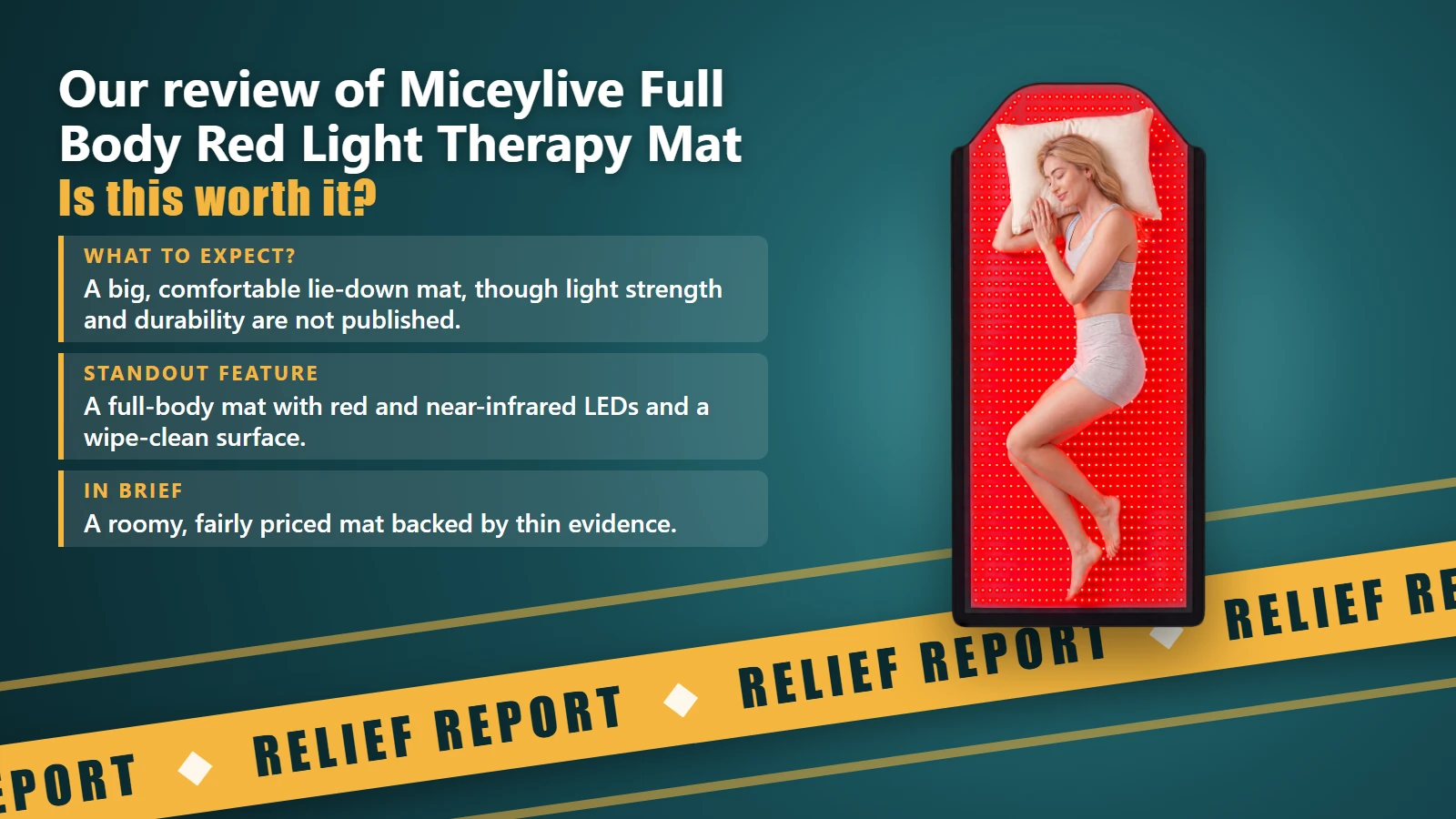
If you want much more coverage, our Miceylive Full Body Red Light Therapy Mat findings cover a $339.99 option, though I'd call the evidence on it thin. For the premium end, my FliKEZE S2 Full Body Red Light Mat review looks at a mat that costs $899.99 and what we do and don't know about it.
If what you really want is plain heat for a stiff back, a heating pad may suit you better, and what our clients found with the Comfier CF-6413 Heating Pad With Massage ($69.99) is the one that adds vibration. For the lowest price on heat alone, the full write-up on the Bob and Brad TheraHeat ($49.98) covers cozy heat and the reports of a short lifespan.
What Should You Look for When Buying a Red Light Therapy Device?
These factors come from what members say matters and from what went wrong for our clients. Checking them before you pay would have saved several people a return.
- Wiring and build: Flexible pads are prone to wire breaks and shorts when creased or bent, and 3 of our 6 clients had failures.
- Real light output: Members say cheap brands inflate (irradiance - how strong the light is at the skin, in mW/cm²) numbers, and one buyer's own light meter found little from several products.
- Separate red and near-infrared switches: Members prone to melasma or sensitive skin want to turn the near-infrared (the warmer light) off, and this mat does not list that option.
- The cover and the folds: Plastic that sticks and creases that will not flatten were the two comfort complaints, and Andrew returned the pad over the folds.
- Timer and controls: A built-in timer helps if you fall asleep, and one buyer found the switches under the pad awkward when sitting on it.
- Size and cord length: A 24" x 12" pad won't cover both knees and ankles, and one buyer found the cord too short to reach a chair.
Also look for a stated warranty and a seller that answers messages, because the company here replaced or refunded without argument in three reviews. Members also say a basic two-wavelength device used consistently matters more than obsessing over extra wavelengths.
How Do You Use It Safely and Get the Most From It?
The listing suggests 20 minutes a day, and members say mats are usually run for 15 to 30 minutes on bare skin, with 3 to 5 times a week the most widely suggested routine. Clothing of different colors or thickness may waste some light, so I would put the pad against the skin.
Members also say more is not better: pushing past 20 to 30 minutes on one area gives diminishing returns and irritation. If you are new, start with a short first session and see how your skin reacts.
Keep your eyes closed or use blackout goggles, because members using bright panels without goggles reported glare and blurry vision. If you take medication that makes you sensitive to light, or you have a light-sensitive skin condition, check with your doctor first.
Heat deserves respect. One reviewer blistered the first time, and members with neuropathy or reduced feeling in the skin should be careful with any direct-contact pad, so stay awake and check the skin after the first few minutes.
One buyer who was dealing with cancer returned the pad after reading a warning in the manual about growth. I haven't verified that wording, so read your manual and ask your doctor before using red light if you have cancer, are pregnant, or manage any medical condition.
Verdict: Should You Buy the Comfytemp 24x12 Mat?
In this Comfytemp red light therapy mat 24x12 review, the pad earns its $80.99 as a warm, roomy, easy way to try red light on your back. It is not an investment, because 3 of 6 clients and 8 of 16 buyers describe lights or wiring giving out.
Buy it if you want an inexpensive pad for a lower back or torso, you will keep the receipt, and you are fine asking for a replacement. Skip it if you need a pad that wraps a hip or knee flat, you can't stand plastic on bare skin, or you want it to last for years; a heating pad or one of the other mats above fits those people better.
One honest limit: nobody in our Facebook group has posted about this exact mat, so everything here comes from 6 clients and 16 buyers who skew toward lower ratings.
If you decide to try it, you can check the current price of the Comfytemp 24x12 mat.
(If you buy through this link we may earn a small commission. It doesn't change what our clients and group members reported.)