

Key Takeaways
- It is a joint wrap that rewards tinkering, not a hands-free whole-body system: knees and upper arms fit well, while shoulders and back need a $50 extender.
- Hold a tape measure to the joint, since the short strap and slipping buckle were the top complaint, raised by 1 of our 3 clients and by several reviewers and buyers.
- At $499 it makes sense only if you already know red light suits your knee or ankle; otherwise a cheap mat is the smarter first purchase.
- A module quit inside two months for one client, yet Brandon is a year in and bought a second one, so durability is mixed.
- At the premium end you pay for metal modules, a magnetic dock and a travel case; a good strap is not part of that.
Jerome, a recreational basketball player and one of our three clients, spent three months with a bone bruise below the knee and was mostly walking with a cane. After about two and a half weeks of daily use, Jerome noticed a difference in the pain and was walking over a mile a day without the cane.
That story is why people ask me about this device, but it is only one chapter of this Kineon Move+ red light therapy wrap review. The wrap is made for someone who wants portable red and near-infrared light on a knee, ankle or wrist.
My bottom line: the modules are the best part and the strap is the worst, so budget for the extender and expect mixed results. Nobody in our Facebook group has posted about this exact listing, so the group section is brand evidence, and I say where it is thin.
What Do You Get for $499?
The wrap gives off (660 nm and 808 nm - 660 is visible red light, 808 is near-infrared light you can't see, which members say reaches deeper). The listing does not state how strong the light is, so the table below sticks to what it does state.
| Spec | What it means for you |
|---|---|
| Price: $499.00 | Premium; listing says HSA/FSA eligible |
| 3 LED modules on a strap | Use one on a small spot or all three on a joint |
| 660 nm red + 808 nm near-infrared | Two light colors, with a pulsed mode |
| Cordless, 4-hour charge | Run time is not stated |
| 0.79 kg (1.74 lb) | Light enough to wear while you move |
| One button per module | Pressing one starts all three, which sync |
| 10 to 15 minutes a day | The brand's session suggestion |
| Heat and intensity: not stated | You can't judge warmth or strength from the listing |
| Warranty: not stated | One client mentions a 30-day window |
The box also holds three holders, two bridges, a magnetic charging dock, a USB-C cable, a travel case and a start guide. The brand claims it was tested for 15,000 hours, which is a brand claim and not something clients can check.
Who Is This Wrap Built For, and Who Should Skip It?
The people who liked it most used it on one limb and expected to fuss with the strap. The people who liked it least wanted it to cover a shoulder or back out of the box.
- Knee, ankle and wrist users: these are the spots where the included strap works.
- Travelers: the case doubles as the charger and the kit is compact.
- Daily users with one nagging joint: Brandon and a member in our group have used it for about a year.
- Shoulder and back buyers: you need the $50 extender, and clients still improvised.
- Plug-and-play shoppers: the single button and the strap both take learning.
- Anyone hoping for fast results: at least one reviewer saw no change after weeks.
- People who take photosensitizing medication: check with your doctor first.
What Did Three of Our Clients Find After Weeks and Months of Use?
Three clients are in the table, each from one real review. The ratings run from 2 to 5 stars, and the split between the metal modules and the strap shows up in almost every row.
| Client | Why they bought it | How they used it | What worked |
|---|---|---|---|
| A client who wanted something easy after workouts | Knee pain | Strapped on the knee each time | It worked at first on the knee |
| Jerome, recreational basketball player | Bone bruise below the knee | Every day for about 2.5 weeks | Pain eased, walking a mile a day without a cane |
| Brandon, a longtime client | Knee pain recovery after athletic years | First unit for a year, then bought a second | Post-game nagging pain is gone |
| Client | What didn't | Their verdict |
|---|---|---|
| A client who wanted something easy after workouts | Awful strap holder, one module died at 6 weeks | 2/5 |
| Jerome, recreational basketball player | Only a few weeks of use so far | 4/5 |
| Brandon, a longtime client | Not reported | 5/5 |
The client who wanted something easy after workouts said the wrap worked on the knee at first. The strap and its plastic holder were so awful that they had to be jerry-rigged into place every time.
At six weeks one of the three modules would not hold a charge, and the 30-day warranty window had passed.
Jerome had been on a cane for three months before starting. Within about 2.5 weeks of daily use there was a noticeable difference in the pain, and Jerome admits not much else changed except time passing.
The rating stays at four stars because Jerome has had it only a few weeks and wants to see how it handles an upcoming trip with a lot of walking.
Brandon, a former high-level athlete, bought a second one after using the first for a year. The nagging pain after a game or workout is gone, and Brandon likes the time settings and finds it easy to store and travel with.
Across all 3 client reviews, one is 2 stars, one is 4 stars and one is 5 stars. The strap or the extender cost comes up in 3 of the 6 buyer reviews, and 1 of the 3 clients lost a module within about two months.
The happiest clients used one joint daily and accepted the strap fuss. Those who expected shoulder coverage, plug-and-play setup or clear results within a month ended up disappointed, and some sent it back.
Other Observations From Friends, Relatives and Other User Reviews
- A reviewer who works rotating shifts and needed something flexible for neck pain could not get the three modules to sync even after following the manual, since one would go out and turning it back on shut the other two off, though the lights seem to ease the pain when they stay on (2/5).
- A reviewer wanted a sturdy light device for joints and found the modules look and feel medical grade, but the included strap has no elasticity and a $50 extender is needed for most uses, which the reviewer thinks should come free in the box (3/5).
- A reviewer who bought it for a spouse's painful knee found it easy to use, ergonomic and not too bulky, but saw little improvement over about three weeks, and an orthopedist said the light would do no harm but could not say it would help (3/5).
What Did Members of Our Facebook Group Say About Kineon?
No member has posted about this exact listing. These posts name the Move+ or Move+ Pro without a model year, so I can't be sure each one is this unit, and I read them as brand experience.
| Member | Device | Experience | Takeaway |
|---|---|---|---|
| A skier with ankle and shoulder injuries | Kineon Move+ | Awkward over a sweater; daily on knees | Hard to tell whether it is working |
| A member with tennis elbow | Kineon Move+ | Two months; back eased fast, elbow took a month | Results varied by body area |
| A member who asked for a return | Kineon Move+ | Twice daily for 3 weeks; no help, snap clip broke | Returns were hard, no spare parts sold |
| A member with heel pain | Kineon Move+ | Pain eased briefly; modules lost sync and charge | Replacement did the same within days |
| A member with knee pain | Kineon Move+ | Daily for about a year; keeps using it | Says it settled the knee; fears a relapse |
| A member comparing wrap brands | Kineon Move+ and Flexbeam | Returned the Kineon, preferred the warmth | Large muscles may suit another form |
Clients and members agree that the strap is the weak point and that results are uneven. Where they split is on value: Brandon and the year-long knee member are staying loyal, while the member who asked for a return and the heel-pain member wanted out within weeks.
One more member with a ligament tear used it for two months and noticed only warmth near the end of a session. That is the honest middle of the pile: some people feel a lot, some feel nothing, and the evidence here can't tell you which group you will be in.
Does the Listing Match What People Found?
| What the listing promises | What users actually found |
|---|---|
| Targeted relief for joints and muscles | Mixed: some felt a difference, at least 1 of 3 felt none |
| Fits knee, shoulder, back, wrist and neck | Included strap fits limbs; trunk needs a $50 extender |
| Cordless, hands-free portability | Strap and buckle slip with movement |
| Results in 2 to 3 weeks | Some saw it, several saw nothing at 3 weeks |
| Tested for 15,000 hours | Metal modules feel sturdy, but some lost a module in weeks |
Charging, Controls and the Case: What Reviewers Noticed
Reviewers praise the magnetic snap-in dock that doubles as secure storage, and a semi-hard case with a small silicone port lets you charge with the case zipped. The modules sync so that you only turn one on and the others follow in brightness and duration, and the one you sync from becomes the master.
One button handles power, duration and sync, which one buyer dislikes and needed the short manual to remember. That is easy to forget when you have a sore knee and a strap in your hands.
- Charging: the box has a USB-C cord and no power block, and the manual warns against fast chargers without defining them.
- Cord: one buyer says the charging cord has very bright blue lights.
- Waiting on support: one reviewer would not charge it until the company answered a charging question.
What Do the Modules Feel Like, and Do They Beep?
They feel like medical gear. Each module is metal-backed and heavy for its size, fits in an adult hand, and snaps into the strap holders tightly enough that one reviewer pinched a finger getting them out.
Heat is not listed, and one group member with a ligament tear noticed only gentle warmth near the end of a session. Noise is not listed either, but one buyer with muscle spasms found the power-on beep loud and jarring when trying to relax.
Durability, Battery and the Complaints That Keep Coming Up
- Strap: 1 of our 3 client reviews mentions the strap slipping, breaking, falling short or the extender cost, and 3 of the 6 buyer reviews say the same.
- Modules and sync: 1 of our 3 clients had a module shut off, refuse to sync, or stop holding a charge, and one buyer saw only 2 of 3 modules show a charge.
- Support: one reviewer describes slow or no replies, while two reviewers and one buyer praised quick, helpful responses.
- Parts: one buyer returned a broken-strap unit and reordered, while a member found no spare clips sold.
The listing shows an average of 4.1 from 176 ratings, so the picture is better than my client pile alone suggests. The client and buyer reviews I went through lean toward the middle ratings, which is why failures look more common here than in the star average.
How Long Until It Helps, and How Long Until Something Breaks?
Users gave me a wide range, from a couple of days to nothing at all after a month. The failures cluster in the first two months, which is where the sync and battery trouble shows up.
- Days: one reviewer with an ankle injury said the ache settled after two days, and another reviewer used it twice a day for 15 minutes and felt a bicep and elbow ache ease within ten days.
- Two to three weeks: Jerome noticed a difference at about 2.5 weeks, and another reviewer said it took about two weeks to notice anything and that it was not earth shattering.
- Nothing yet: at least two reviewers, one of them after 3 weeks, report no change in pain.
- Hardware: a strap broke inside a week for one reviewer and one buyer, a module quit at 3 weeks for another reviewer, and others, including our 2/5 client, lost a module at about 6 and 7 weeks.
- A year in: Brandon bought a second unit after a year, and a member in our group has used it daily for about a year.
The brand says to expect results in 2 to 3 weeks, but that is a brand claim, and I would not plan around it. Jerome was honest that not much else changed besides time passing, which is why I read every one of these stories as one person's experience.
Which Body Parts Does the Strap Actually Fit?
The included strap is good on limbs and awkward on the trunk, and that single fact explains most of the disappointment. Here is what clients and members reported by area.
- Knees and upper arms: one reviewer called these the "Goldilocks" spots, and they are where Jerome, Brandon and a reviewer's spouse all used it.
- Ankles, wrists and neck: the strap is long enough to go around them, though Cedric could not see the lights on the neck to know they were on.
- Shoulders: the included strap will not stretch over a shoulder, and a skier in our group found it awkward to put on over a sweater.
- Back and hips: you need the $50 extender, and one reviewer without it lay on the stomach with the buckle undone while another held the modules to the hip by hand for five minutes.
If your problem spot is a shoulder, hip or low back, count the extender in the price from day one. If you can't tell where the strap will land, measure the area before you order.
How Does It Compare With Flat Mats and Other Wraps?
| Product | Price tier | Key difference | What users liked |
|---|---|---|---|
| Kineon Move+ | Premium, $499.00 | Wearable wrap, 3 sync modules | Portable, sturdy modules |
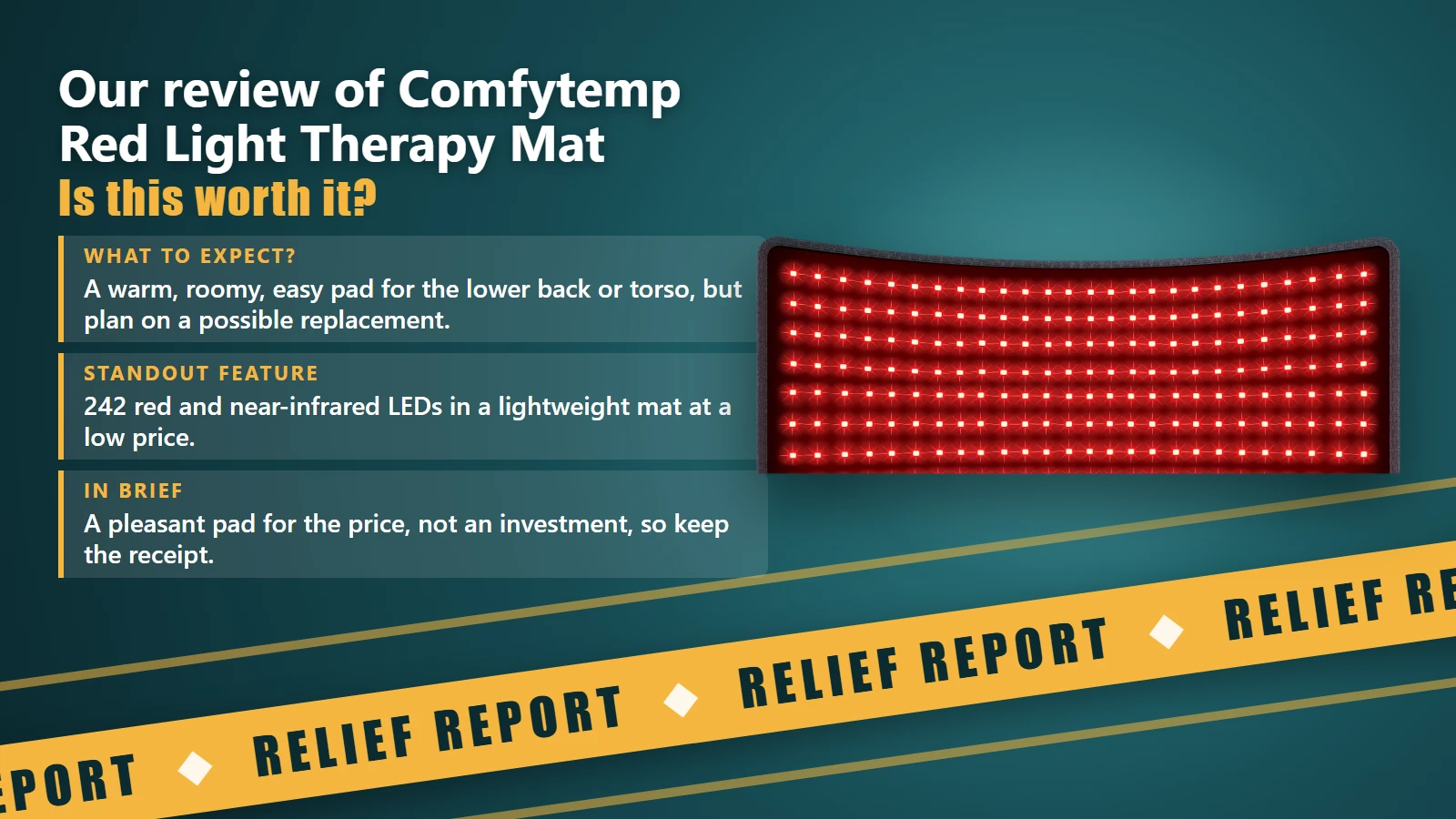
| Comfytemp 24" x 12" mat | Budget, $80.99 | Flat mat, 242 LEDs, plug-in | Price, warmth, size |
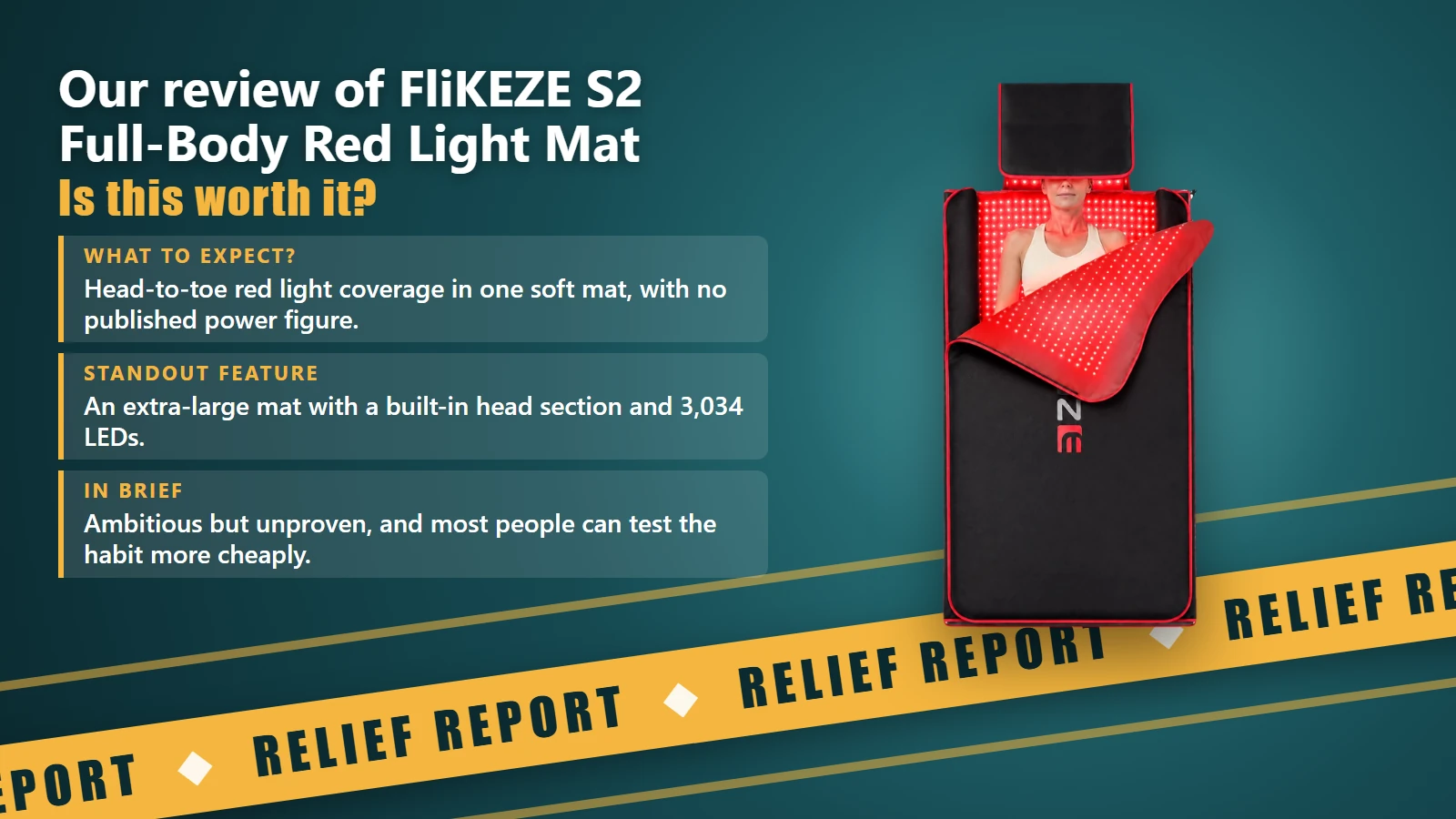
| FliKEZE S2 mat | Premium, $899.99 | Full-body mat with head hood | Size and soft feel, one client |
| Flexbeam | Not reported | Warms the skin, covers large muscles | Warmth and wide coverage, per one member |
| Solio Alfa+ | Not reported | Heat up to 44°C, handheld glide | Better for meaty areas, per a member |
| Prungo | Not reported | Claims 50-100 mW/cm², 660 and 850 nm | Higher claimed output |
| Product | What users disliked | Best for |
|---|---|---|
| Kineon Move+ | Strap slips, modules can fail | Knee and ankle targeting |
| Comfytemp 24" x 12" mat | Lights failed for several clients | A cheap test run |
| FliKEZE S2 mat | Price, thin evidence | Head-to-toe floor use |
| Flexbeam | Details not reported | Big muscle groups |
| Solio Alfa+ | Must be held and moved by hand | Back and abdomen |
| Prungo | Claimed figures not verified | Output-minded buyers |
If you want to test whether red light suits you without straps, what our clients found with the Comfytemp Red Light Therapy Mat shows a flat pad at $80.99, though 3 of 6 clients in that review saw lights fail. For whole-body coverage on the floor, the FliKEZE S2 Full Body Red Light Mat costs $899.99 and has thin evidence behind it.
For a panel, Joovv is one name members mention, and members say it and Hooga offer only 660 nm and 850 nm. Members also warn that makers inflate power numbers, and one comparison lists this wrap at 5 to 25 mW/cm² against a rival's claimed 50 to 100, so I'd trust measured output over brand names.
Is $499 Worth It, and What Does the Extra Money Buy?
Members mention paying about $300 on a flash sale and $450 with a discount code, so the $499 list price is not the only number out there. On top of that, the extender is $50, so a shoulder or back buyer is closer to $549.
What the money buys is solid metal modules, one-button sync, a magnetic dock and a travel case that charges with the zipper closed. It does not buy a strap that stays put, and a member who measured a generic wrap at about 10 mW/cm² still reported knee relief from it, so a higher price does not guarantee a better result.
If the Wrap Doesn't Suit You
- You want warmth and big muscles: a member returned the wrap for Flexbeam because it gets warm and covers large areas.
- You want a back or abdomen tool: a member says Solio Alfa+ suits meatier areas, but you hold and glide it yourself.
- You want pressure instead of light: our Kineon Relief+ Trigger Point Massager findings cover a $99.00 manual tool with no battery to charge.
What Should You Look for When Buying a Red Light Therapy Device?
These factors come from what went wrong for our clients and what members say matters.
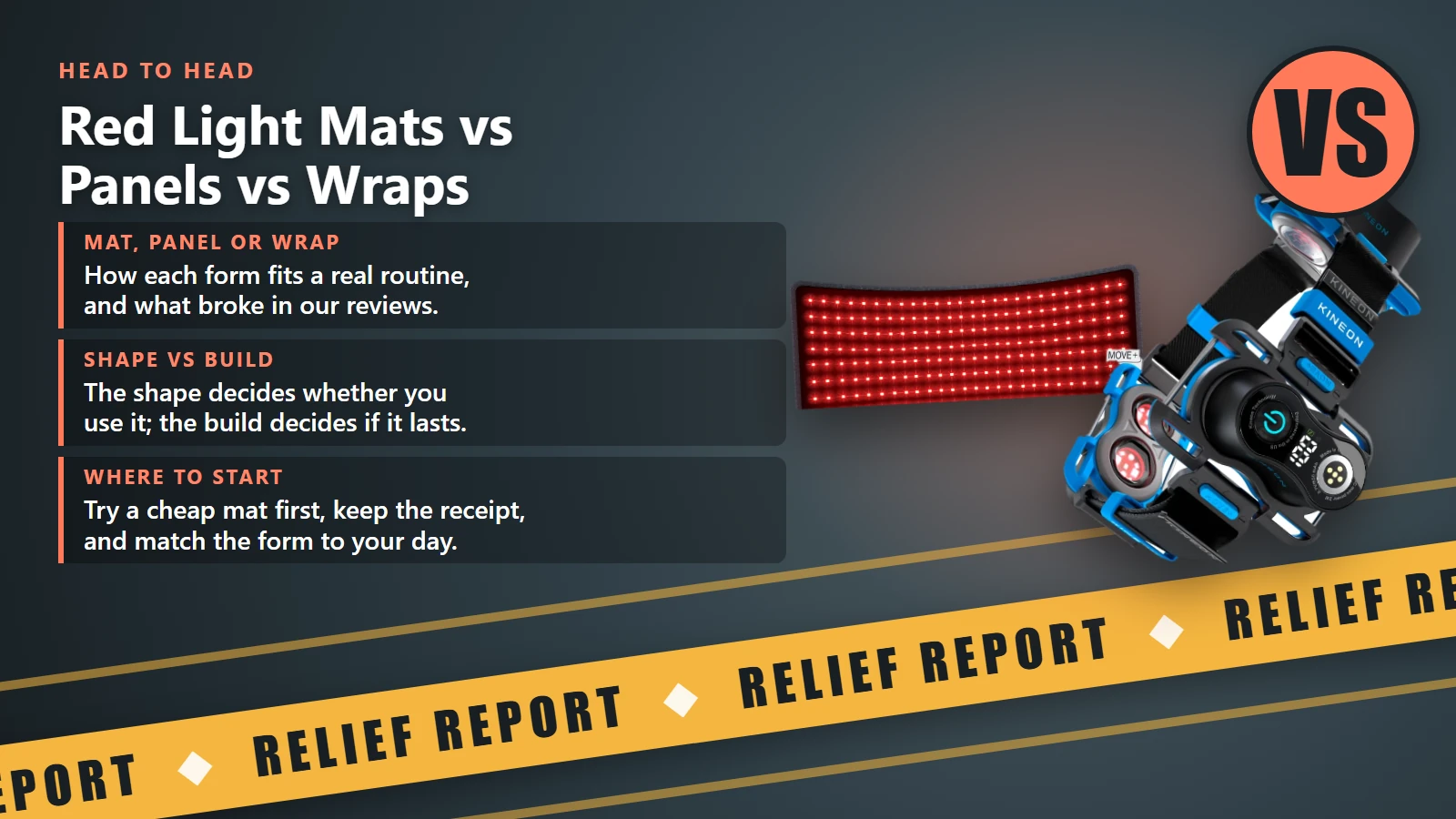
- Form factor: wearable wraps let members stay consistent while working or walking, while panels need dedicated standing time and mats need a spot to lie.
- Light source: members say near-infrared lasers around 808 nm reach about 5 to 6 mm, while red LEDs reach only 1 to 2 mm of skin.
- Real output: members warn that cheap brands inflate (irradiance - how strong the light is where it meets your skin, in mW/cm²) using solar meters, and this listing shows none.
- Strap and fit: measure the joint first, because the strap was the top complaint here and clip breaks left some members without spare parts.
- Battery and sync: for wraps, members say dock durability, battery life and module sync are the usual failure points.
- Support and returns: members want a clear trial period and replacement parts, because some returns here took weeks.
- Separate red and near-infrared controls: members prone to melasma want to turn near-infrared off, and this wrap does not list that.
Members who stayed happiest matched the form to their real routine, not an imagined one. If you only need to find out whether a mat format suits you, a flat pad is a cheaper first step.
How Do You Use It Safely and Get the Most From It?
The brand suggests 10 to 15 minutes per area daily, and the listing says to stay still and relaxed and use it for external use only. Members add that more is not better, so start at the low end and take about one rest day a week.
Keep the modules away from your eyes, and close them or wear blackout goggles if you use it near the face. If you take photosensitizing medication or have a light-sensitive skin condition, talk to your doctor before you start.
Members report near-infrared flaring pigment patches in some skin types after only a few sessions, so stop if you see unusual redness or dark spots. Poorly made infrared devices have caused skin burns for some members, and anyone with reduced feeling in the skin should be careful with any direct-contact device.
The listing states no precautions beyond external use, so ask a clinician before using it if you are pregnant, healing from surgery or managing a medical condition. This is a comfort tool, and none of the stories here are a promise that it will fix a joint problem.
Questions People Ask About This Wrap
Can you use it on a shoulder or lower back?
Not well out of the box. Clients say the included strap fits knees, ankles, wrists, necks and upper arms but will not stretch over a shoulder, so a $50 extender is sold separately for back and torso use, and one group member gave up on the shoulder after trying it over a sweater.
What charger does it need?
The box has a USB-C cable and no power block. The manual warns against "fast chargers" without defining them and names a specific certified 5V adapter, so ask support for exact limits before using a spare brick, as one reviewer who held off charging did.
Is it safe for my eyes and skin?
Keep the modules away from your eyes, and close them or wear goggles if you use it near your face. Members report near-infrared light flaring melasma after 3 to 4 sessions in some skin types, and anyone on photosensitizing medication or with light-sensitive skin should check with a doctor first.
What happens if a module stops working?
One of our 3 clients lost a module within about two months. Two reviewers and one buyer praised quick, helpful support, while one reviewer describes slow or no replies, and one client noted a 30-day warranty window, so test every module in the first week and keep the receipt.
How long and how often should a session run?
The brand suggests 10 to 15 minutes per area daily. One reviewer ran 15 minutes twice a day on a bicep and elbow, while members advise taking about one rest day a week because more light is not better, so start at the low end.
Is it good for travel?
Yes, that is its best-liked trait. The kit packs into a small semi-hard case that doubles as the charger, weighs about 1.74 pounds, and charges with the case zipped, though airline rules for lithium batteries are not something I have data on.
Is it loud?
I have one report on noise, and it is about the beep. A buyer with muscle spasms found it loud and jarring when trying to relax, and no one else mentioned sound, so I'd call the modules quiet and the beep the only catch.
Verdict: Should You Buy the Move+?
This Kineon Move+ red light therapy wrap review comes down to well-built modules with an unreliable strap and a $499 price. Buy it if you have a specific knee, ankle or wrist problem, already tolerate red light well, and will buy the extender and work out the strap.
Skip it if you want shoulder or back coverage out of the box, need results within a month, or hate managing rechargeable modules. For most beginners, spending less to test whether red light suits you is the smarter move.
The evidence is limited: no member has posted about this exact listing, six buyer reviews are on file, and the 3 client reviews lean critical. If you still want it, you can check the current price of the Kineon Move+ wrap.
(If you buy through this link we may earn a small commission. It doesn't change what our clients and group members reported.)