

Key Takeaways
- Three of six clients who tried an $80.99 red light mat saw the lights fail, so keep the receipt and use a budget mat as a trial run.
- Panels hit harder, at 60 to 100+ mW/cm² in member talk, but only if you will really sit or stand still for 5 to 20 minutes.
- A wrap covers one joint and lets you keep moving, and the short strap was the top complaint, so measure before you buy.
- Members who own both a mat and a panel say the mat comforts while the panel does more for deep aches.
- Near-infrared light can darken skin patches for some people, so keep it off a patch-prone face and protect your eyes with any panel.
Three of six clients who tried an $80.99 red light mat saw the lights fail. That number tells you the real story of at-home red light: the shape of the device decides whether you use it, and the build decides whether it lasts.
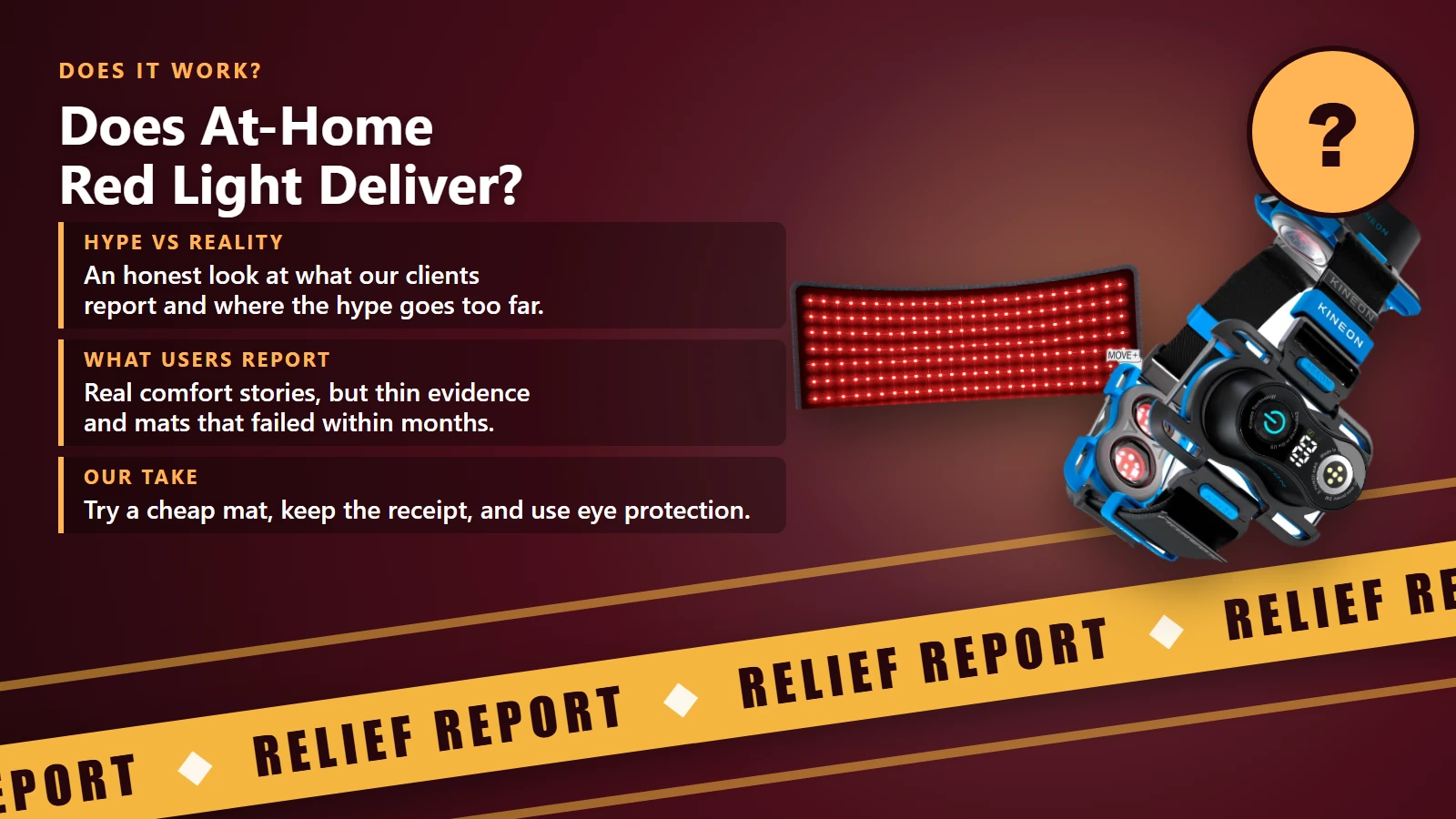
This guide pulls together what our clients reported across four red light reviews and what members of our Facebook group posted over months of real use. For broader background, see our look at whether at-home red light therapy lives up to the hype.
I am not going to push you toward one form. I will tell you what broke, what felt good, and what people still used after the first week.
Why Does the Shape Matter So Much?
Members of our Facebook group debate form more than any other feature. A device that fits your day gets used, and one that does not collects dust.
Panels deliver strong light, called irradiance (how much light energy reaches your skin, measured in mW/cm²), at 6 to 24 inches away. You sit or stand in front of one, so you need a clear spot and 5 to 20 minutes where you are not doing much else.
Mats sit flush against your skin, and you lie down on them. Some people find that relaxing and others find it boring.
The trade-off is lower power, around 25 to 30 mW/cm² in member talk, though direct contact means less light bounces off. Wraps strap onto one joint, so you can walk around in one, but the coverage is small and the straps can be a problem.
Members who stayed happiest matched the form to their real routine, not an imagined one.
Mats: Is Lying Down Worth the Lower Power?
Mats are the lie-down option. You place one on a bed or floor, lie on top, and let the light reach your back, legs or torso.
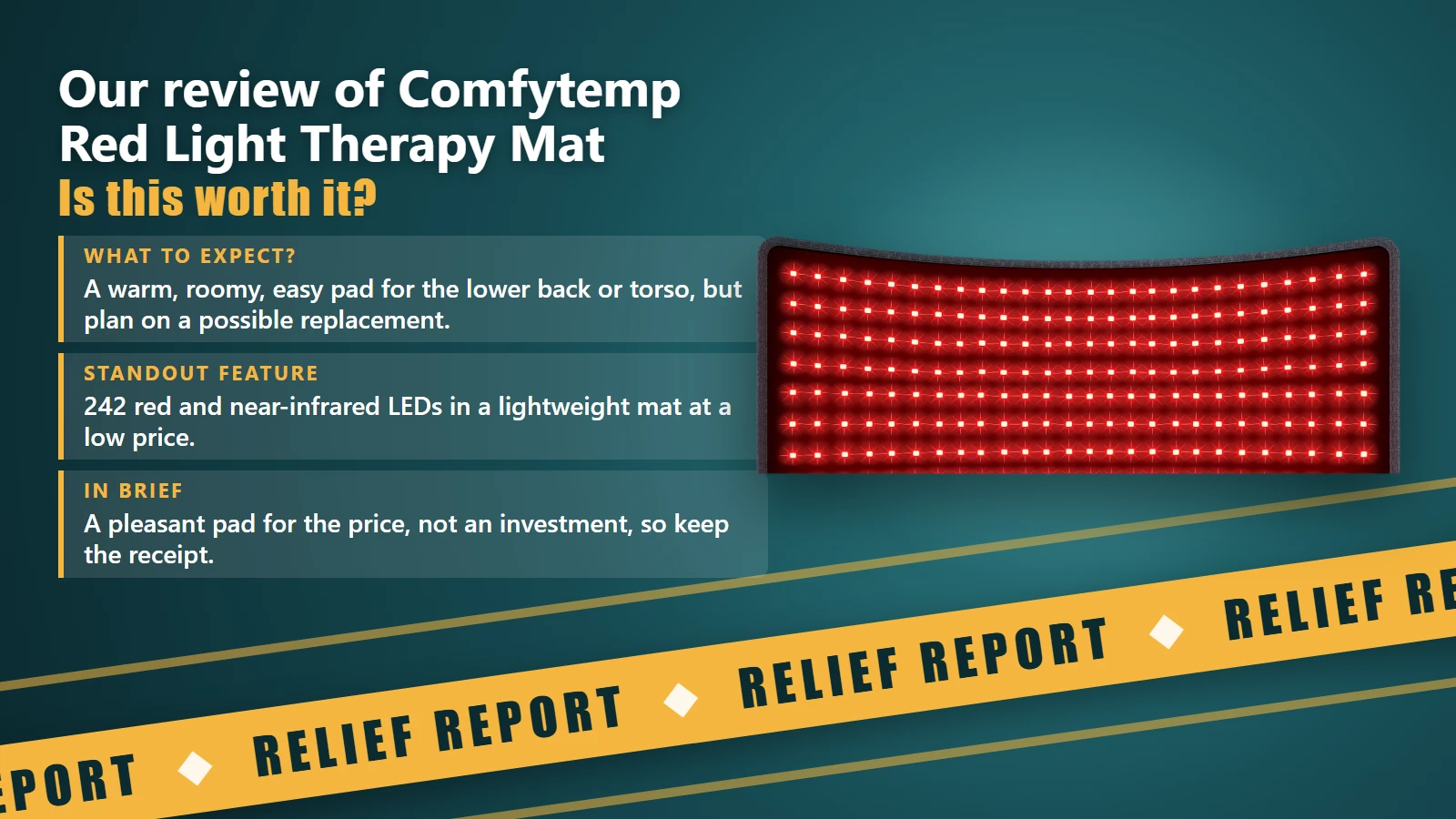
Our cheapest mat review looked at the Comfytemp Red Light Therapy Mat at $80.99. It is a 24-by-12-inch pad with 242 LEDs that warms up fast and feels roomy across the back.
The downside is durability: 3 of 6 clients and 8 of 16 buyers described lights or wiring giving out, some within a few uses and others by about 6 months. The pad ships folded, and the creases are the trap.
One client needed the light over the left hip and low back, but the creases stuck straight up and would not lie flat even after two sessions. It also smelled strongly of chemicals at first, which mattered for a client with multiple chemical sensitivity.
Members blame bending for broken wiring in mats like this, because folds stress the thin wires inside. They say flexible mats do best laid flat on something firm, not creased or pressed into a soft mattress.
One reviewer who trains first thing in the morning reported that the first session blistered the skin on the back, though it cooled down after that. A buyer said that after a year the LEDs shifted and heated the black material so much that the pad was unusable after 10 minutes.
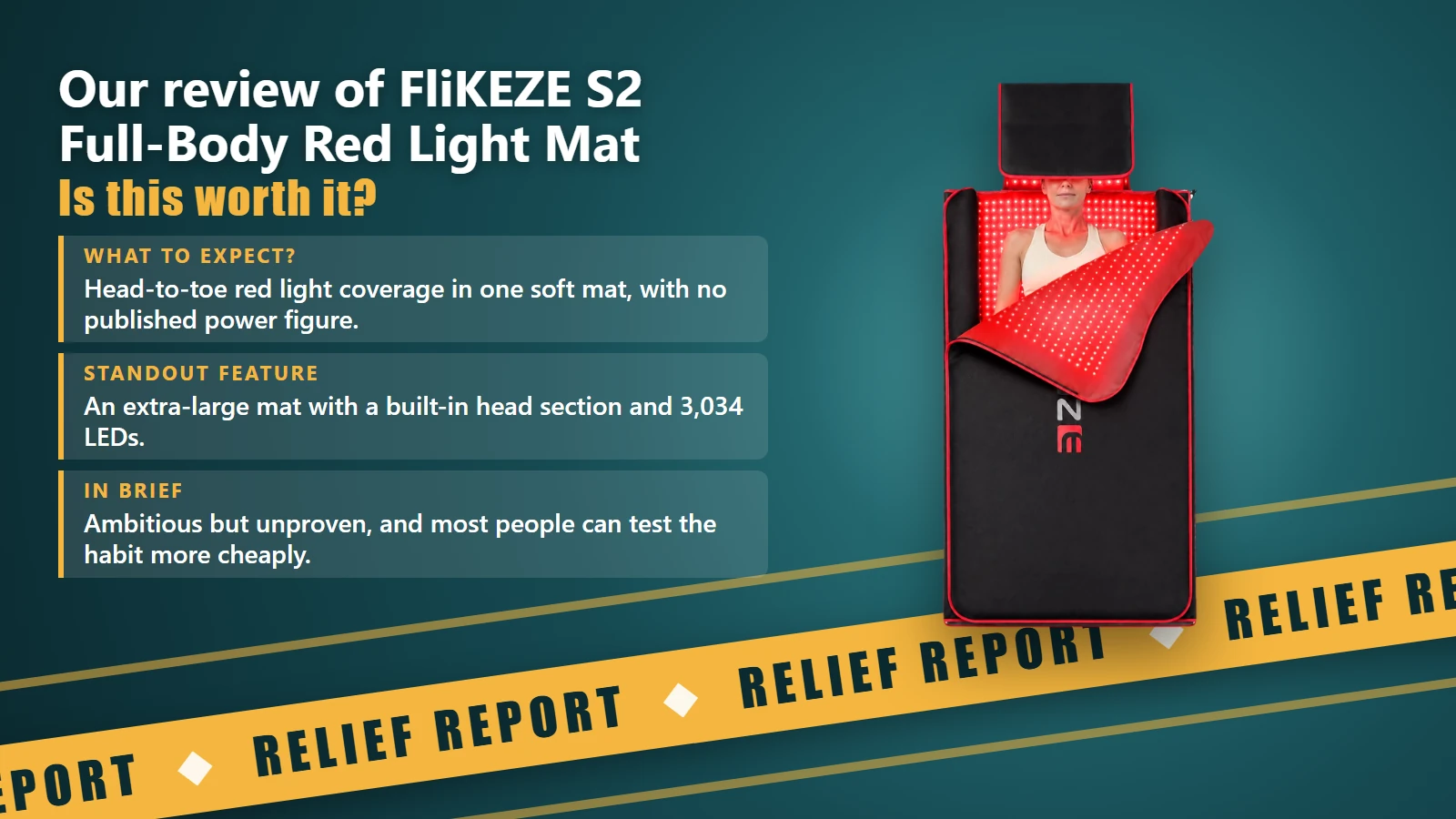
At the other end of the mat market, our full write-up on the $899.99 full-body mat covers the FliKEZE S2. It has 3,034 LEDs and a built-in head section, with two wired controllers so you can run the head and body separately.
The one client who tried it likes the full-body coverage and the soft material. The problem is evidence: there is no published power figure, and the 4.8-star rating rests on 27 ratings and one readable review.
Members put full-body mats at $1,000 or more, so the S2 sits at the lower edge of that tier. We have no evidence the S2 fails like cheaper mats, and none that it avoids it.
In the middle, the Miceylive Full Body Red Light Therapy Mat at $339.99 offers 73 by 33 inches of coverage. Everyone who tried it gave it 5 out of 5, but there is no warranty information, no published light strength and only two buyer reviews.
An 81-year-old client has a family member carry the roughly 8-pound mat to the bed, then slides it into place instead of lifting it. The same client tried near-infrared (light you cannot see but may feel as warmth, which members say reaches deeper than visible red) by tapping the remote until the visible lights vanished.
That first night ran 40 minutes, and the usual routine is one 30-minute session at night. The client also rigged a Velcro strap from an old mat to a headboard to make a slight tent over the upper body for extra coverage.
A member who owned both a mat and a panel said the mat comforted back aches but the relief wore off within hours, while the panel did more. Mats are for comfort, relaxation and sleep, not deep aches. The listing says "medical-grade," but that is the seller's wording with nothing independent behind it.
Panels: Is Standing Worth the Extra Power?
Panels are the stand-up option. You mount one on a stand or hang it on a door, then sit or stand 6 to 24 inches away.
High-output panels deliver 60 to 100+ mW/cm² at that distance. Sessions run 5 to 10 minutes for facial skin or 15 to 20 minutes per side for full-body muscle soreness.
The upside is power and coverage, since a large panel can reach your whole back or both legs at once. The downside is that you have to sit or stand still, and members say that gets boring fast.
Several buyers let expensive panels collect dust for exactly this reason. It is a common regret in our group.
Panels need heatsinks (metal parts that pull heat away from the LEDs so they do not wear out) and internal cooling fans. Mats cannot support fans, which limits their total power, and that is why panels hit harder.
Members warn that many cheap brands report inflated power by using a solar meter instead of a calibrated spectrometer (a lab tool that measures light output precisely). Some claim 800W but draw only 200W from the wall.
If a panel does not publish a tested power figure, read the number on the box with caution. Eye protection matters too, because members report severe glare, halos, temporary green vision and floaters from bright panels used without good goggles.
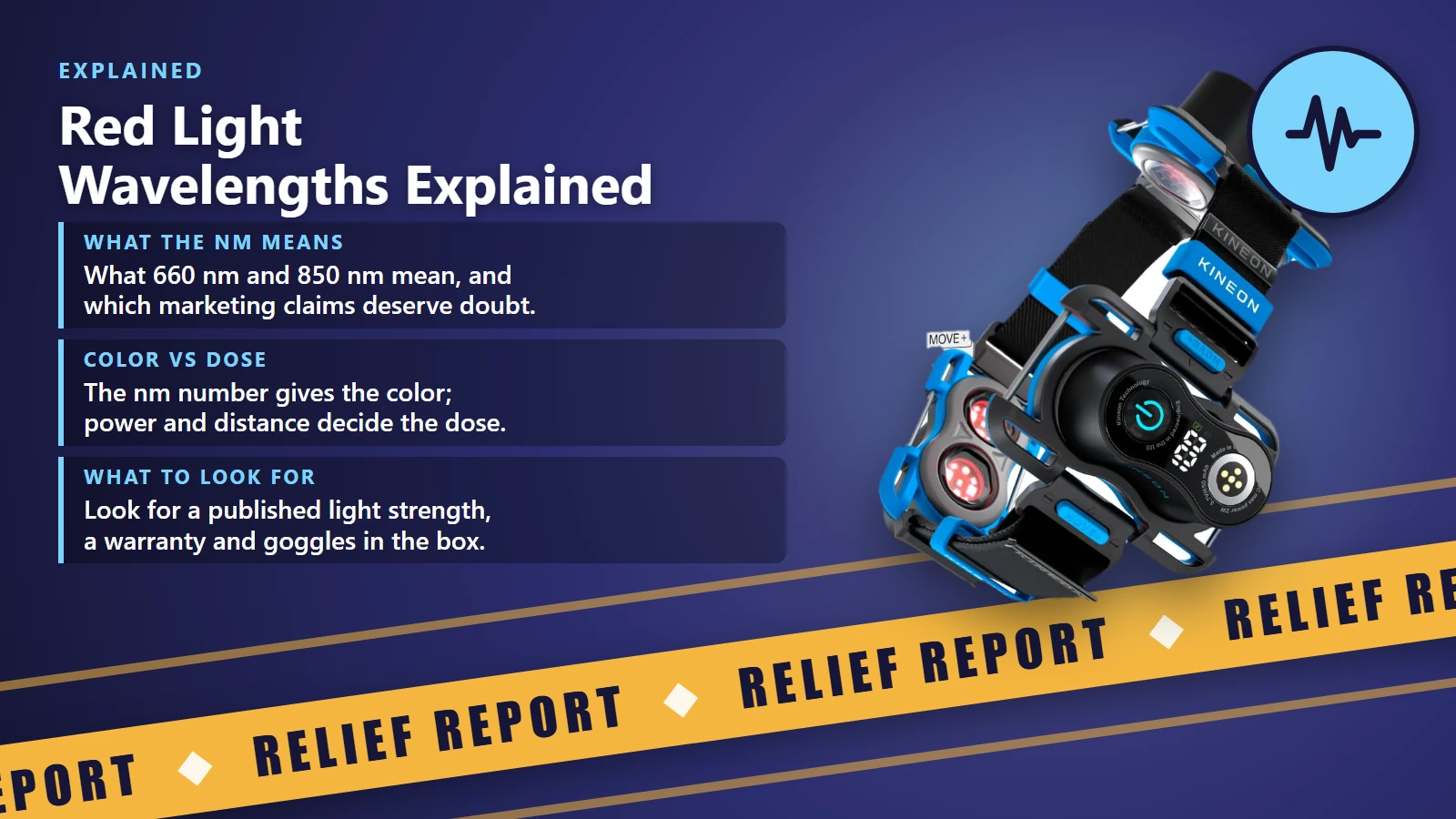
Keep the light away from your eyes, and wear proper eye protection if you use a panel near your face. For a deeper look at the light colors themselves, our guide on 660nm, 850nm and the marketing around them breaks down what each one does and what is just packaging.
Wraps: Can You Target One Joint Without the Hassle?
Wraps strap onto a joint. You get three or so small LED modules on a band, and you position them over a knee, ankle, wrist or elbow.
The big advantage is movement, because you can walk, work or cook while wearing one. Our wrap review covers the Kineon Move+ Red Light Therapy Wrap at $499.00.
It has three LED modules that use 660 nm (nanometers, the unit that measures the length of a light wave, which sets the color) red light and 808 nm near-infrared. The modules are solid and well built.
The strap is the problem. One of three clients and several reviewers said the short strap and slipping buckle were the top complaint.
One client had to jerry-rig the strap into place every time, and a module died at 6 weeks for another. Yet a different client is a year in and bought a second one, so durability is mixed.
At $499, this wrap makes sense only if you already know red light suits your knee or ankle. If you are just testing the idea, a cheap mat is the smarter first purchase.
The brand suggests 10 to 15 minutes per area daily, and members advise about one rest day a week because more light is not better. Shoulders and back need a $50 extender that does not come in the box, so hold a tape measure to the joint before you buy.
Which Form Fits Your Day?
The table below sets the main forms side by side, using what our clients and members reported.
| Type | Coverage | Convenience |
|---|---|---|
| Small mat (Comfytemp) | Back or torso while you lie on it | Lie down 15 to 30 minutes; warms fast |
| Full-body mat | Head to toe, 73 by 33 inches (Miceylive) | Lie down; the Miceylive weighs about 8 pounds |
| Panel | Whole back or both legs from 6 to 24 inches | Needs a clear spot and 5 to 20 still minutes |
| Wrap (Kineon Move+) | One joint such as a knee, ankle or wrist | Wear it while you walk; 10 to 15 minutes |
| Type | Common problem | Best for |
|---|---|---|
| Small mat (Comfytemp) | Lights or wiring failing; creases from folding | A cheap trial run |
| Full-body mat | Heavy to move; thin evidence on strength | Long lie-down sessions at night |
| Panel | Inflated power claims; eye glare; dust collecting | Short, high-power sessions |
| Wrap (Kineon Move+) | Short strap slips; shoulders need a $50 extender | One sore joint, staying active |
Here is how I would match them to real routines. If you already lie on the floor to stretch after lifting, a mat fits.
The one client who tried the FliKEZE S2 said the full-body coverage felt convenient and the soft material made them look forward to using it. Mats suit people who want to unwind at night while the light runs.
If you want quick, high-power sessions and do not mind standing, a panel fits. Panel users often listen to podcasts or do light stretches while the light runs, and morning sessions after waking are popular for mood and wakefulness.
If you have one sore joint and want to keep moving, a wrap fits, as long as you accept the strap hassle. Members say wraps help them stay consistent while working or walking.
One client bought the Comfytemp with leftover HSA funds to add red light to a routine while traveling for work. It was easy to set up and light enough to pack.
After a couple of months of a few sessions a week, that client could not say yet how much it helps with aches, but had no recent flare-ups and nothing felt worse. That is a reasonable expectation for a budget mat.
What Should You Check Before You Buy?
Check the power figure. If the listing publishes no irradiance number, you are guessing at the dose, and neither the FliKEZE S2 nor the Kineon Move+ publishes one.
Check the warranty. The Miceylive listing states none, and we only have a few months of experience with it.
Flexible mats are prone to solder fatigue (tiny cracks in the metal joints inside the wiring, which grow worse when the mat is bent). A longer warranty therefore matters more than LED count.
Check the weight. The Miceylive mat weighs about 8 pounds, and an 81-year-old client needs help carrying it. If you cannot lift or slide the device into place, you will not use it.
Check for separate red and near-infrared switches. Members prone to melasma (dark patches on the skin, often darkened by heat and light) say the warmth of near-infrared can flare those patches, so being able to run red alone matters for sensitive facial skin.
Check the strap length if you are buying a wrap. The Kineon Move+ strap was the top complaint, and shoulders and back need a $50 extender.
Skip underpowered knockoffs. Members who spent $50 to $100 on generic wands or small bulbs reported negligible results and endless repositioning.
Questions People Ask
Can I use a mat and a panel together?
Yes, and some members do. A member who owned both said the mat comforted back aches while the panel did more for deeper ones, so using both lets each form cover a different goal instead of forcing one device to do everything.
How long before I notice anything?
Most members run sessions 3 to 5 times a week. One client who used the Comfytemp for a couple of months could not point to a specific change yet, but had no recent flare-ups, so give any device several weeks, start at the low end of the session time, and build up slowly.
Is near-infrared safe for my face?
Members report near-infrared light darkening melasma patches after 3 to 4 sessions in some skin types. Anyone on photosensitizing medication (medicine that makes skin react more to light) or with light-sensitive skin should check with a doctor first, and a panel with a separate red-only switch gives you more control.
Do mats really fail that often?
In our reviews, 3 of 6 clients who tried the Comfytemp saw lights fail. Our category notes list flexible mats shorting out, losing rows of lights or failing at the cord within days to months as a common regret, and laying the mat flat on a firm surface gives it the best chance.
Bottom Line: What To Do Next
If you want to try red light without spending much, start with a cheap mat like the Comfytemp at $80.99. Use it for a few weeks to find out whether you will actually lie down on a mat regularly, and keep the receipt.
If you want deeper power and do not mind standing, look at panels in the $300 to $550 range. Make sure you have a spot to stand or sit, and buy good goggles.
Skip a panel if you cannot spare 10 to 20 quiet minutes a day. If you have one sore knee or ankle and want to keep moving, the Kineon Move+ at $499 works if you accept the strap and measure your joint first.
Whatever you choose, start with short sessions, build up slowly, and stop if anything feels wrong. More light is not better, and the device you use three times a week beats the one you never take out of the box.