

Key Takeaways
- The lowest setting matters as much as the top one: two reviewers found even a 50 mmHg minimum too much, and one felt it painfully around the ankles and the top of the foot.
- Members mostly run 70 to 120 mmHg for regular sessions, even though boots advertise ceilings of 150 mmHg or more.
- Begin at the lowest level for about 15 minutes and step up over several sessions, because most people adapt after a few tries.
- Members prefer a squeeze that moves up the leg in order, foot first, over boots that inflate everything at once like a balloon.
- Sudden one-sided calf swelling, pain or shortness of breath needs urgent medical attention before you use any compression device.
One of our clients who tried the Quinear Air Compression Boots had a blunt warning: do not go full blast on day one, or you may be rushing to get the boots off. That client is not alone.
In our Facebook group, members report that pressure set too high causes pain, nausea, tingling or pinching, and the advice from clients and members alike is to begin low.
This guide pulls together what our clients and group members have learned about compression boot pressure across our product reviews. You will find out what mmHg means, what settings people actually use, why cranking it up is usually a mistake, and how to spot the signs that tell you to turn it down.
The numbers here come from brand listings and from people who tried these boots and told us what happened.
What Does mmHg Actually Mean?
mmHg (the pressure unit, the same one as a blood pressure cuff) is how compression boots measure squeeze strength. A blood pressure cuff tightens around your arm to a certain mmHg reading, and these boots do the same thing around your leg, so the higher the number, the harder the squeeze.
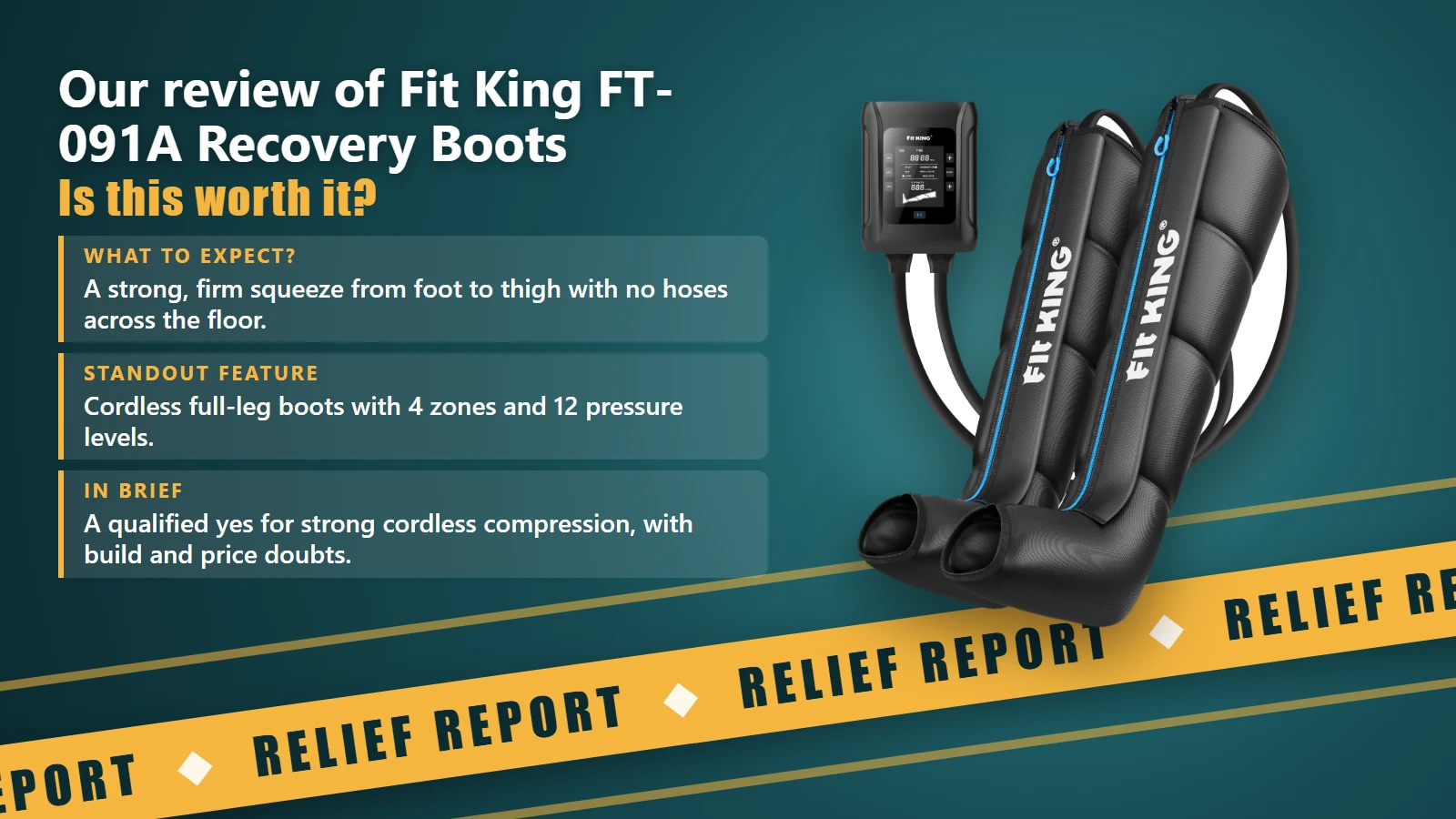
Most boots in our reviews range from about 50 to 150 mmHg. The Fit King FT-091A runs 40 to 150 mmHg across 12 levels, and our full write-up of those recovery boots has the details.
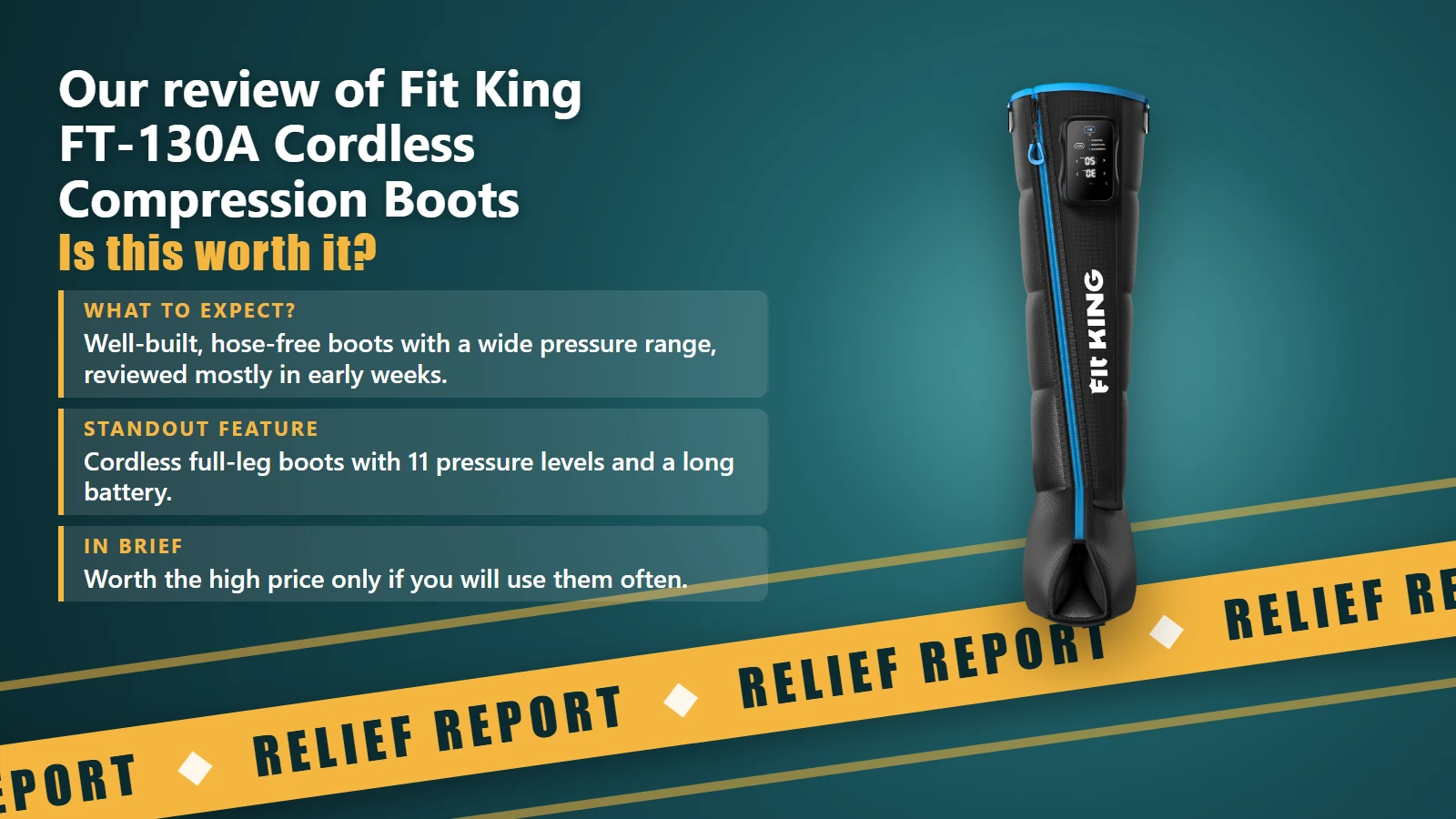
The Fit King FT-130A starts at 50 and tops out at 150 in 11 steps, while the Quinear Air Compression Boots use three levels listed as 60, 90 and 140 mmHg.
Some budget sets do not show a number at all. The Quinear QN-072A uses three strengths with no mmHg figure printed, so you rely on feel, and our review of that full-leg compression set covers what that is like in practice.
Standard compression sleeves you wear during the day run much lower, around 10 to 25 mmHg. Recovery boots are a different tool: a short, firm session while you sit still, not something you walk around in.
What Pressure Range Do Members Actually Use?
Here is where the marketing and the real-world numbers part ways. Boots advertise ceilings of 150 or even 200 mmHg, but members of our Facebook group mostly run 70 to 120 mmHg for standard sessions.
The strength coach in our group runs 80 to 100 mmHg for 45 minutes after heavy leg days. A client found 80 a bit strong on the FT-130A, whose own default is 50 mmHg.
One reviewer never went above 80, while a marathon trainee in our group sits at level 7 most days. The pattern is that people who use these regularly settle in the middle, not at the top.
Members use higher settings right after long runs or heavy training, and lower ones once soreness has already set in or for circulation concerns. The setting should match the day, not just the person.
The lowest setting matters as much as the highest. Two reviewers who tried a Quinear system with a 50 mmHg minimum said even that was too much, and some members returned boots whose lowest level felt like a vice.
If the floor is too high, you never get a gentle start. The table below sums up the ranges members use, drawn from our reviews and group posts.
| Goal | Typical setting | Session length | Watch out for |
|---|---|---|---|
| First session | The lowest setting your boots offer | 15 minutes | A lowest level that already feels like a vice |
| Standard recovery | 70 to 120 mmHg | 15 to 30 minutes | Pain, tingling, nausea or pinching |
| After heavy training | 80 to 100 mmHg | 45 to 60 minutes, rarely 90 | Deep skin marks; legs falling asleep |
| General upkeep | A comfortable middle setting | 15 to 30 minutes, 2 to 3 times a week | Chasing the top number on the box |
| Medical condition or sensitive legs | Set with your clinician | Ask your clinician | Bruising; one-sided calf swelling needs urgent care |
If you are buying your first pair, look for a set that starts low. Our review of the Fit King FT-130A cordless boots covers a 50 mmHg start with 11 steps up to 150, and members say you can step up over a few sessions.
Why Max Pressure Is Rarely the Answer
A member of our Facebook group who knows lymphedema pumps (medical devices that squeeze a swollen limb to move fluid along) warned that more pressure is not better. That member pointed out that recovery boots run 50 to 150 mmHg, while a clinical lymphedema pump operates at 20 to 90 mmHg.
Members say higher numbers do not buy faster recovery, and too much pressure caused pain, tingling and numbness for some.
Reviewers of the Fit King FT-091A called the max setting "almost scary" and the top level "somewhat painful." A client who tried the Quinear Air Compression Boots said the strongest setting was uncomfortable and a bit painful, and the middle one was a bit aggressive.
A marathoner who reviewed those boots warned that on high pressure your legs can fall asleep for a while, so do not stand up mid-session. Pain is not the same as productive pressure.
The Fit King FT-115A has a 150 mmHg ceiling, but the happiest clients praised the zone control and the screen, not the max pressure. A member likened the boots to foam rolling, where the payoff comes from regular use, and what our clients found on that model fits the same pattern.
Start at the bottom of the range, try a 15-minute session, and step up only if it feels comfortable. Members say most people adapt over a few sessions, so what feels tight on day one may feel more manageable later.
Sequential Squeezing vs Whole-Leg Balloon
Not all boots squeeze the same way. Sequential compression (chambers, or air pockets, that squeeze one after another, feet first, so the squeeze moves up the leg) is what members strongly prefer.
The chambers fill from the foot to the calf to the thigh, which members say pushes blood and fluid upward toward the torso. The alternative is whole-leg inflation, where every chamber fills at the same time like a single balloon.
The Fit King FT-091A uses four chambers that the brand says simulate kneading, and the member who owns it describes a wave that builds up the leg. The FT-130A has five chambers, and the Quinear QN-072A has 13 airbags per leg in 4 chambers, filling in sequence from the feet up.
Higher-end models let you switch off specific zones (sections of the boot, such as the foot) or add hold time to certain areas. That matters if you find foot squeezing uncomfortable or need to avoid a sensitive spot.
If a listing does not say whether its modes are sequential, ask before you buy, because one cordless set we reviewed never said. Our guide on whether compression boots actually speed recovery goes deeper on what users feel compared with the evidence.
How Long and How Often Should You Run a Session?
Members of our Facebook group typically run 15 to 30 minutes for standard recovery. After heavy training days, some go 45 to 60 minutes, and a few stretch to 90 minutes.
The most common timing is evening, sitting on the couch or winding down before bed. A reviewer who swims laps used the Quinear QN-072A for about 30 minutes on swim nights, and said the cramps that used to show up later eased off.
A member who loves the Fit King FT-115A taps out around 15 to 20 minutes, because longer feels like overkill. A desk worker with midnight leg cramps ran nightly sessions for a month on the FT-091A and reported no cramps since, which is one member's comfort report, not a promise.
For frequency, members go daily or 4 to 6 times a week during peak training blocks. For general upkeep, they drop to 2 to 3 times a week.
Timers vary by model. The FT-091A offers 10 timer settings from 15 to 60 minutes, and the FT-115A gives the same range, while the QN-072A shuts itself off after 20 minutes.
Starting with the shortest timer is smart, because you can always run another cycle. Members also wear lightweight capris, pajama bottoms or sweatpants inside the sleeves, which prevents deep skin indentations and red marks that take hours to fade.
Signs the Pressure Is Too High
Your body tells you when the setting is wrong, and the signs are consistent across our clients and group members. Tingling and numbness are common signals, and setting pressure too high or running sessions too often can cause nerve tingling or numbness.
Nausea and lightheadedness are another one. Members explain it as pooled blood and fluid shifting back toward the center of the body too quickly, and they advise starting on the lowest setting and drinking water before and after a session.
Deep skin indentations are a sign the pressure is too high or you are using the boots on bare skin. Members report marks and divots that take hours to fade, so if they are deep even through thin pants, drop the setting.
Reviewers called the top settings "almost scary," "somewhat painful," and "torture." A client who was pregnant found level 3 on a full-leg set torture and stayed on level 2 for 40-minute sessions before bed, and anyone pregnant should check with a clinician first.
Members with lipedema (a condition where fat builds up unevenly in the legs and hips) reported massive bruising under the buttocks and thighs from excessive pressure. Anyone with a circulation condition, lipedema or any medical issue should work out settings with their clinician before using compression boots.
Two safety points matter for everyone. Sudden or unexplained one-sided calf swelling, pain, or shortness of breath needs urgent medical evaluation to rule out a blood clot before you use any compression device.
If you have heart failure or a circulation condition, ask a clinician before trying compression boots. For what else goes wrong, see our guide to the top complaints about air compression leg massagers.
Questions People Ask
What mmHg should I start with as a beginner?
Start at the lowest setting your boots offer, for about 15 minutes. That floor is 40 mmHg on the Fit King FT-091A, 50 on the FT-130A and near 55 to 60 on the Quinear Air boots, but two reviewers found even 50 too strong on another Quinear set, so check the lowest level before you buy.
Can I use compression boots every day?
Members do, especially during heavy training blocks. They run daily or 4 to 6 times a week in peak training, and 2 to 3 times a week for upkeep, with sessions of 15 to 30 minutes and longer ones after the hardest days.
Do compression boots replace a massage?
No. Reviewers across multiple products said plainly that compression squeezes and does not knead. If you want hands-on pressure or rolling, look at a massage gun or a shiatsu device, because boots can help sore muscles feel looser but they are a different tool.
Are higher settings better for recovery?
No. Members mostly use 70 to 120 mmHg, and a member who knows clinical pumps warned that more pressure is not better. Too much pressure caused pain, tingling, numbness and nausea for some, so most members stay in the middle of the range.
Bottom Line
If you are buying compression boots for the first time, ignore the max pressure number on the box. What matters is the low end of the range, the number of chambers, and whether the squeeze moves up your leg in sequence.
Start at the lowest setting, run 15 to 20 minutes, and step up only if it feels comfortable. If you train hard several times a week and hate hoses, the cordless FT-130A is the pair the hard trainers in our group use, although a client and a few reviewers could not tell what the premium bought them at home.
If you exercise now and then or just want to unwind after long days on your feet, members found real relief from boots well under $200. Our review of the Quinear Air Compression Boots covers a plug-in option at $169.99.
Measure your inseam and your widest calf before you order, because fit decided the scores on at least one of the sets we reviewed. If you have a medical condition, talk to your doctor first, and if you have sudden one-sided calf swelling or shortness of breath, see a doctor before you use any compression device.