

Key Takeaways
- For one stubborn spot like a glute or upper-back knot, this is a sturdy, battery-free tool; for broad, easy relief, my pick would be a vibrating roller or a massage gun.
- It's a floor-based pressure tool rather than a massager: no motor, no heat, no vibration.
- Best for people willing to learn body positioning, not so good for anyone who wants to lie back and let a motor do the work.
- Lying down on it cold is the classic first-night mistake: Everett compared the feeling to a stack of Legos, and the directions say 10 to 15 seconds per spot.
- A sturdy block for spot work, if the $99.00 price bothers you less than it did 4 of 6 clients.
- If a cheap cork or lacrosse ball already reaches your knots, you're paying mostly for the base and the shape.
Everett, who drives long distances for work and is one of our six clients, said lying on this tool felt like lying on a stack of Legos. Everett also felt no relief and got more from electric shiatsu seat inserts that cost about the same.
That is the tension in this Kineon Relief+ trigger point massager review: a $99.00 silicone block with no motor that 2 of 6 clients praised as sturdy and 4 of 6 called pricey. It suits people who like focused, manual pressure and will learn the positioning, and it does not suit anyone who expects vibration, heat or effortless relaxation.
I have 6 client reviews and 8 buyer reviews to go on, and no group member has posted about this exact tool. My bottom line is a very well-built tool with a real learning curve and a price that most clients questioned.
What Are the Key Specs of the Kineon Relief+?
The Relief+ is a pink silicone mound with four rounded humps of different heights, set in a low black collar. You lean your body weight onto it for (trigger point work - pressing on a tight knot in a muscle for a few seconds), and nothing about it is electric.
| Spec | What it means for you |
|---|---|
| Price | $99.00; no budget or premium label fits manual tools |
| Type | Manual four-hump silicone block on a base; no motor |
| Power | None; no battery, heat, vibration or settings |
| How you use it | Lean body weight onto it; the brand says 10 to 15 seconds per spot |
| Size | 7.28 x 3.15 x 9.92 inches |
| Weight | 1.27 kg (2.8 lb); one client called it heavy |
| Material | "Medical-grade" silicone, brand says; rinses clean, clients say |
| Body areas | Neck, shoulders, back, hips, legs and feet, per the listing |
| Extras | Carry bag; pink top lifts off the black base |
Who Is It Built For, and Who Should Skip It?
The firm shape splits people. These groups got the most from it.
- People who like focused pressure and will take time to learn positioning, which is who the evidence points to.
- Neck-focused users who want a small contact point, since one reviewer called it perfect behind the neck and another said it feels fantastic there.
- Travelers, because it comes with a carry bag and one reviewer said it fits in luggage.
- Anyone who wants a no-battery tool, with nothing to charge and nothing to break electrically.
These readers I would send elsewhere.
- Anyone expecting motion, since it doesn't vibrate, shake or move.
- Budget-minded buyers, because 4 of 6 clients and 4 of 8 buyers questioned the value.
- People who want to relax, as one buyer found it far less relaxing than electronic tools.
- Anyone who is pregnant or has a medical condition, who should ask a professional first, per the listing.
What Happened When Six of Our Clients Tried It?
All 6 client reviews are in the table, and they run from 3 to 5 stars.
| Client | Why they bought it | How they used it | What worked |
|---|---|---|---|
| Everett, who drives long distances | Not reported | Lay on it, aiming at target spots | Very sturdy; you could drive over it |
| Mark, on his feet most of the day | Achy calves after workouts | Set on the floor, moved around it | Heavy, steady; rinses clean; has a bag |
| Dennis, a friend new to strength training | Expected a massager | A few minutes per zone at bedtime | Results after one use; more relaxed |
| Ryan, a client I coach on programming | Tested it against other tools | Compared with balls, rollers, peanuts | More accurate than other tools; built to last |
| Wade, back in the gym after a long break | Rollers couldn't hit tough spots | Eased in over time | Big step up for tension relief |
| My dad, who wanted something simple | Back after long days outside | Nightly, before bed or after golf | More relief than expected; simple |
| Client | What didn't | Their verdict |
|---|---|---|
| Everett, who drives long distances | Felt like Legos; no relief; poor value | 3/5 |
| Mark, on his feet most of the day | Steep price | 3/5 |
| Dennis, a friend new to strength training | Confusing at first; pricey | 4/5 |
| Ryan, a client I coach on programming | Price; would buy other tools first | 4/5 |
| Wade, back in the gym after a long break | Took a minute to learn | 5/5 |
| My dad, who wanted something simple | Not reported | 5/5 |
Everett found it very sturdy, the kind of tool you could drive over, but lying on it felt awkward. It digs in as body weight goes down, getting it onto the right spot meant contorting, and the electric shiatsu seat inserts gave far more relief for the same money.
Mark sets it flat on the floor and moves around it, using it on achy calves after workouts and on back knots, and calls it shockingly heavy in a way that means business. Mark thinks the price is steep but expects it to hold up for the long haul, and likes that it rinses off and comes with a carry bag.
Dennis expected a massager and got a tool that isn't electric in any way, closer to a foam roller for focused spots. It hurts a little in the good-hurt way, a few minutes on the glutes and upper back is enough, and the result after one use was feeling more relaxed at bedtime, though the price puzzled Dennis.
Ryan tested the Relief+ against trigger point balls, lacrosse balls, peanut massagers and foam rollers, and says it gets into places more accurately than any of them. The build is excellent and should last for years, but price is the one big negative and Ryan would buy other tools first.
Wade loves foam rollers and balls, and said those kept moving across the tough spots, while this one holds still on them. It took a minute to work out how to use it and it is more intense than a foam roller, so Wade's advice is to ease into it, and it was a big step up for tension relief.
My dad bought it alongside the Kineon red light wrap and uses it from the lower back up to the neck as a nightly ritual, before bed or after golf. He says it gave more relief than he expected and is straightforward, and he called the price affordable, making him the only client who said the value was there.
Across all 6 client reviews, 4 questioned the price, 2 praised the build, 2 mentioned a learning curve or awkward positioning and 4 described tight spots easing. One client felt nothing at all, so the split is about value and technique more than about whether pressure on a knot does anything.
What Members of Our Facebook Group Reported
No member has posted about this exact Relief+, so the table below uses members' experiences with other manual tools and one post about the Kineon red light wrap, which is a different product. Each row says what the post was really about.
| Member | Device | Experience | Takeaway |
|---|---|---|---|
| A marathon runner | Amazon Basics foam roller (category) | A hamstring knot a massage gun couldn't budge; a $12 roller worked it out, painfully | Slow body-weight pressure can reach what a gun can't |
| A weightlifter and cyclist | Rumble Roller (category) | Bought on sale for $70; bruised legs at first, now used nightly | Knobby tools need a gradual break-in |
| A member with a disc protrusion and sciatica | Massage ball (category) | On a physical therapist's advice, 20 seconds on upper glutes, then 20 harder, twice daily | Said it eased their sciatica; guided by a clinician |
| A member with chronic pain | S-shaped hook cane (category) | 20 minutes cut pain in half; overdoing it later made it much worse | Short holds beat long grinding sessions |
| High-training athletes | Lacrosse balls vs. rollers and guns (category) | A small, dense surface puts more pressure into the muscle | Same logic as the Relief+'s small contact area |
| A member who used it twice daily for 3 weeks | Kineon Move+ (red light wrap, same brand) | Not helpful for them; returning it was difficult; the strap clip was fragile | A different product, so a brand note only |
Clients and members agree that small, dense tools reach spots broad rollers can't, and that going too hard too fast backfires. They split on value, since members' own favorites cost $8 to $70 while this one costs $99.00.
The hook-cane story is the one I repeat to clients: relief during the session, then a flare-up hours later. The same pattern is why the 10 to 15 second advice matters.
How Do the Listing's Claims Match What Users Found?
| What the listing promises | What users actually found |
|---|---|
| Non-slip surface and stable base | Heavy and steady; one client had the top come apart from the base |
| Adjustable pressure by leaning | True, but you set it with body weight, which several found awkward |
| Ergonomic four-hump design | 2 of 6 clients mention a learning curve or awkward positioning |
| Medical-grade, sweat-resistant silicone | 2 of 6 praised the build; clients say it rinses clean |
| Compact and portable | Comes with a carry bag, but 2.8 lb; one client calls it heavy |
| Trigger point relief | 4 of 6 clients felt tight spots ease; 2 clients and 2 buyers felt nothing |
The weak spot in the listing is guidance. Reviewers wanted better instructions, including one who bought it for the neck and found no neck instructions in the box.
Durability, Materials and the Complaints That Keep Coming Up
I went through 6 client reviews and 8 buyer reviews, and the pattern is a tough product with a price problem:
- Build: 2 of 6 clients praised it as sturdy, and none of the 14 reviews reports cracking or tearing.
- Price: 4 of 6 clients and 4 of 8 buyers called it pricey or poor value, while one buyer found it worth the cost.
- Learning curve: 2 of 6 clients struggled with positioning, and one buyer said they couldn't get it into the spots they needed.
- Comfort: one client compared it to lying on Legos and a buyer to a dog toy, while another called it the good kind of hurt.
- Base and top: one reviewer had the top separate from the base during use, and another removes the pink nubs on purpose to use them alone.
- Support: one reviewer said the brand's support team was responsive on technique and best practices.
One client and two buyers felt no relief at all, so this isn't a tool that works for everybody. If lying on hard rubber with your full weight sounds miserable, trust that instinct.
How Does the Relief+ Compare With Other Recovery Tools?
| Product | Price tier | Key difference | What users liked |
|---|---|---|---|
| Kineon Relief+ | $99.00 | Manual four-hump block on a stable base | Sturdy; pinpoint pressure; carry bag |
| Cork or lacrosse ball | Cheap; members cite $8 to $30 | Single dense ball, no base | Concentrates pressure on small spots |
| Rumble Roller | $70 on sale, per a member | Knobby cylinder for big muscles | Does wonders post-workout |
| Renpho Power+ massage gun | $129, mid-range | Motorized percussion, six heads | Quiet and strong |
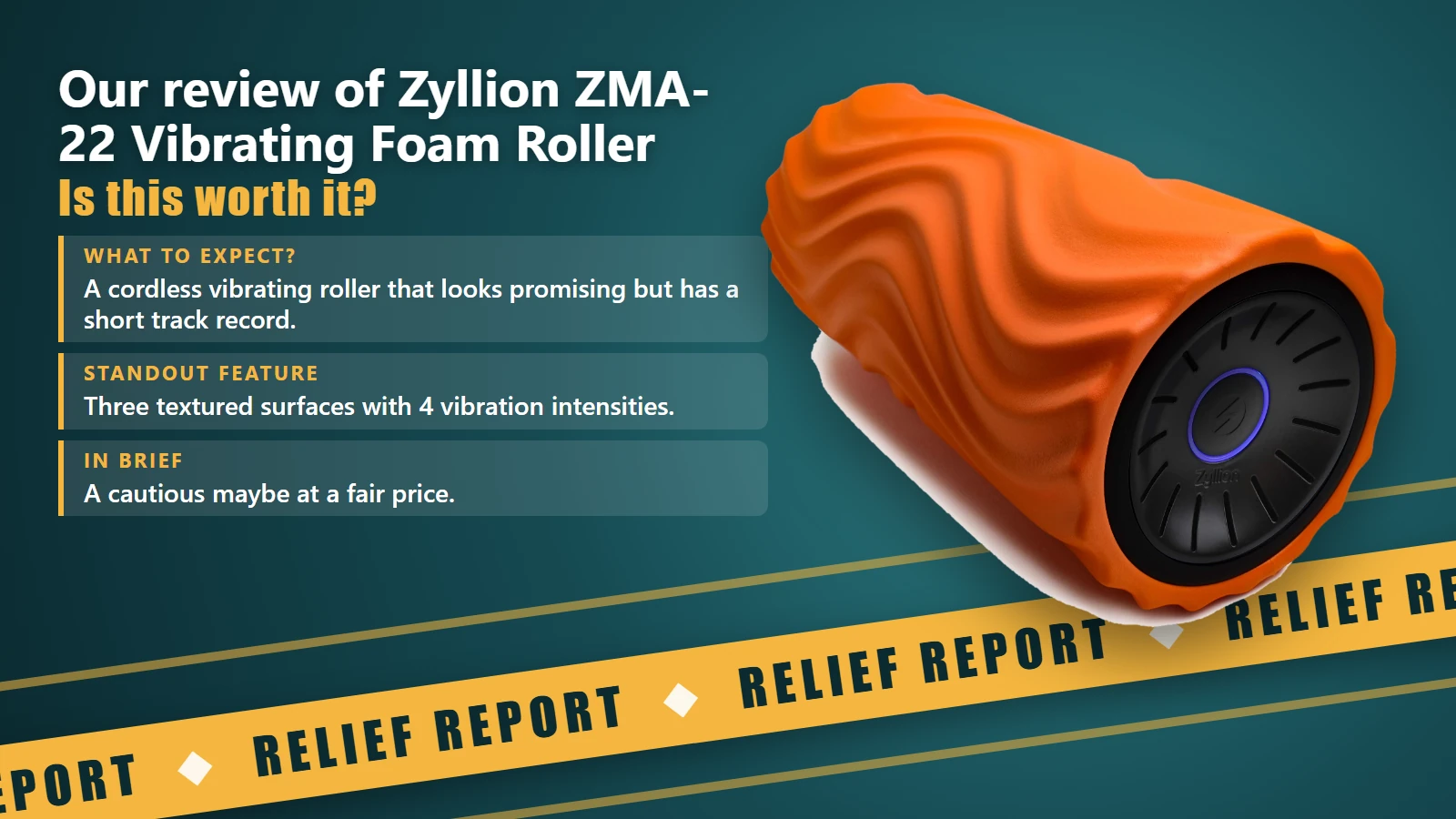
| Zyllion ZMA-22 roller | $99.95 | Vibrating foam roller, 4 speeds | Not reported; very thin data |
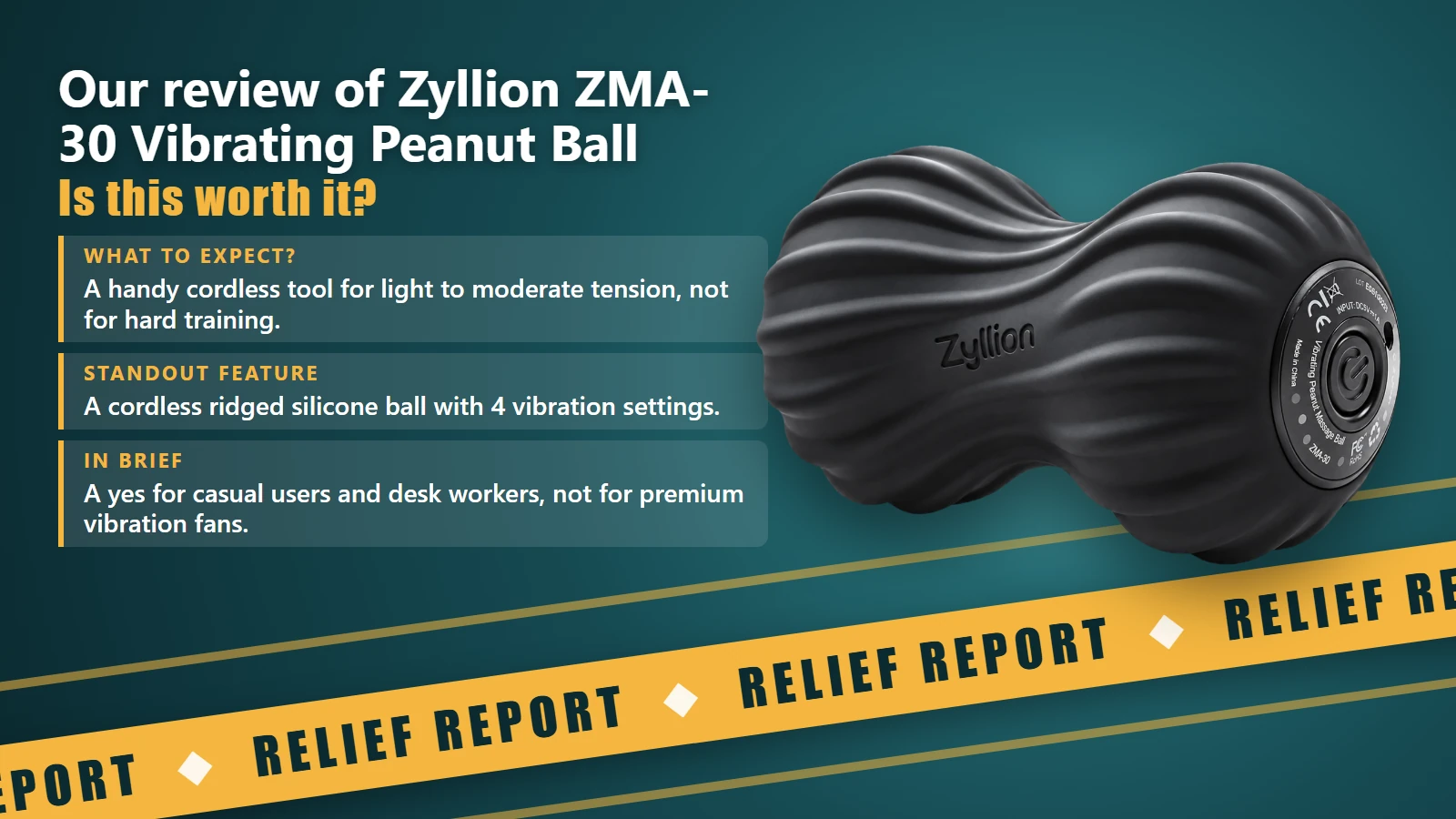
| Zyllion ZMA-30 peanut ball | $59.95 | Vibrating peanut ball, 4 modes | Handy and portable |
| Product | What users disliked | Best for |
|---|---|---|
| Kineon Relief+ | Price; awkward positioning | Holding pressure on one spot |
| Cork or lacrosse ball | Not reported | Budget spot work |
| Rumble Roller | Bruised legs at first | Dense quads and hamstrings |
| Renpho Power+ massage gun | 2 of 7 clients had power or charging failuresHands-off relief from the couch | |
| Zyllion ZMA-22 roller | Not reported | Broad rolling with vibration |
| Zyllion ZMA-30 peanut ball | Too weak for athletes | Cradling the spine area |
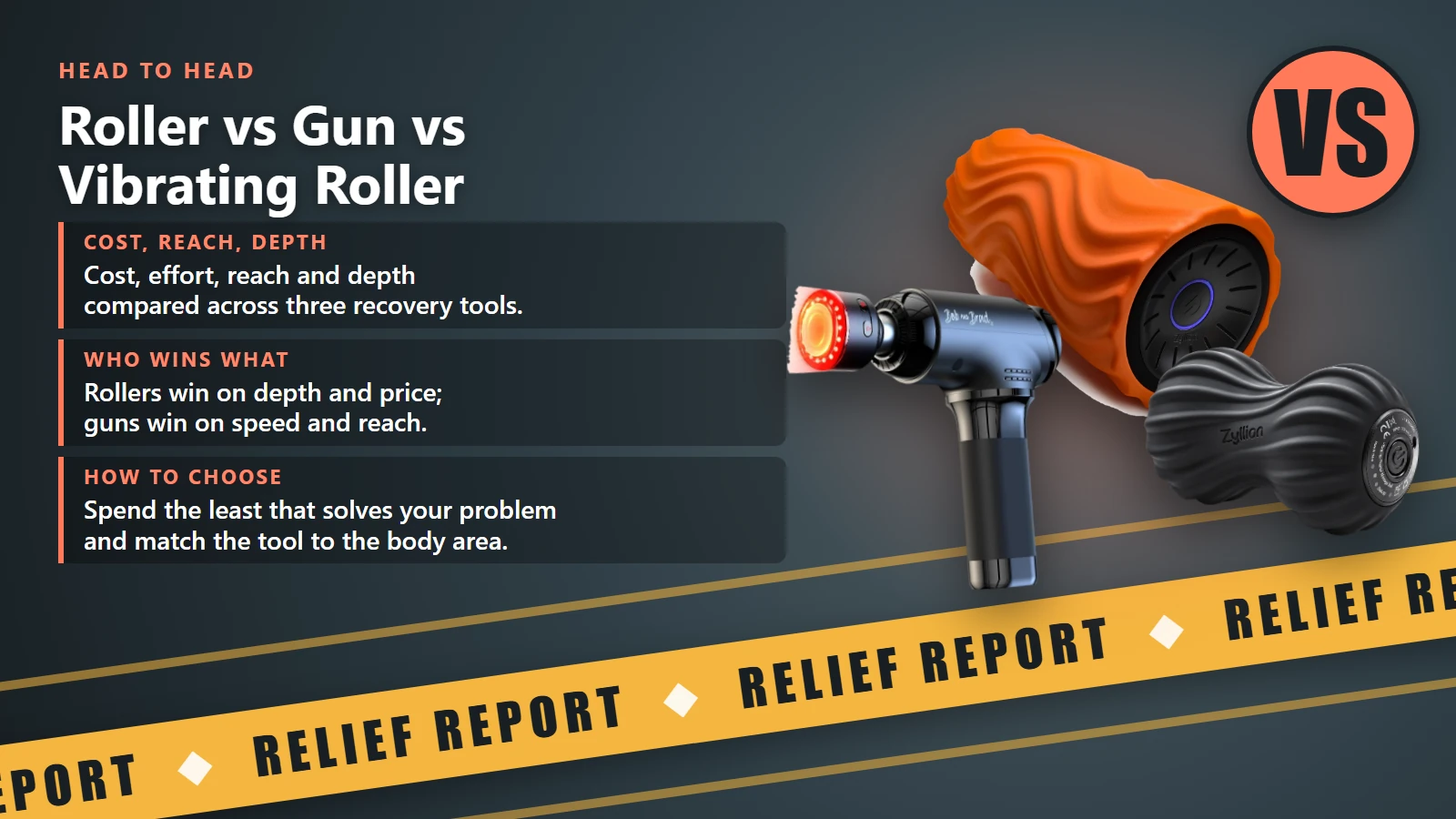
If you would rather sit on the couch and let a motor work, our Renpho Power+ Massage Gun findings cover a quiet, strong gun, though 1 of 4 clients hit power or charging trouble. One reviewer said they would rather spend this money on a Theragun, which is a fair thought if you want hands-off relief.
For broad rolling with vibration, how the Zyllion ZMA-22 Vibrating Foam Roller held up is worth a read, with the warning that its data is thin. One client owns the red light wrap too, and the full write-up on that wrap covers it in detail.
What to Look For When Buying a Massage Roller
Members and clients keep returning to a handful of points:
- Contact area: Small 2.5 to 3 inch tools concentrate force on stubborn knots, while wide rollers spread your weight and soften it. The Relief+ is on the small-contact end.
- Firmness and texture: Dense, knobby tools can bruise early on, as the Rumble Roller member found, and the silicone here is firm but not as hard as some myofascial balls, per one reviewer.
- Base stability: A base keeps the tool where you put it, which suits static holds, while balls and cylinders suit rolling.
- Vibration or none: Members say vibration helps with cramping and takes less effort, and what our clients found with the Zyllion ZMA-30 Vibrating Peanut Ball shows what a cheaper motorized option looks like.
- Reach: Hook canes let you work the upper back and neck without balancing on the floor, which matters if the floor is hard for you.
- Price against alternatives: Cheap balls and rollers run $8 to $30 in our group, so a $99.00 tool has to earn its place.
The checklist boils down to three questions: do you need to hold pressure on one spot, can you get down to the floor, and will you use it enough to justify the money?
How Long, How Often and Where Should You Use It?
Keep your direct compression to 10 to 15 seconds per spot, as the brand's directions say, and release slowly before shifting. Members who hold pressure aim for about a 4 out of 10 on the discomfort scale for 15 to 25 seconds, and Dennis's few minutes per zone at bedtime is the longest any client described.
Clients used it on the glutes, upper back, calves, the IT band, behind the neck and the lower back up to the neck, and Wade's advice is to ease in because it is more intense than a foam roller. You can use it with or without the base, and one reviewer says the base version is firmer.
Using the Relief+ Safely
Avoid bony areas, the front of the neck and acute injuries. That means no pressing on the spine's bumps, hip bones or ribs, and no use over open skin, inflamed areas or swelling, as the listing also says.
Members add three cautions. Digging for 20 minutes can feel good during the session and flare hours later, rolling straight onto the lower spine with a disc problem or sciatica can make the muscles seize, and throwing your weight cold onto a hard fulcrum can trigger spasms, so a folded towel over the humps is a fair way to grade it.
If you have a medical condition or are pregnant, ask a professional first, per the listing. This is a comfort tool for tight spots, not a treatment for any condition.
Is the Kineon Relief+ Worth $99.00? The Verdict
This Kineon Relief+ trigger point massager review ends in a qualified yes for a narrow group. Buy it if you want a sturdy, battery-free tool that holds pressure on one spot, you will learn the positioning and you are fine paying for the shape and the base.
Skip it if you expect vibration, heat or effortless relief, want the best value per dollar or find lying on hard rubber unpleasant. If a cheap ball or a vibrating roller sounds closer to what you want, start there.
The evidence is limited: no group member has posted about this exact tool, so this rests on 6 client reviews and 8 buyer reviews. If you decide to buy, you can check the current price of the Kineon Relief+.
(If you buy through this link we may earn a small commission. It doesn't change what our clients and group members reported.)