

Key Takeaways
- It won't rebuild a shrunken quad the way a clinic unit can, but it gives you TENS for sore, tight spots and a gentle EMS contraction in a pocket-sized kit.
- Against pricey units like Compex and NeuroMD, the gap is mostly build and top-end power, not the pulses your nerves actually feel.
- Some reviewers could not get the pads to stay on, while others, including our client, said they held well, so pad grip seems to depend on skin prep and luck.
- One reviewer who wears it 4 hours a day at setting 10 needed a recharge by day three, so read the 50 hours on the box as a minimum-power number.
- The sweet spot in our group is 20 to 30 minutes a session, not the 60-minute maximum this unit allows.
- For learning what TENS and EMS feel like, this is an easy first unit; for all-day wear, expect to recharge often and keep spare pads handy.
One reviewer who sits at a desk all day bought two of these for chronic low back pain. Each one runs about 4 hours a day at setting 10, and by the third day the battery quits before the session ends.
For this Neocarbon TENS unit muscle stimulator Pro review I leaned on one client report, other user reviews, 23 buyer reviews and the posts in our Facebook recovery-gear group. The listing shows 4.5 stars from 3,967 ratings, and our client gave it 4 of 5, with the pads and the battery as the sore spots for other reviewers.
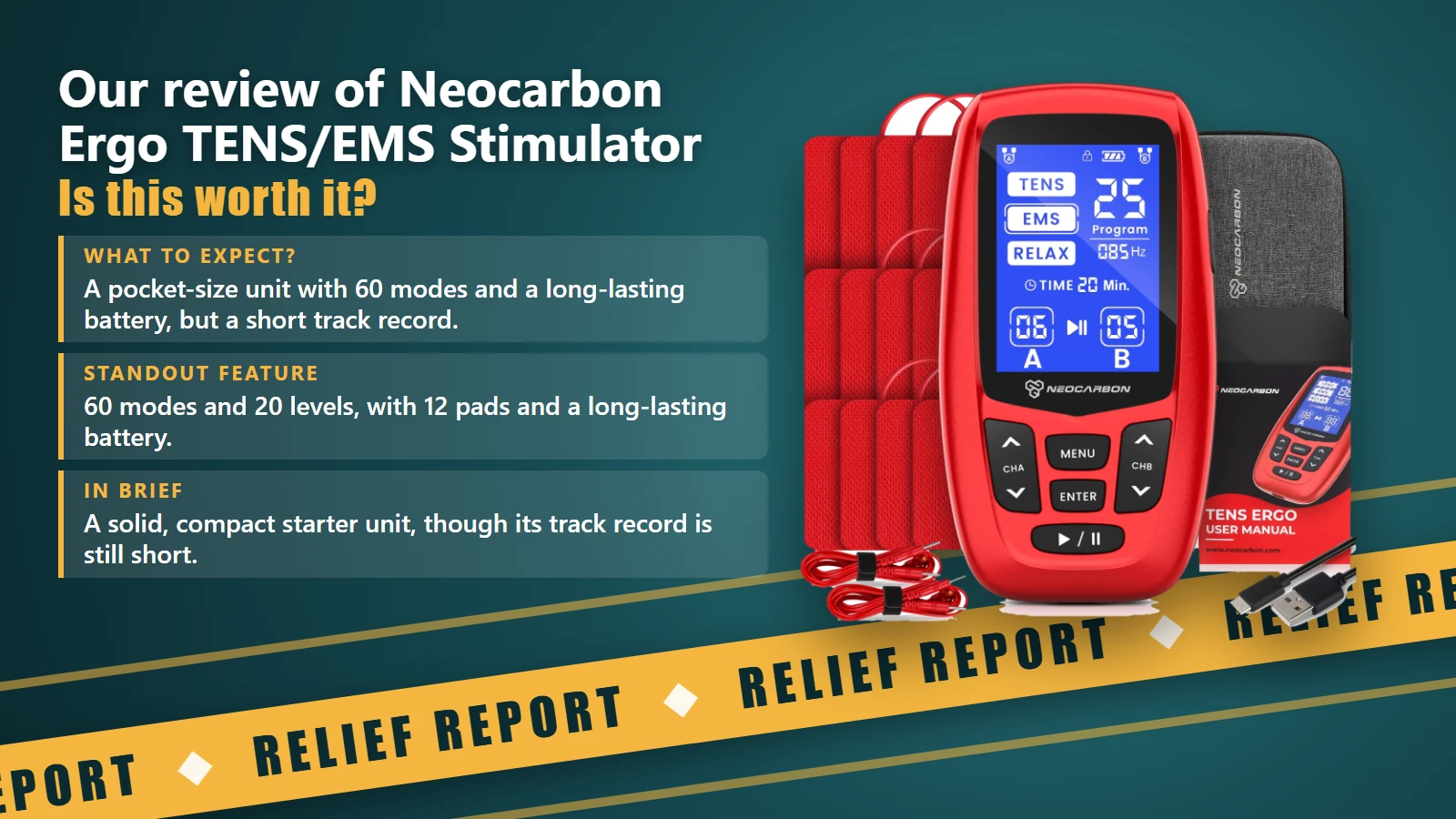
It is a $69.97 TENS/EMS kit for people who want one box with pads, a case and a backlit screen. My bottom line: it does the basics well, the 50-hour battery claim only holds at very low settings, and the pads are hit or miss.
What Do You Get for $69.97?
The unit is small enough to drop in a pocket, which several reviewers liked. A few of the specs need plain-English context.
| Spec | What it means for you |
|---|---|
| Price | $69.97 (checked Oct 2026), mid-range for TENS/EMS |
| Type | TENS and EMS in one unit, plus a relax mode |
| How it works | Sticky pads on your skin send small electrical pulses |
| Power | USB-C rechargeable, about 2 hours to full |
| Battery claim | Up to 50 hours, but reviewers got under 12 at setting 10 |
| In the box | 12 pads, 2 pad holders, USB-C cable, travel case |
| Screen | Backlit LCD with large icons, easy to read |
| Size and weight | 6.97 x 5.04 x 2.32 inches, 13.4 ounces (package) |
| Session limit | 60 minutes at most, no rest periods |
Prices move, so check the current price here (if you buy through this link we may earn a small commission, and it doesn't change what our client and group members reported).
The unit has three modes. (TENS - pulses that work on the pain signal; EMS - stronger pulses that make the muscle contract) are the two that matter, and RELAX runs gentler patterns for long, seated sessions.
Each mode has 12 patterns, so 36 in total. The manual says 24, which is one of several places it trips people up.
Who Is This Unit For, and Who Should Skip It?
This comes from what our client, other reviewers and group members actually reported, not from the box.
It suits
- First-time TENS buyers who want pads, a case and a cable in one box
- People replacing an old 9V unit who are tired of buying batteries
- Anyone who wants a device small enough to wear in a pocket during the day
- People curious about both TENS and EMS without buying two machines
Skip it if
- You need sessions over 60 minutes or rest periods between contractions
- You expect days of battery from all-day use at a mid setting
- You want the A and B channels to run in sync, since they run separately
- You have a pacemaker or any implanted electrical device (see the safety section)
What Did One of Our Clients Say About It?
We heard from one client, who rated it 4 stars. The table shows that client, and the other user reviews follow below it.
| Client | Why they bought it | How they used it | What worked |
|---|---|---|---|
| Nathan, who wants better recovery habits | Upgrading a 15-year-old unit | Tried all 3 modes and patterns | Very sticky pads, more modes |
| Client | What didn't | Their verdict |
|---|---|---|
| Nathan, who wants better recovery habits | Manual numbering wrong, no belt clip | 4/5 |
Nathan was upgrading from a pain-clinic unit he had for 15 years, one mode and five patterns. He liked the extra modes and the rechargeable battery that ends the $5 9V habit, and he fixed the manual's wrong pattern numbers by writing the right ones in himself.
Across the user reviews, the screen and the size get praise and the pads split people. Some reviewers could not get them to stick, while Nathan, one reviewer who used gel and others said they held well.
Other Observations From User Reviews
- A reviewer with questions about safe use tried the pads on several body areas and they kept peeling off, so they wrapped an ace bandage around them. They liked the nice case but missed the old unit's rest periods and its option to run longer than 60 minutes (2/5).
- A reviewer who works out at home cleaned and dried the skin first, and the pads still fell off, rarely lasting a full 20-minute session. Even when they held, the stimulation felt very weak at the top setting (2/5).
- A longtime reviewer who compared it with cheaper units found the screen less helpful, so they cycled through programs blind or kept the booklet nearby. The separate A and B channels bothered them too, though it works fine for basic use (3/5).
- A reviewer with chronic low back pain bought two, liked the compact size and the screen that is easy on older eyes, and wears it about 4 hours a day at setting 10. The battery needs a recharge after three days, with the third day cut short on both units (4/5).
- A reviewer whose quad shrank after ACL graft surgery uses it before and after work with ice, and says the quad is activating more and getting stronger. The pads hold with gel, so they bought extra pads and gel (5/5).
- A reviewer who has used it almost daily for over six months only wants cheaper refill pads.
- Another reviewer found it hard to figure out, says it helps a bit with neuropathy and wishes they had just bought a cheap unit.
- A reviewer with back pain was happy with it, which is one report and not proof of anything (5/5).
- Another reviewer with back pain was also happy with it (5/5).
What Do Members of Our Facebook Group Say?
Honestly, our group has little to say about this exact model: one question, one thread explanation and a roundup of comments. I have added two brand posts about the Neocarbon TENS muscle stimulator, labeled as that, since members did not give the model name.
| Member | Device | Experience | Takeaway |
|---|---|---|---|
| A member with cervical dystonia | Neocarbon TENS muscle stimulator (brand post) | Pads on shoulders or arm work well | One of few things that helps them |
| A member who sits for long stretches | Neocarbon TENS muscle stimulator (brand post) | Uses relax mode while seated | Other modes too aggressive for them |
| A member wanting a sharper "zap" | Neocarbon TENS unit | Asked how to get a taser-like effect | Another member said it is built for pain relief |
| A member new to TENS and EMS | Neocarbon TENS unit | Asked what the two terms mean | Told it is a fine place to start |
| Comments rounded up in a group post | Neocarbon TENS unit | 3 liked pads, 3 size, 3 modes | 5 found instructions confusing, 2 had pad trouble |
Reviewers and members agree on size and the simple screen. They split on the pads: in that roundup 3 comments praised how long they last and 2 said they stick poorly, which is the same divide the reviewers showed.
Instructions are the one thing both groups grumbled about. Five comments in the roundup called them confusing, and Nathan rewrote his manual by hand.
The member who wanted a zap never got one from this unit. A reply in that thread described the Neocarbon as built for pain relief and muscle conditioning, which fits one reviewer finding it very weak at max and others being happy with plain steady output.
How Do the Listing's Promises Hold Up?
| What the listing promises | What users actually found |
|---|---|
| Up to 50 hours of use per charge | Under 12 hours at setting 10, same on two units |
| Easy to use, simple screen | Easy screen, but 5 group comments call instructions confusing |
| Helps with soreness and recovery | Some reviewers reported relief; one found it very weak |
| Complete kit with 12 pads | Pads very sticky for some, fell off for others |
| 3 modes, 24 patterns per the manual | 3 modes, 36 patterns; manual numbering is off |
| Strong, adjustable stimulation | One reviewer called it strong; another barely felt it |
The biggest gap is the battery. The brand says 50 hours, and one reviewer's 4 hours a day lasted three days on both units, so under 12 hours at setting 10.
The second gap is the manual, which gets the pattern count wrong and misnumbers the programs for EMS and RELAX. Nothing in the listing says whether the unit has a warranty, so ask before you buy.
Does It Last, and What Goes Wrong?
Three of the 23 buyer reviews I read describe the unit failing for good: after 6 weeks, after 1 year (the intensity stuck on zero) and after 2 years. The 2-year buyer added that a unit from 2010 still works for them, which is a fair yardstick for any new one.
Pads come up more. Two buyers and two reviewers had trouble, and one buyer used up two sets in under 24 hours even with the recommended gel.
- Battery: about 4 hours a day at setting 10 lasted three days on two identical units.
- Pads: from one use to many sessions; skin prep and a drop of gel seem to decide it.
- Leads: one buyer said they split easily, and one reviewer suggests snap-pad replacements over the pigtail connectors.
- Missing or damaged extras: one buyer got no wall plug for the USB cable, another a case with a bad zipper.
- Screen and body: plastic, so don't sit on it or keep it in a back pocket.
- Brand support and warranty: not reported anywhere in our data.
If you want to compare inside the brand, my Neocarbon Ultra TENS EMS review covers the $89.97 sibling.
Is It Worth It Compared With Compex, NeuroMD and Cheaper Units?
| Product | Price tier | Key difference | What users liked |
|---|---|---|---|
| Neocarbon TENS Unit Pro | $69.97, mid-range | Full kit, 12 pads, case | Simple screen, size, modes |
| Compex | Not reported (one buyer called it expensive) | Used for years by one buyer | Higher top-end power |
| NeuroMD NMES | Premium (the SM9113 we reviewed is $154.99) | Wireless NMES for rehab | One member reported 90% less back pain |
| Twin Stim 3 | $50, budget | Manual dials, 9V battery | Cheap generic pads, full control |
| Product | What users disliked | Best for |
|---|---|---|
| Neocarbon TENS Unit Pro | Short battery, pad luck | First-time TENS/EMS buyers |
| Compex | One buyer's units died twice | Not reported |
| NeuroMD NMES | Not reported | Rehab after therapy stalls |
| Twin Stim 3 | Not reported | Buyers who want control |
One buyer who used Compex for years said this unit is a fraction of the price and just as good, though it lacks the huge top-end power. A member who tried NeuroMD systems after physical therapy made no difference reported back pain down by 90% or more, a result no reviewer reported from the Neocarbon Pro; that member used the Back Corrective and Full Body 2.0 systems, and how the NeuroMD SM9113 NMES Muscle Stimulator held up is the one model of theirs we reviewed.
For a simpler Neocarbon, what our clients found with the Neocarbon TENS EMS Pulse Massager costs $59.97. I point first-time buyers to the Pro, anyone rehabbing a quad toward a stronger NMES unit, and anyone who likes tinkering toward the $50 Twin Stim 3.
Is it worth $69.97? For a learner kit with a case and 12 pads, I think yes, though two reviewers said they would have bought a cheap unit.
What Should You Look for in a TENS/EMS Unit?
| Factor | Why it matters | What to look for |
|---|---|---|
| Channels | 2 channels cover one area, 4 cover several zones | 2 for a knee or wrist; 4 for radiating pain |
| Controls | Dials let you fine-tune; digital menus hide the numbers | A screen you can read without the booklet |
| Mode | TENS masks pain; EMS makes the muscle contract | Confirm you need contraction, not just pain relief |
| Pad connectors | Proprietary pads cost more than generic ones | Standard connectors that take cheap pads |
| Battery | USB-C saves money; 9V never makes you wait | 9V or AAA for flare-ups, USB-C for convenience |
| Timer | Some cap at 60 minutes, others run to 90 | Longer or back-to-back cycles for chronic pain |
| Price | Members said $33 to $60 units can match pricier waveforms | Pay for build and pads, not an app |
Our group is blunt about this: one member advised against $300 to $700 app-based units with subscriptions and proprietary pads, and said the electricity is the same either way. A member who paid $33 for an entry-level unit said it cut an 8-year chronic pain problem down to about 10% of what it was.
The Pro has two channels and all three modes, but it only has presets and a rechargeable battery, so it misses on control and battery style. If you are also weighing percussion for sore muscles, the Renpho Active Massage Gun (Metal Housing) is a different tool at $66.49, and our Renpho Active Massage Gun findings cover a pricier compact version.
How Long and How Often Should You Use It?
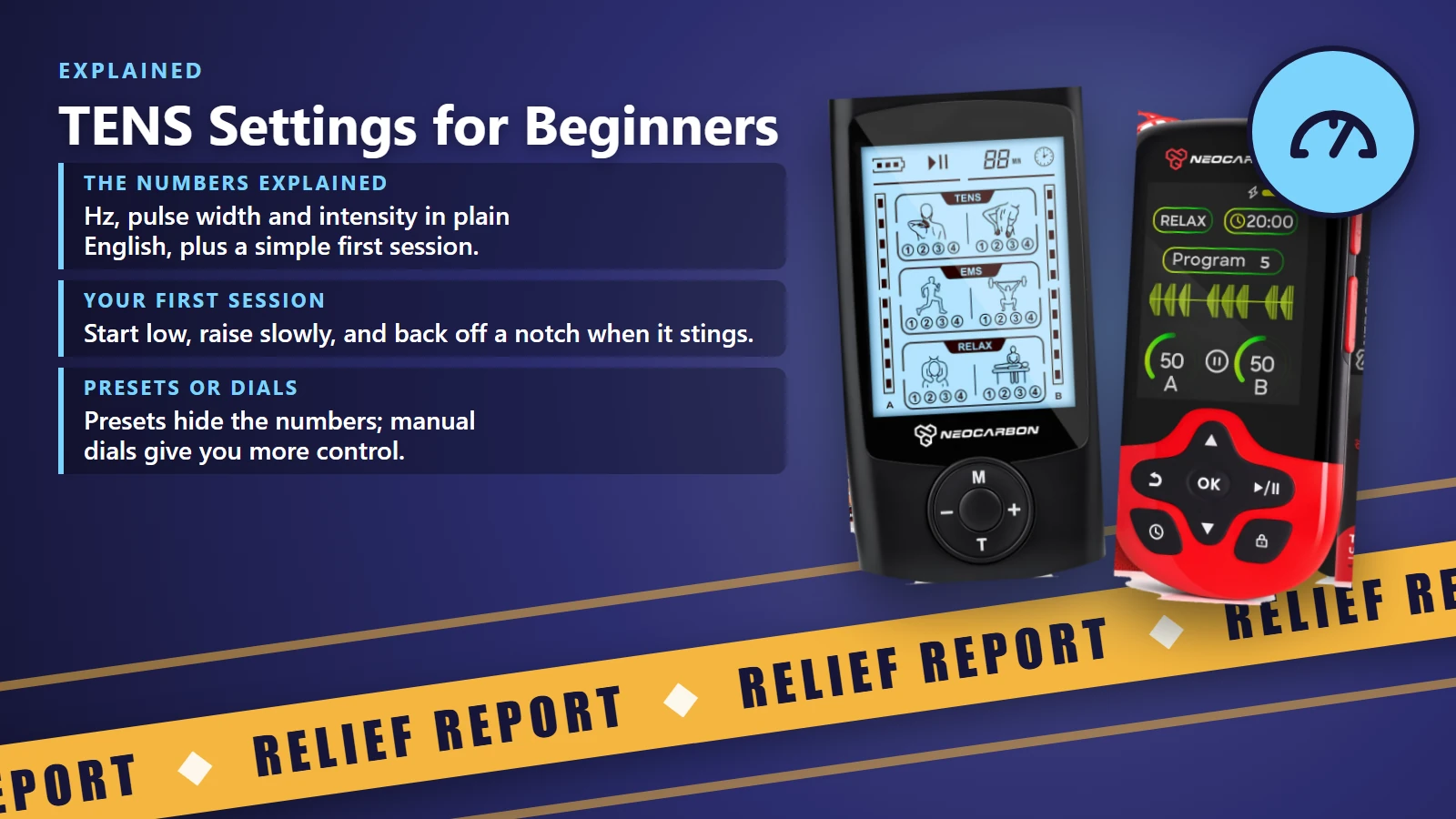
Members run sessions of 15 to 45 minutes, with 20 to 30 as the usual baseline. Start with 20 minutes at a low setting and raise it slowly until you feel a strong, comfortable buzz, then back off a notch if it stings or cramps.
The unit caps at 60 minutes with no rest periods, so longer runs mean restarting it by hand. Clean the skin with soap and water or alcohol before the pads go on, add a drop of conductive gel to dry pads, and store them sealed on their backing in the fridge to stretch them to 20 or 30 uses.
Keep the wires tucked inside your clothing so their weight doesn't peel the pads loose. Place electrode pairs on the same side of the body, over soft muscle and not on the spine or bone.
Never use it with a pacemaker or any implanted electrical device. Keep pads off the chest and heart, the head, the front of the neck and broken skin, and never across the chest.
If you are pregnant, have epilepsy or a heart condition, talk to your doctor before using any TENS or EMS unit. It only masks pain signals or contracts a muscle, and pain often returns soon after the unit powers off.
Neocarbon TENS Unit Muscle Stimulator Pro Review: The Verdict
Buy the Pro if you are new to electrical stimulation and want a pocket-sized kit with 12 pads, a case and a screen you can read. Check the current price before you order.
Skip it if you need sessions over 60 minutes, synced A and B channels, or battery life close to the 50 hours on the box. Skip it too if you have a pacemaker or implanted device, or want manual control over pulse width and frequency, since it only has presets.
For those buyers I would look at the $50 Twin Stim 3 for dials and a 9V battery, or a stronger NMES unit like Compex or NeuroMD for post-surgery quad work. This Neocarbon TENS unit muscle stimulator Pro review comes down to one question: do you want a learning tool or a daily driver?
For learning, it earns its $69.97. For heavy daily use, expect to recharge often and buy spare pads.