

Key Takeaways
- Paul counted the 24 modes and found 6 modes with 4 sub-modes each, and Jeremy said the modes and levels all feel about the same.
- Ray, one of the 5-star clients, had owned a much larger unit before and said there is no comparison in power, so the unit seems to reward people who already know what they want.
- Conrad's warning is blunt: the pads' stickiness wears off, and without full contact you get a shock.
- Don't expect abs from a unit like this; the friend who lifts weights laughed at that idea and uses it after heavy deadlifts for the buzz.
- One reviewer found that changing any setting means starting from the beginning and clicking through every item again.
- A pacemaker or similar implant means this stays in the box, and the listing gives no safety information, so read the manual before the pads go on.
Paul, one of our six clients, spent about 24 hours with this unit before deciding that a much older, simpler TENS unit gave better relief. Ray, another of our clients, couldn't believe the power in something that small, and keeps it in a pocket while walking around.
This Neocarbon TENS EMS muscle stimulator pulse massager review draws on six client reports and 20 buyer reviews, and the split between them is the story. Two clients gave it 5 stars, one gave it 4, one gave it 3 and two gave it 2.
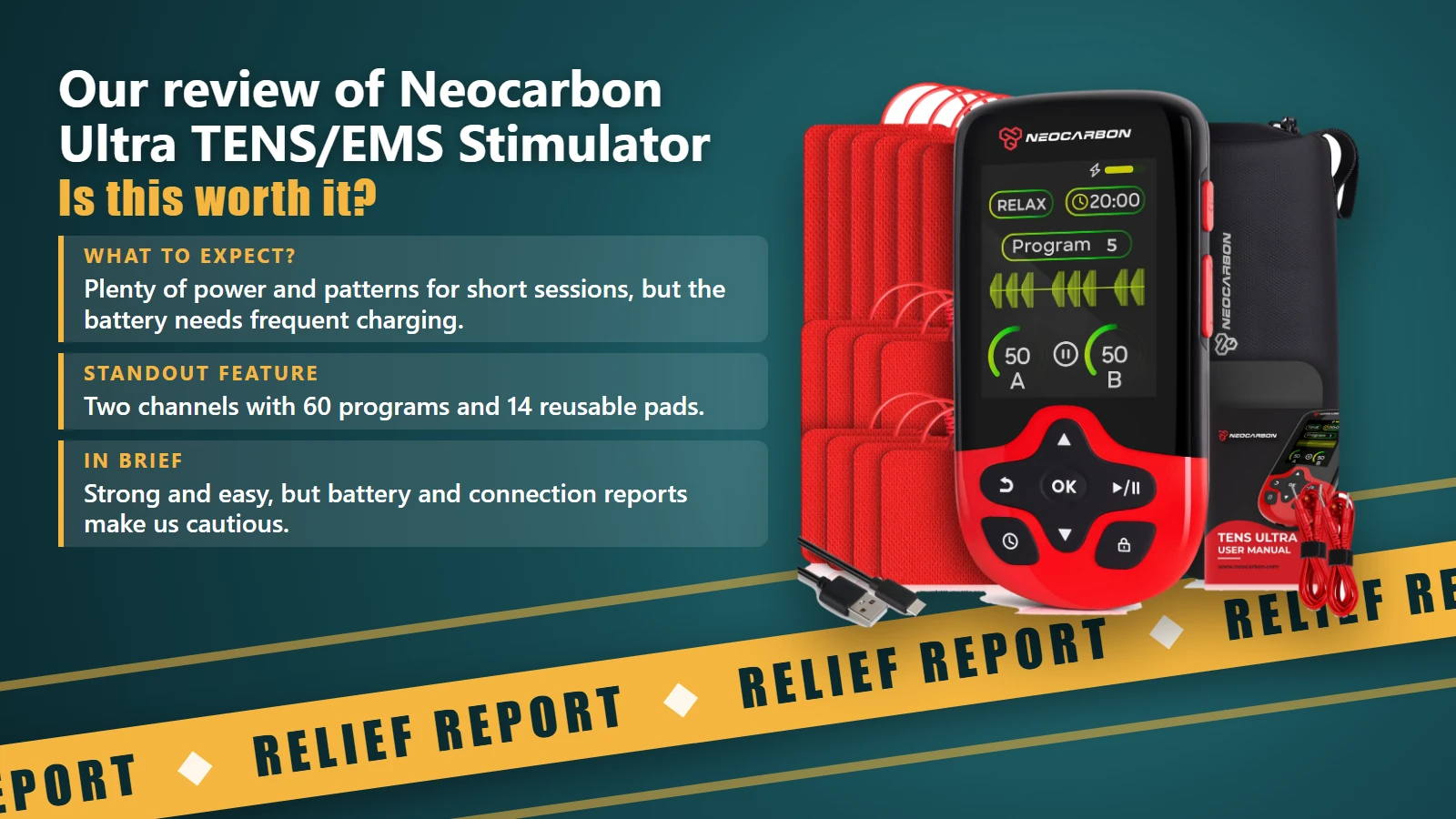
It is a pocket-sized, rechargeable TENS and EMS unit with 24 modes, 20 intensity levels and 16 pads, for $59.97. My bottom line: it is strong for the size and the kit is generous, but the modes are hard to tell apart and the pads wear out.
Neocarbon TENS EMS Muscle Stimulator Pulse Massager Review: What Is in the Kit?
| Spec | What it means for you |
|---|---|
| Price | $59.97 (checked Oct 2026), mid-range for TENS/EMS |
| Type | TENS and EMS, 2 channels, up to 4 pads at once |
| Modes and levels | 24 modes, 20 intensity levels, time control |
| Power | Rechargeable by USB; brand says 2 hours gives about a month |
| Size and weight | 1.97 x 4.72 x 6.69 inches, 14.82 ounces as listed |
| In the box | 16 pads (S/M/L), 2 snap cables, 2 pad holders, case, manual |
| Auto shut-off | Turns off at timer end; slide switch to restart |
| Heat | Not stated |
| Safety info on listing | None, so read the manual first |
Prices move, so check the current price here (if you buy through this link we may earn a small commission, and it doesn't change what our clients and group members reported).
The kit is generous for the money. A reviewer who has bought five or so of these over the years said it cost only $10 or $15 more than the ones normally bought, and liked that it came with pad holders and a nice case.
Who Is This Pulse Massager For, and Who Should Skip It?
Buy it if you
- Already know how TENS and EMS feel and want a small, strong second unit
- Need something that fits in a pocket or a gym bag
- Want a full kit with several pad sizes for different body areas
- Don't mind clicking through presets until you find one you like
Skip it if you
- Are buying your first TENS unit and want clear guidance
- Need modes you can tell apart, or a steady constant pulse
- Expect EMS to build visible muscle
- Have a pacemaker, ICD or any implanted electrical device
What Did Six of Our Clients Say About It?
I have six client reports. All of them are in the table below.
| Client | Why they bought it | How they used it | What worked |
|---|---|---|---|
| Paul, who wanted a practical home setup | Wanted something better than an old unit | About 24 hours of use | Small, ergonomic, battery lasts |
| Someone I've helped with recovery routines | First TENS device | Used it about 3 times | Not reported |
| Jeremy, third TENS unit in 30 years | Replacing an older unit | Kept it because returns cost more | Works as a basic stimulator |
| Conrad, who hikes most weekends | Wanted ready-made routines | Pre-programmed routines | Many routines, many pad sizes |
| Ray, who drives long distances | Wanted something powerful and small | Both channels at once | Strong for its size, pocketable |
| A friend who lifts weights | Wanted easy controls | After heavy deadlifts, with a timer | Easy controls, pads reusable, long battery |
| Client | What didn't | Their verdict |
|---|---|---|
| Paul, who wanted a practical home setup | Only 6 real modes, poor instructions, pricey pads | 2/5 |
| Someone I've helped with recovery routines | TENS, EMS and massage felt the same | 2/5 |
| Jeremy, third TENS unit in 30 years | Manual poor, modes and levels feel alike | 3/5 |
| Conrad, who hikes most weekends | Pads lose stickiness | 4/5 |
| Ray, who drives long distances | Dual-channel instructions unclear | 5/5 |
| A friend who lifts weights | Nothing reported | 5/5 |
Paul found the instructions very poor and counted the 24 modes down to 6 modes with 4 sub-modes each. Only 8 of them are the TENS kind, 4 for shoulder and 4 for back, and the older, simpler unit at home did a better job.
Paul also worried about the slide switch that has to be pushed to restart the unit after the timer ends. The replacement pads look pricey for how long they last, and returning it within the week was on the cards.
The first-time buyer in the group was blunter. The three labels on the screen (TENS, EMS and massage) felt like the same buzz with different pictures, and they used it about three times before giving up.
Jeremy has owned three TENS units across 30 years and called this one the least friendly and lowest in quality. With four modes at four levels each, Jeremy expected different sensations and got about the same one every time.
Returning it would cost more than the purchase price, so Jeremy will keep using it until a trip back this summer, when a Dr. Ho's unit is the plan.
Conrad said the pre-programmed routines and pad shapes and sizes do the job. The stickiness of the pads wears off, though, and full contact is a must or you will be in for a shock.
Ray had an earlier, much larger unit and said there is no comparison in power. Ray got stuck running both terminals at once, emailed the seller, and had detailed instructions within hours.
The friend who lifts weights calls the controls super easy and says the pads can be reused many times by pressing a moist cloth to them. The battery lasts so long that the friend sets a timer, falls asleep and wakes up with the device off, which I wouldn't copy.
The pattern is that the clients who had owned TENS units before either loved the power or found the modes pointless, while the first-timers struggled with the instructions. The hardware gets less criticism than the manual and the screen flow.
Other Observations From Friends, Relatives and Other User Reviews
- A reviewer found the unit much smaller than it looks online and the screen clear but small, and had to start over every time a setting changed (3/5).
- A reviewer who has owned five or so of these over the years called it the best one yet, with lots of pattern options and a lot of power for something so small (5/5).
What Do Members of Our Facebook Group Say?
No member has posted about this exact unit by name. These are posts about Neocarbon TENS units, labeled as brand posts, plus a few threads where a Neocarbon unit came up.
| Member | Device | Experience | Takeaway |
|---|---|---|---|
| A member with cervical dystonia | Neocarbon TENS muscle stimulator (brand post) | Pads on shoulders or arm work well | One of few things that works for them |
| A member who sits for long stretches | Neocarbon TENS muscle stimulator (brand post) | Relax mode while seated | Moving the body part raises intensity |
| A member wanting a "zap" effect | Neocarbon TENS unit | Asked how to get a taser-like feel | Replies called it a pain relief unit |
| A member new to TENS and EMS | Neocarbon TENS unit | Asked what the two terms mean | Told it is a fine place to start |
| Comments rounded up in a group post | Neocarbon TENS unit | 3 liked pads, 3 size, 3 modes | 5 found instructions confusing, 2 had pad trouble |
Clients and members agree on two things: these units are small and good for pain relief rather than high power, and the instructions are the weak point. Five comments in the group roundup called them confusing, which fits Paul, Jeremy and the first-timer.
The pad split shows up again, since 3 comments praised how long pads last and 2 called them poor, much like Conrad. The reply to the member asking for a "zap" described the Neocarbon as built for pain relief and conditioning, not high-power stimulation, which fits Ray's "powerful for the size" more than it fits a shock-collar feel.
Does the Listing Match What Users Found?
| What the listing promises | What users actually found |
|---|---|
| 24 modes | 6 modes with 4 sub-modes; 2 clients said they feel alike |
| 20 intensity levels | One buyer got painful jolts above level 2 |
| About a month per 2-hour charge | Two clients said the battery lasts a long time |
| 16 reusable pads | Pads lose stickiness; replacements seen as pricey |
| For neck, back, abs, knee and more | Clients used shoulders, back and legs; no abs effect |
| Complete kit with case | Kit praised; manual and instructions criticized |
The biggest gap is the mode count. Paul counted 6 modes with 4 sub-modes each, one buyer found only pattern settings and no constant option, and another said most patterns were more annoying than relieving.
The power claim holds up better, with Ray and another reviewer both calling it strong. A few buyers disagree: one felt hardly any pulse at all, and another found everything but one setting painful above level 2.
Is It Reliable, and What Goes Wrong?
Of the 20 buyer reviews, four call it hard or complicated to use and one more tells you to read the booklet. Another says it doesn't work half the time, one says the pads don't stick, and one says it barely produced a pulse.
- Modes and instructions: at least 3 clients and 4 buyers call it confusing or the modes alike; this is the most common complaint.
- Pads: Conrad, Paul and 1 buyer say the pads wear out or don't stick.
- Switch: Paul worries the slide switch won't survive many restarts, though nothing has failed.
- Power: mixed; Ray and another reviewer say strong, 2 buyers say weak or too jolting.
- Support: Ray had a detailed seller reply within hours, the only support story we have.
- Warranty: not stated, and nobody in our group has owned it long.
Durability is unknown. If the brand fixed the manual and the pad adhesive, this would be an easier recommendation.
Is It Worth $59.97 Next to a Twin Stim 3 or the Pro?
| Product | Price tier | Key difference | What users liked |
|---|---|---|---|
| Neocarbon TENS EMS Pulse Massager | $59.97, mid-range | 24 presets, 16 pads, case | Power, size, kit |
| Neocarbon TENS Unit Pro | $69.97, mid-range | 36 patterns, 12 pads | Easy screen, size |
| Twin Stim 3 | $50, budget | Manual dials, 9V battery | Cheap pads, full control |
| Balego NMES | About $60 per a member | Built for quad activation | Post-surgery stimulation |
| NeuroMD NMES | Premium (the SM9113 is $154.99) | NMES for rehab | One member reported 90% less back pain |
| Product | What users disliked | Best for |
|---|---|---|
| Neocarbon TENS EMS Pulse Massager | Alike modes, poor manual | Experienced users |
| Neocarbon TENS Unit Pro | Battery shorter than claimed | First-time buyers |
| Twin Stim 3 | Not reported | Simple direct control |
| Balego NMES | Low power in 9 comments | Quad rehab |
| NeuroMD NMES | Not reported | Rehab when PT stalls |
If you want simple controls and cheap pads, members point to the Twin Stim 3 at $50 and say electricity is electricity. Compex doesn't come up beside this unit in our data, so I'm leaving it out.
For a bigger Neocarbon kit, my Neocarbon TENS Unit Pro review covers the $69.97 sibling, whose pads are also mixed. For serious rehab money, our NeuroMD SM9113 NMES Muscle Stimulator findings are the full write-up, although the member who reported a large back-pain drop used two other NeuroMD systems.
Is it worth $59.97? For Ray and others who like the power, yes, but for anyone who wants clear modes or guidance I'd say no, and the Twin Stim 3 saves $10 and the guesswork.
What Should You Look for in a TENS/EMS Unit?
| Factor | Why it matters in real use | What to look for |
|---|---|---|
| Control style | Presets hide the numbers; dials expose them | A way to set frequency and pulse width |
| Steady mode | One buyer found only patterns, no constant setting | A constant pulse option |
| Setup flow | One reviewer had to restart the menu for each change | Change one setting without starting over |
| Pad connectors | Standard pins take $5 packs of 20 generic pads | Check before you buy |
| Battery | Replaceable cells never make you wait | 9V or AAA for flare-ups, USB for convenience |
| Timer | Ranges run from 10 to 90 minutes | One long enough for your routine |
| Apps and subscriptions | They can lock you out if the company folds | Skip them |
| Price | Members say $33 to $60 is enough | Pay for build and pads |
Group members say effective TENS units cost $33 to $60 and that $300 to $1,200 units add features rather than better stimulation. At $59.97 this one sits right at the top of that range.
If you are weighing percussion instead, how the Renpho Thermacool Deluxe R-WMG83 held up covers a heat-and-cold gun with no pads, and what our clients found with the Renpho Active Massage Gun is the plainer option. A TENS unit works on pain signals while a gun works the muscle, so they are not swaps.
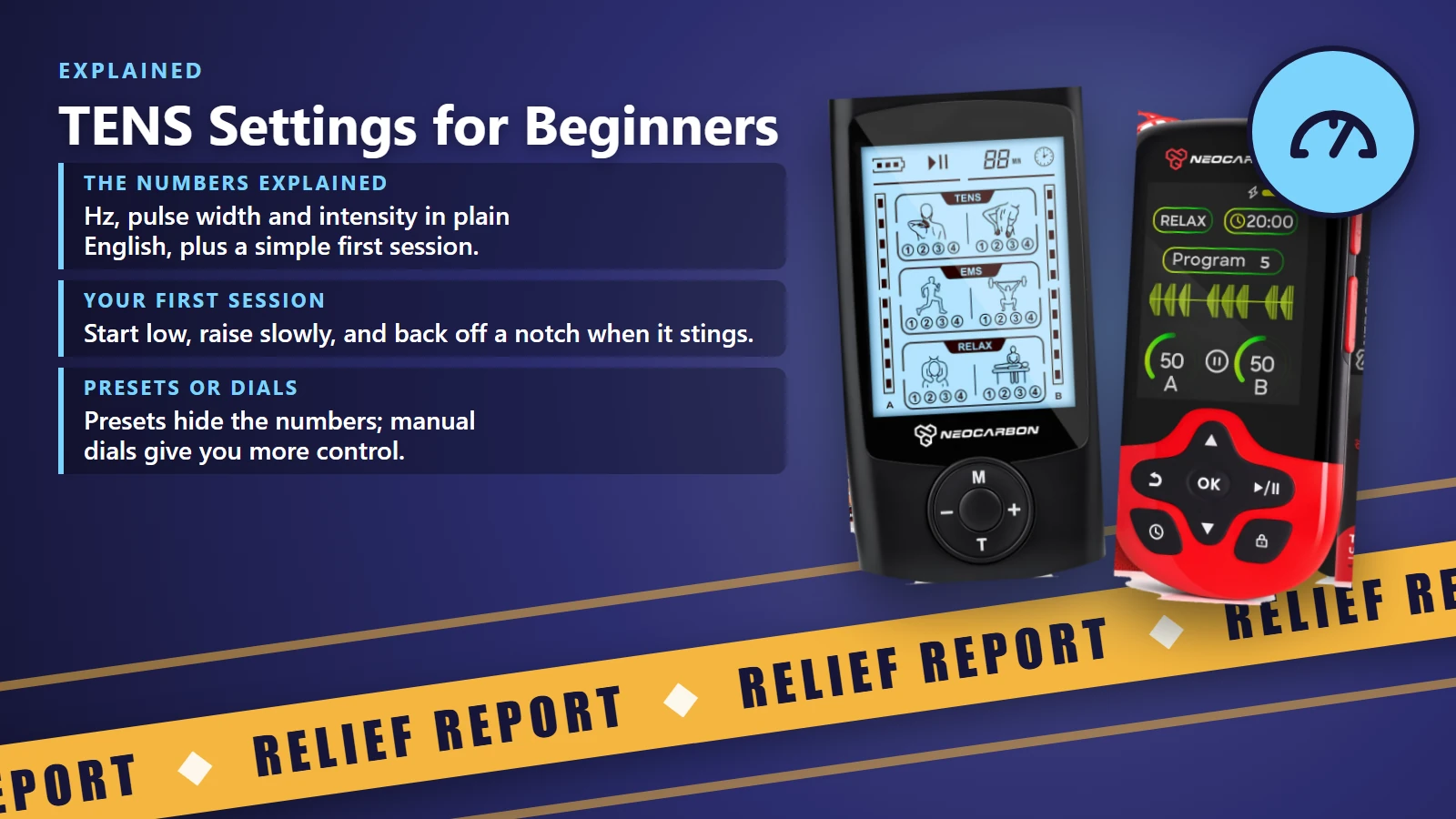
Members who have used TENS for years like to set 3 Hz for chronic aches or 80 Hz for acute pain. If you cannot adjust frequency and pulse width, you are limited to the presets, which is the case here.
How Long and How Often Should You Use It?
Sessions of 20 to 30 minutes are the usual baseline in our group, and some members run back-to-back cycles for 1 to 3 hours during flare-ups. If you do, check that the pads still have full contact.
Start at low intensity and raise it slowly until you feel a strong buzz or mild contraction, then back off a notch. Stop if it turns into a sharp sting or a cramp.
Never use it with a pacemaker or any implanted electrical device. Keep pads off the chest and heart, the head and the front of the neck, and off broken skin.
Pregnancy, epilepsy or a heart condition means checking with your doctor first. Keep pads on soft muscle, in pairs on the same side of the body, and not on the spine or bone.
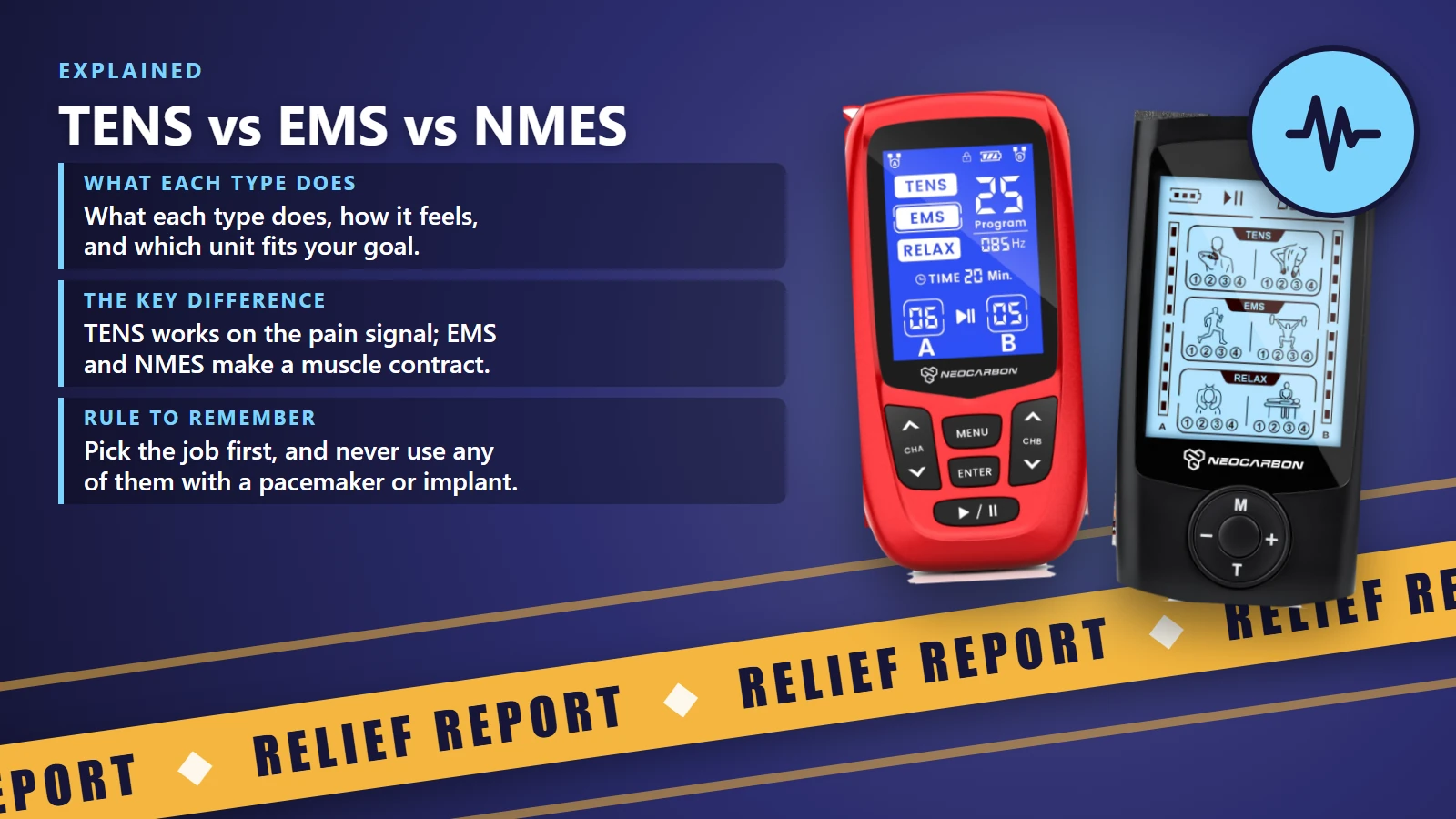
If a pad peels mid-session, turn the unit off before you press it back on. TENS dulls pain signals and EMS makes a muscle contract, but neither fixes anything underneath, and pain often returns soon after it turns off.
Neocarbon TENS EMS Muscle Stimulator Pulse Massager Review: The Verdict
Buy it if you already know how TENS and EMS feel and want a strong pocket-sized unit. The kit is generous for $59.97, and the power surprised people who had used other units.
If that sounds like you, check the current price before you order.
Skip it if this is your first TENS unit, you need clear instructions or you expect 24 modes that feel different. For those buyers I'd choose the $50 Twin Stim 3 with manual dials, or the Pro for a fuller kit.
This Neocarbon TENS EMS muscle stimulator pulse massager review comes down to one tension: the hardware is good, and the manual and mode design are not.