

Key Takeaways
- Start every session at the lowest intensity and raise it slowly until you feel a strong buzz or a mild muscle contraction, then back off a notch.
- Members who have used these units for years set about 3 Hz for dull aches and about 80 Hz for sharp, new pain.
- Locked presets can leave you stuck: two of our clients said the Pulse Massager's modes all feel alike, and the Neocarbon TENS Unit Pro hides pulse width and frequency entirely.
- Moving or bending the muscle under an active pad can sharply raise the intensity, so turn it down before you stand up or reach.
- Anyone with a pacemaker or ICD should skip every TENS and EMS unit, a doctor should weigh in on pregnancy, epilepsy or a heart condition, and pads stay off the chest and the front and sides of the neck.
The box on one pocket TENS unit promises up to 50 hours of battery, yet a reviewer who wore it 4 hours a day at setting 10 needed a recharge by day three. That gap between the box and real life is why the settings deserve a few minutes of your attention.
This guide shows you how to read the dials, start low, and find a strong but comfortable buzz without getting lost in the manual. It draws on what our clients reported and what members of our Facebook group actually do.
You do not need a physiology degree to use these devices safely. A few simple rules will keep you comfortable and help you avoid the common mistakes that send these units back to the seller.
What are the three main settings you need to know?
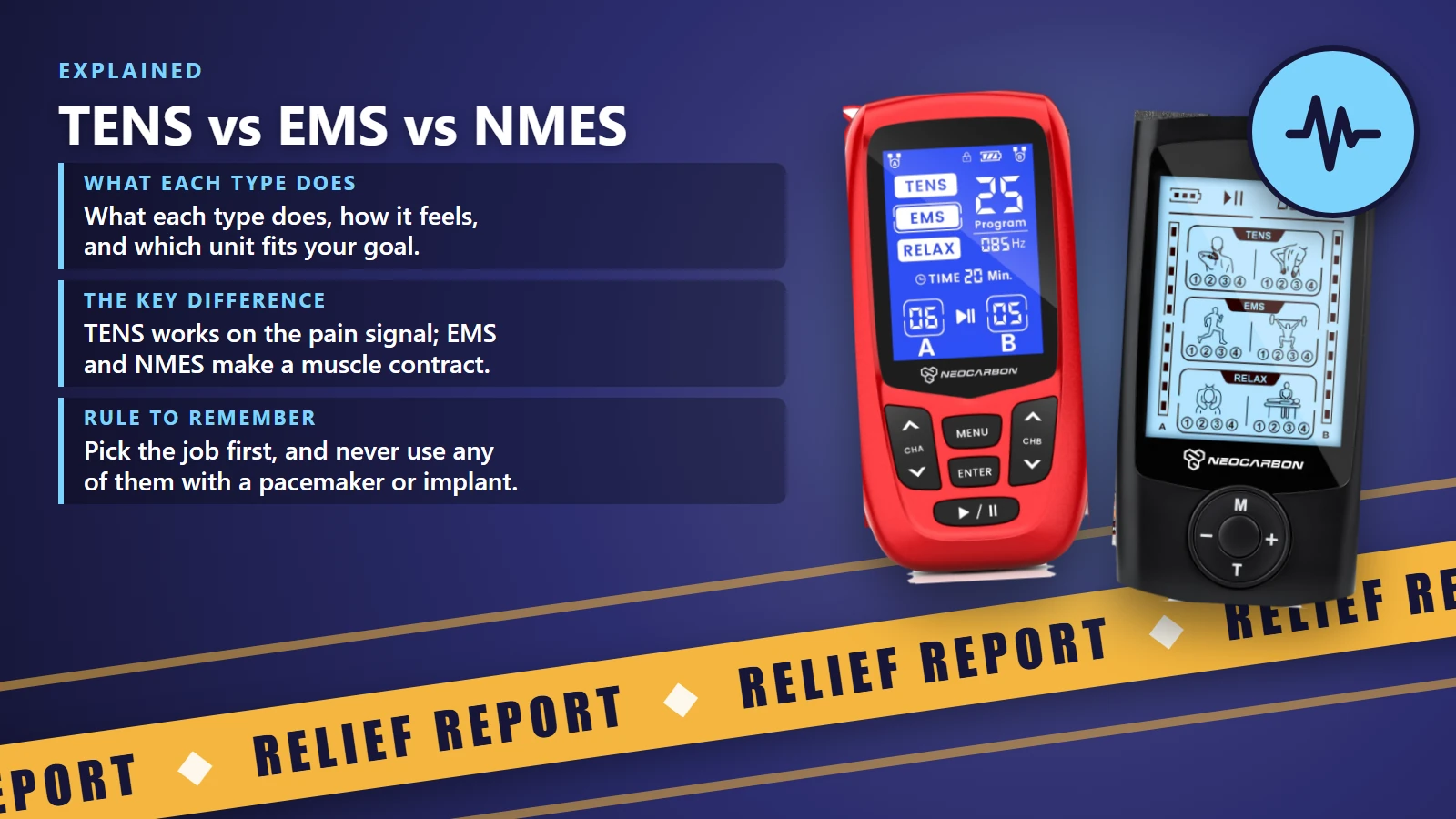
When you turn on a typical unit, you face three controls: frequency, pulse width and intensity. Most beginners start with TENS (pulses that work on the pain signal, giving a gentle buzz) for sore, tight spots, while EMS (stronger pulses that make the muscle contract) makes the muscle twitch.
Our guide on TENS vs EMS vs NMES explains the difference in full. Here we only need to know how the settings change the feeling on your skin.
Members recommend choosing between 2-channel and 4-channel units (each channel runs a pair of pads you can set separately) depending on coverage. A 2-channel unit uses 2 to 4 pads and suits one area like a knee or wrist, while a 4-channel unit uses up to 8 pads and can cover the lower back, glute and calf at once.
Wired units allow much wider pad separation, so you can run leads from the lower back down to the ankle. Wireless patch-style units cut the cables, but members say they can press uncomfortably into your back when you sit in a chair.
What does frequency (Hz) actually do?
Frequency is how many pulses hit your skin every second, measured in Hz (hertz, meaning pulses per second). A low number usually feels like a slow, rhythmic thump, and a high number like a fast, continuous buzz.
Members who have used these units for years like 3 Hz for chronic aches and 80 Hz for acute pain. High settings between 70 and 100 Hz are used for sharp, new pain, while low settings from 1 to 10 Hz are used for long-term, dull aches and are said to encourage the body's own pain-easing chemicals.
The problem with many preset devices is that they hide these numbers from you. You get a button labeled "Shoulder" or "Back" and have to trust the machine.
Members often advise physical dials over complicated touchscreen menus, since simple dials let you fine-tune the frequency yourself. A flap or cover over the dials also stops accidental bumps that spike the intensity.
What is pulse width and why does it matter?
Pulse width is how long each electrical pulse lasts, measured in µs (microseconds, one-millionth of a second). Think of it as the size of each drop in a steady stream.
Members pair short widths of 50 to 200 µs with high frequencies for sharp, new pain. They pair wider widths of 120 to 280 µs with low frequencies for dull aches and muscle relaxation.
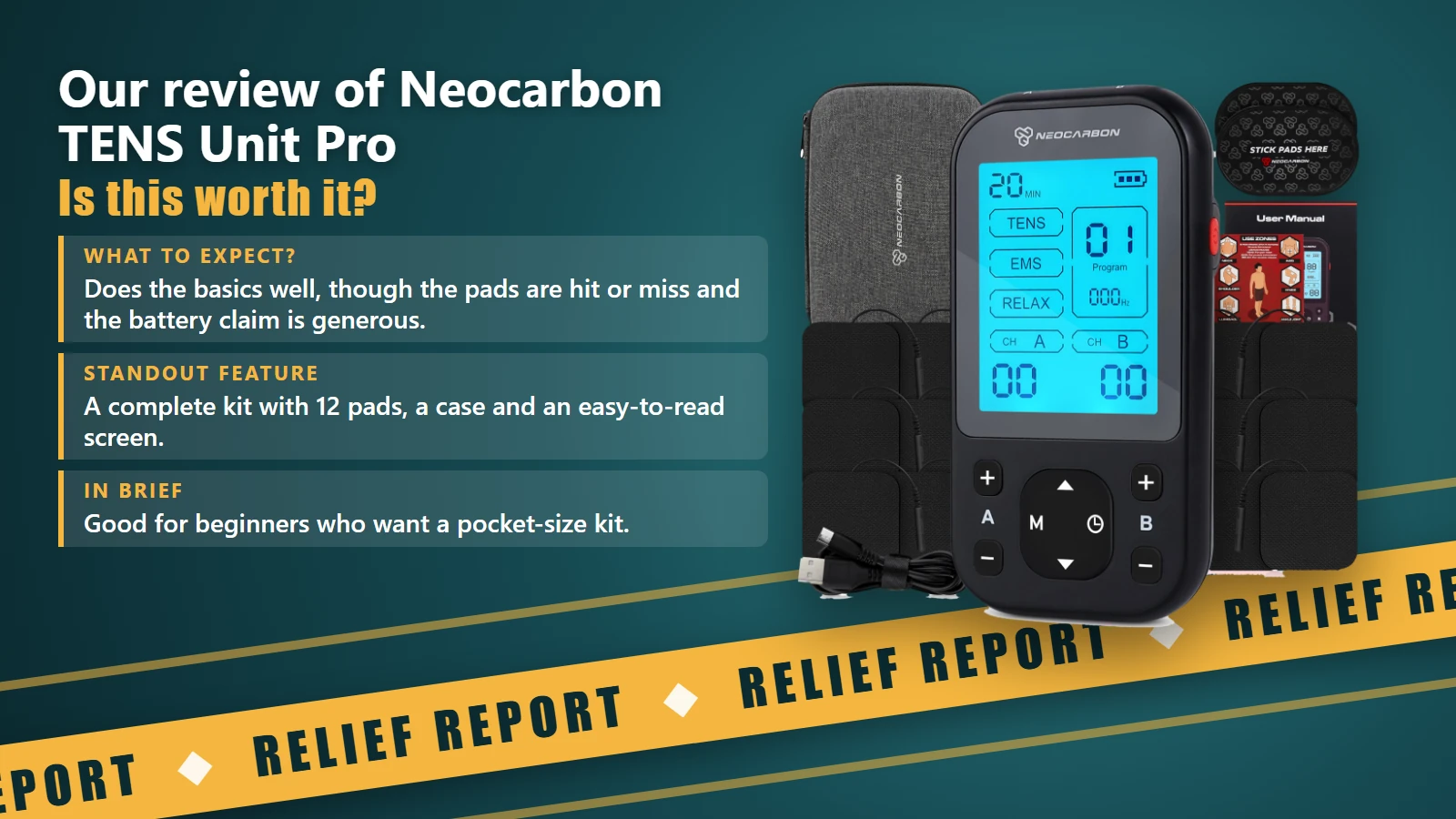
Some devices only offer locked presets, which is the case with the Neocarbon TENS Unit Pro. The Pro has three modes and 36 patterns, but you cannot adjust the pulse width or frequency, so you are stuck with whatever the maker chose.
The manual for that same unit says 24 patterns, which is one of several places it trips people up. One of our clients fixed the wrong pattern numbers by writing the right ones in by hand.
Members also list locked presets among their regrets, because some left them on cycles that felt either imperceptible or jarringly harsh.
How do you find the right intensity?
Intensity is the raw power of the unit, measured in mA (milliamps, how strong the current is), though most devices just show levels from 1 to 20. Always start at the lowest setting and work up slowly.
You want a strong buzz or a mild muscle contraction, and then you back off a notch if it stings or cramps. Do not judge power from the first minute.
Buyers of the Neocarbon Ultra TENS EMS split on this. One said it has plenty of power for the toughest stiff muscles and another said it clears back and leg aches in 20 minutes, but a third said full power hurts and a fourth hoped for the strength of a machine they had used for twenty years.
That spread fits what the group says about every unit of this type: the right level depends on the person, the pad position and how tight the muscle is. Moving or bending the muscle under an active pad can sharply raise the intensity, so turn it down before you stand up or reach.
What are preset modes and are they useful?
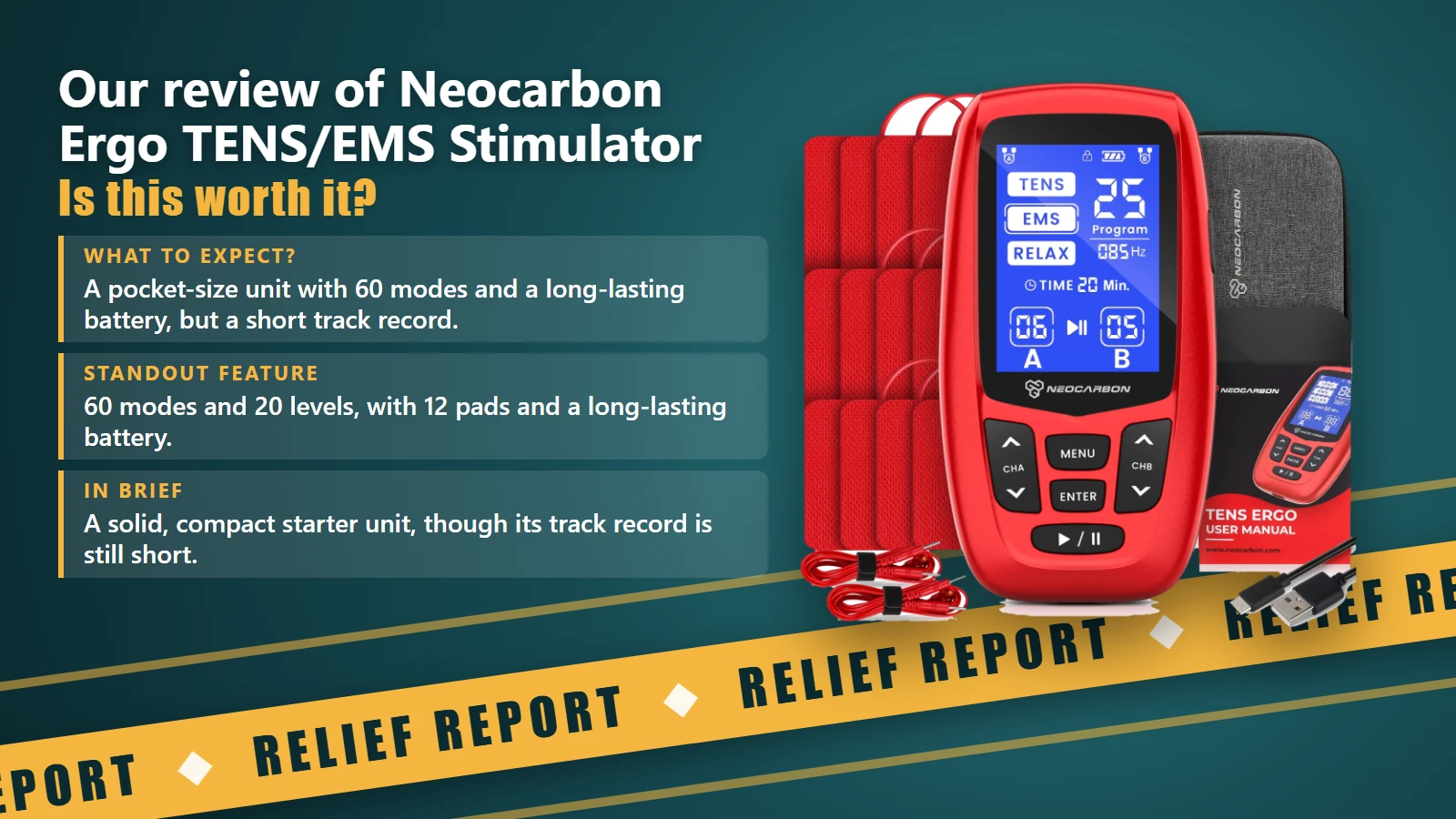
Many modern units advertise dozens of modes. The Neocarbon Ergo TENS EMS has 60 modes and 20 intensity levels, and a buyer wanted it to remember the last setting, so test the menu in your first session.
The Neocarbon TENS EMS Pulse Massager advertises 24 modes, and one client counted 6 modes with 4 sub-modes each. Two of our clients said the modes and levels all feel about the same.
A preset is a stored combination of frequency and pulse width, which is why a locked one leaves you with no way to change it. One buyer found only pattern settings and no constant option, and another said most patterns were more annoying than relieving.
A member of our Facebook group with cervical dystonia uses the relax mode on their shoulders or arm and turns it down if moving raises the intensity. For them it is one of the few things that works, though that is one member's story.
If you like to tinker, look for a unit with manual controls. If you want one-touch simplicity, a preset unit is fine, but a higher mode count does not mean a better experience.
How do you run a simple first session?
A standard session runs 20 to 30 minutes. This table shows how members set the dials for different goals.
| Goal | Frequency | Pulse width | How it should feel |
|---|---|---|---|
| Sharp, new pain | 70 to 100 Hz, often 80 | 50 to 200 µs | A strong but comfortable buzz |
| Dull aches or muscle relaxation | 1 to 10 Hz, often 3 Hz | 120 to 280 µs | A slower, rhythmic thump |
| Locked-preset unit | Not adjustable | Not adjustable | Pick the relax mode; start at the lowest level |
| Any unit, first session | Whatever the unit offers | Whatever the unit offers | Strong buzz or mild contraction, then back off a notch |
Members with chronic pain sometimes use 40 to 45 minutes twice a day, and during severe flare-ups some run back-to-back cycles for 1 to 3 hours. For a first session, keep to around 20 minutes and build up from there.
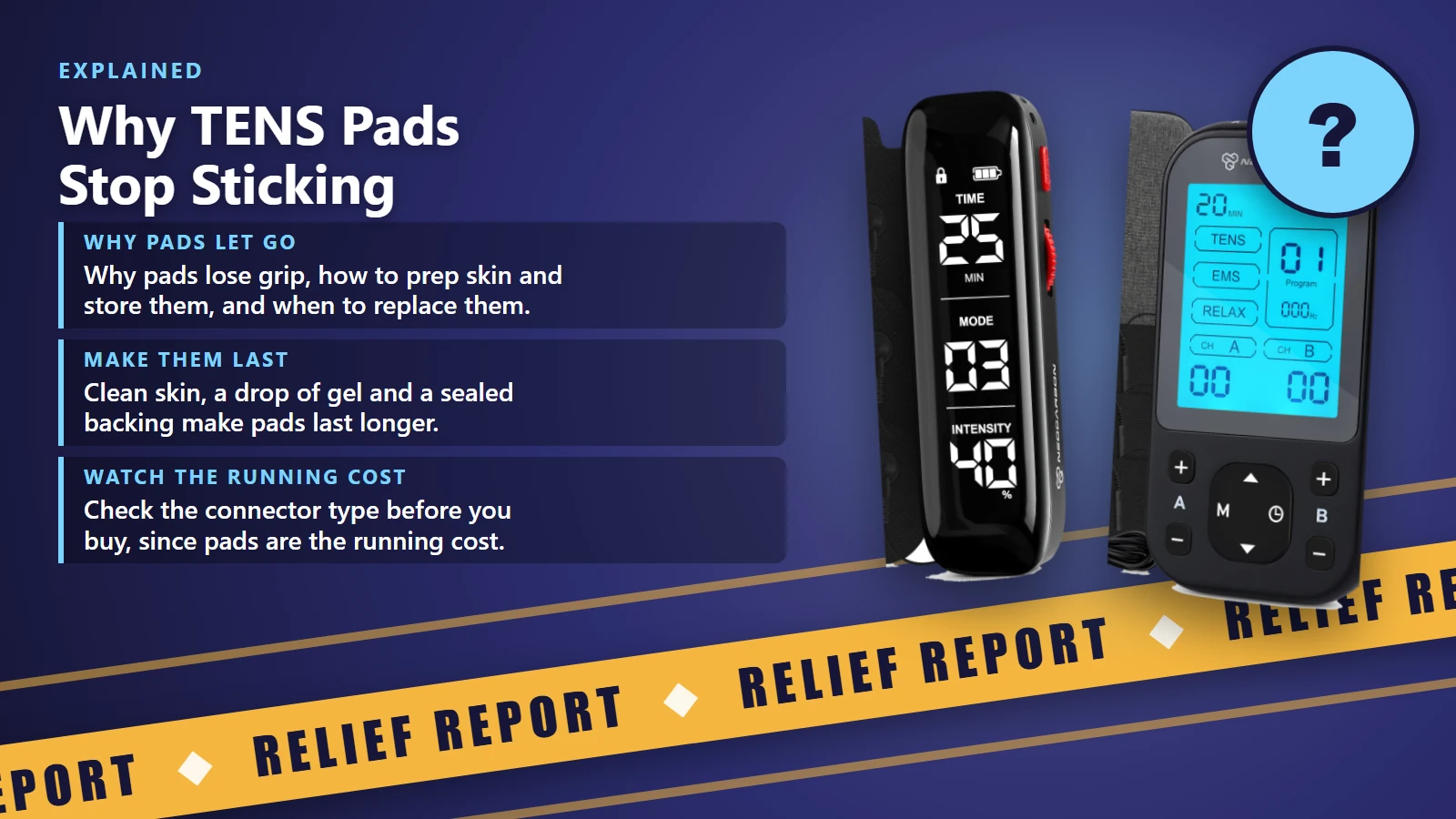
Clean your skin with alcohol wipes or plain soap and water before you place the pads, since this removes oils and helps them stick. One client found the pads stopped being sticky after about five uses, and our guide on why TENS pads stop sticking covers the fixes.
Members say a tiny drop of conductive gel or water on dry pads, and storing them sealed on their plastic backing in the refrigerator, helps them keep their grip across 20 to 30 uses. Anchor the wires inside your clothing so cable weight does not peel the pads loose.
A pad that lifts is a real hazard. The current then concentrates on a tiny point and can shock you, so turn the unit down before you press it back on.
Many members report better relief wearing the unit during light yoga or household walking, which lets tight muscles relax into the pulse. Others use a "sandwich" of TENS pads on the lower back with an ice pack or heating pad on the lower abdomen.
These units can help sore muscles feel looser, but they do not fix the cause, and members regret expecting a permanent fix for things like disc problems. If pain returns at full strength the moment the unit powers down, that is common, but severe or new pain deserves a call to your doctor.
Anyone with a pacemaker or ICD (an implanted device that regulates the heart) should skip every TENS and EMS unit. Pregnancy, epilepsy or a heart condition mean a physician should weigh in before you begin.
Keep pads off your chest and off the front and sides of your neck. Stop the session if you feel dizzy, nauseous or faint, because some members returned units after dizziness or severe muscle cramping from sessions that overstimulated sensitive nerves.
Questions People Ask
Can I use a TENS unit on my neck?
Keep pads off the front and sides of your neck, which is a standard caution for these units. If your neck feels tense, ask a clinician where pads can go, and use fleshy muscle such as the upper shoulders rather than the neck itself.
Why does the same mode feel different on different days?
Members say the right level depends on the person, the pad position and how tight the muscle is, and all three change from one session to the next. Pad grip matters too, so start low every time and do not judge the power from the first minute.
How long do the sticky pads last?
Members say pads can last 20 to 30 uses with care, though some units ship with flimsy pads that lift after one or two uses. Clean your skin first, add a tiny drop of conductive gel, store the pads sealed in the refrigerator, and replace them when they lose their tack.
Will a TENS unit build muscle?
No, a TENS unit works on the pain signal and gives a surface buzz. If you want to wake up a quiet muscle after surgery, you need an EMS or NMES device that makes the muscle contract, and even then reviewers and members describe it as light conditioning, not real strength gains.
Your Next Steps
Start with a simple, low-cost unit if you are new to electrical muscle stimulation, and do not pay for 60 modes if you will only use two. Look for manual dials if you want to control the frequency and pulse width yourself.
If you just want a quick buzz for sore muscles after a workout, a preset pocket unit will do the job. Clean your skin, start at level one, and keep your first session to around 20 minutes.
If you feel dizzy or the pads sting, stop and adjust. These tools can help sore muscles feel looser, but they are one part of your recovery routine, so use them to support your training, not to replace rest and good movement.