

Key Takeaways
- The listing sells eight settings starting at 50 mmHg, yet two reviewers said even that lowest setting was too much, and one felt it painfully around the ankles and the top of the foot.
- The longest reports run about 9 months, and two of them ended with a unit that quit, so lean on the 24-month warranty rather than hope.
- Expect a firm hug from foot to thigh, not hands-on kneading: that is what reviewers got from the 20, 25 or 30 minute cycles.
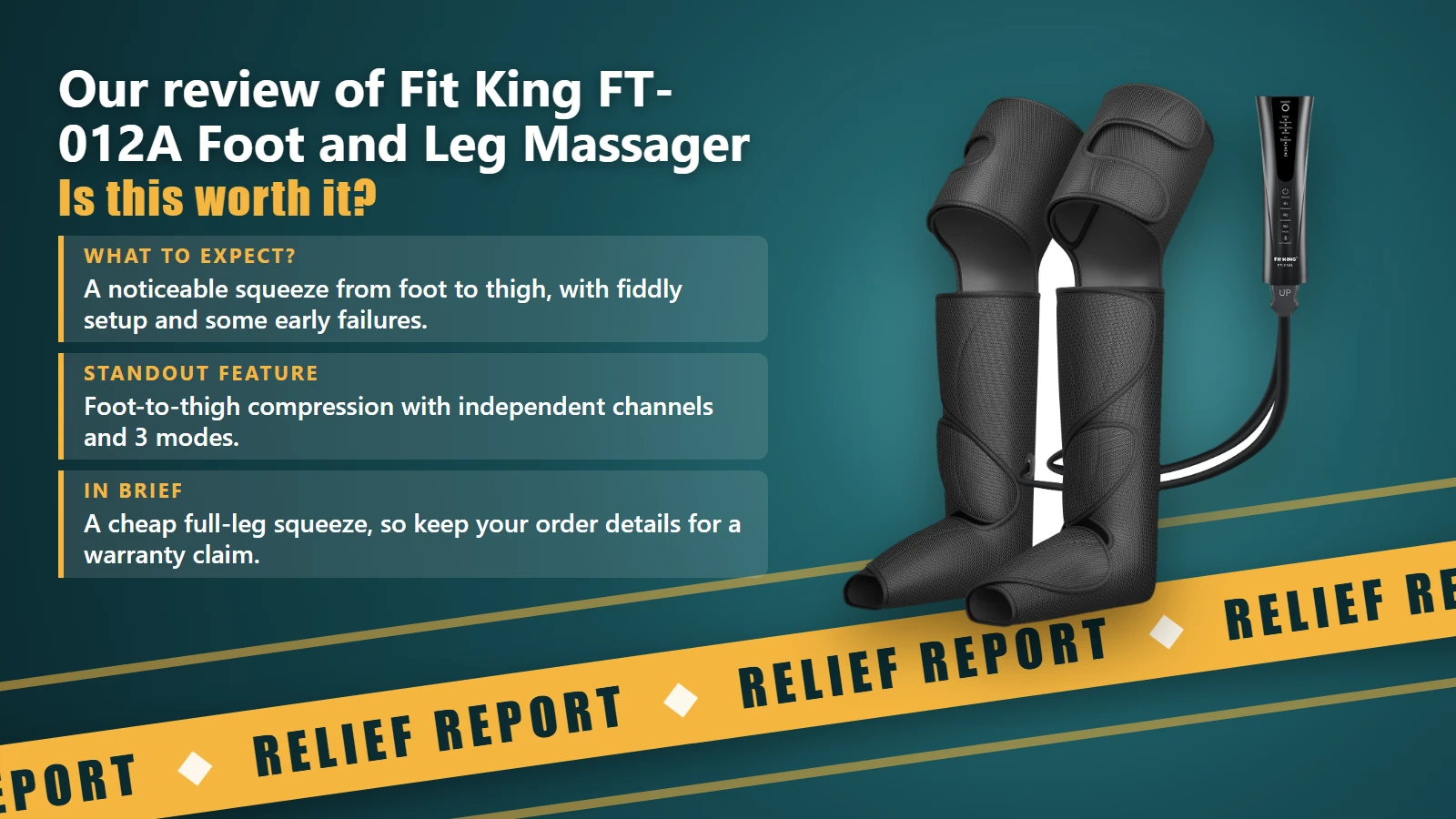
- Price-wise, the closer rival to $359.99 is the Fit King FT-082A at $319.99, which a member said has the same 50 to 120 mmHg range, rather than a $900 Normatec.
- Weak grip or sore hands will make it a chore, since the stiff hose connectors showed up in four separate reviews.
Will ran this system for 1 to 3 hours a day over 9 months as a competitive runner, and it did exactly what was asked until June. Then it started shutting off early, sometimes a minute after turning it on, and Will's attempts to reach support got no reply.
That arc, strong squeeze followed by a unit that quits, runs through this Quinear leg recovery compression system review. It is a corded, full-leg boot set for people who want firm pressure at a lower price than the big names, and it only suits you if your legs tolerate firm pressure and you accept some durability risk.
What Is in the Box, and What Do the Specs Mean for You?
The model number on the spec sheet is QN-071A, and this listing is the Medium size. Here is how each spec translates to daily use.
| Spec | What it means for you |
|---|---|
| Price | $359.99, the premium end for leg boots. |
| Chambers | 4 air chambers: foot, lower calf, upper calf, thigh. |
| Pressure | 8 levels from 50 to 120 mmHg. |
| Modes | 3 patterns: sequence, circulation and combination. |
| Timer | 20, 25 or 30 minutes, then it shuts off. |
| Heat | None. The listing says there are no heat settings. |
| Power | Corded only, no battery included. |
| Weight | 2.5 kg for the set. |
| Warranty | 24 months, per the listing. |
If these numbers match what you want, you can check the current price of the Quinear Leg Recovery System before reading on.
(If you buy through this link we may earn a small commission. It doesn't change what reviewers and group members reported.)
The unit measures its own mmHg (the pressure unit used for blood pressure cuffs) and the listing says a sensor adjusts to your leg size. On first use the display may read 0 for about two minutes while that sensor warms up, and both sleeves must be connected or nothing runs.
Who Should Buy This System, and Who Should Skip It?
Firm compression suits some legs and bothers others, so these lists come from what reviewers and buyers actually reported.
- Buy it if: you want a full-leg, plug-in unit for seated or reclined evenings. A reviewer who gave it 4 stars used it 30 minutes morning and evening while reading or watching TV.
- Buy it if: you have used premium compression and want something cheaper that still squeezes hard. Several reviewers compared it favorably with pricier brands.
- Buy it if: your height is around 6 feet, because the Medium ran long on shorter users. A 6'1" reviewer said the length fit his inseam well.
- Skip it if: firm pressure feels painful to you, since the lowest setting is already 50 mmHg.
- Skip it if: you want heat, a battery for travel or an app, because it has none of the three.
- Skip it if: your hands are weak or sore, or you have mobility issues, because both the zipper and the hose connectors took real effort.
Other Observations From Friends, Relatives and Other User Reviews
Friends, relatives and other reviewers tried this set, and none of them gave it 5 stars. Here is what each of them said.
- A reviewer who bought it for a spouse with POTS used it daily for 9 months and says it worked amazingly until it just stopped. There was no way to contact customer support, and any POTS plan should be run past a doctor first (2/5).
- A reviewer who wanted a massage found the pressure unbearable even at the lowest setting of 50. The verdict was that it behaves more like an air compressor than a massager, and anyone shopping for a massager should look elsewhere (2/5).
- A competitive runner was satisfied with the 50 to 120 range and wished for a longer timer than 30 minutes, though restarting after the shutoff was no problem. Using it 1 to 3 hours a day, they found that since June the unit turns itself off before the timer ends, sometimes after one minute, and it seems to need a long rest before it runs the full 30 (3/5).
- A reviewer on long shifts found the big zipper catches in its own protective strip and unzips itself, and struggled for weeks before getting the hang of it. Putting the boots on while lying down, or sitting with the legs supported, helped, and the compression itself worked well once they were in (3/5).
- A reviewer who had priced spa-style units at $500 to $1,400 found this one at about $399 with a $100 coupon, so the lack of heat didn't feel like a loss. They use it 30 minutes morning and evening and had no regrets, though it is well below the pricey units on features (4/5).
- A gym-goer tried it at a desk and found setup quick, but the 30-minute timer meant running it twice. After 3 to 4 sessions a week they felt no difference in recovery and are returning it, while still saying that if compression is your thing, you can't go wrong (4/5).
- A recreational runner found the ball of the foot squeezed far too hard until wearing stiff-soled shoes, then tried a Normatec, which was easier on the feet and didn't squeeze harder.
- A reviewer working on recovery habits liked the build but said the Medium would suit someone about 6 feet tall and found it awkward on anyone shorter. Another with a 32-inch inseam ordered the small size and still had it ride too high, and said a small would not work for a 29-inch inseam or shorter.
- Two reviewers called the hose connectors the main flaw. One had a strong athletic daughter who couldn't push the release tabs, and the other could not get the three connectors loose at all.
- A reviewer with thicker thighs said the sleeve was fine until midway up the thigh and then got very tight. Another reviewer living with lymphedema reported a visible difference at the end of each day, while one with circulation and lymph problems saw no change, so those questions belong with a doctor, not with a review.
The clearest pattern is that the squeeze is real and the hardware is the weak spot. Some units stopped working, partly or fully, and others fought with the connectors or the zipper.
What Members of Our Facebook Group Reported
No member has posted about this exact model yet, so the table below uses posts about Quinear boots and similar air compression boots. Read it as members' experience with the brand and the kind of device, not with the QN-071A itself.
| Member | Device | Experience | Takeaway |
|---|---|---|---|
| A runner doing double-digit long runs | Quinear compression boots | 20 to 30 minutes after long runs, paid about $200 | Felt soreness dropped a lot |
| A member with an FSA balance | Quinear compression boots | Paid $280 | Unsure of real benefit, likes how legs feel |
| A member comparing with a sibling's pair | Quinear boots vs Normatec | Used both | Normatec slightly better, not worth the gap |
| A member with small legs | Budget copies of premium boots | Compared them to Normatec and Therabody | No difference noticed, fit small legs better |
| A strength coach training 5 to 6 days a week | Fit King FT-082A, then FT-130A | Moved from corded to cordless for regular use | Setup friction decided it |
| A member who returned a Therabody pair | Therabody boots, then Hyperice | Disliked the all-at-once inflation | Preferred a wave moving up the leg |
Members and reviewers agree that a budget set can feel close to the expensive ones for plain squeezing. Where reviewers and members split is cords: our group says corded setups with separate controllers discourage frequent use, and the same complaint shows up here as extension cords across the room.
The member comparing it with a Normatec sums up the trade-off in one line: slightly better, but barely, and not worth the price gap on a budget. Nobody has told us how this specific set lasts beyond what reviewers reported, so that stays open.
The cordless step the strength coach took is covered in my Fit King FT-130A write-up, where the price is $699.99.
Does the Marketing Match Reality?
The listing is clear about its settings and its warranty. Here is how those claims held up against what reviewers and buyers said.
| What the listing promises | What users actually found |
|---|---|
| 8 pressure levels from 50 to 120 mmHg | Two reviewers found 50 too strong, one buyer felt no step from 50 to 70. |
| Sensor adjusts to leg size | Medium ran long under about 6 feet and tight on thick thighs. |
| Sequential wave up the leg | Works, but one reviewer found deflation slow and another found it quick. |
| 24-month warranty | Several could not reach support; one got a replacement after three weeks. |
| Carry bag for portability | One reviewer could not bag it without unplugging the stiff connectors. |
The brand also says the pump sound is low, and no reviewer or buyer mentioned noise at all. I'd call that a point in its favor, but it's an absence of complaints, not a measurement.
How Reliable Is It, and What Keeps Breaking?
I went through 11 buyer reviews, and five of them say the unit stopped working. One no longer held pressure in every zone after under a year, one lost the control box after two months, one quit after a year and a half, one stopped before two years, and one lost a tubing connection at two years.
- Connectors: two more buyers said the cable was hit and miss when plugging in, or that a prong broke while wiggling the adapter out.
- Friends and relatives who lost the unit: some reported a unit that quit, partly or fully. That includes one that lost all pressure after four uses and one where a single leg wouldn't compress at three months.
- Hard hose release: two reviews, one from a reviewer and one from a buyer, said the release tabs take real force.
- Positives: one buyer said it isn't a Hyperice copy but is quality at under a third of the price, and another loves using it several times a day.
What About Customer Support?
Support is the sore point. Three buyers asked how to reach the seller or factory, and one reviewer said support never answered or couldn't be reached.
One reviewer did get a replacement after about three weeks of back and forth, so it isn't hopeless. If you buy, keep the return window in mind, because one reviewer advised returning within 30 days if anything is wrong.
How Does the Quinear System Compare to Other Leg Recovery Gear?
The price tier here is above budget boots and well below the premium names. Prices for other products are the ones members quoted or our tracker lists.
| Product | Price tier | Key difference | What users liked |
|---|---|---|---|
| Quinear Leg Recovery System | $359.99 | Corded, 4 chambers, no heat | Firm squeeze, solid materials |
| Fit King FT-082A | $319.99 per a member | 8 levels, 50 to 120 mmHg, 3 timers | Same pressure range, cheaper |
| Hyperice Normatec | Members put the line at $800 to $999 | Sequential wave, app, cordless options | Kinder to feet, better fit |
| Quinear QN-072A | $129.99 | Heated, with extenders | Warm heat, wide fit range |
| Product | What users disliked | Best for |
|---|---|---|
| Quinear Leg Recovery System | Stiff connectors, mixed durability | Firm-pressure tolerant users |
| Fit King FT-082A | Separate controller, power cables, air tubes | Corded users who want hoses and a controller |
| Hyperice Normatec | Price | High-volume users with a budget |
| Quinear QN-072A | Not a massage, loud for one reviewer | Heat on a tight budget |
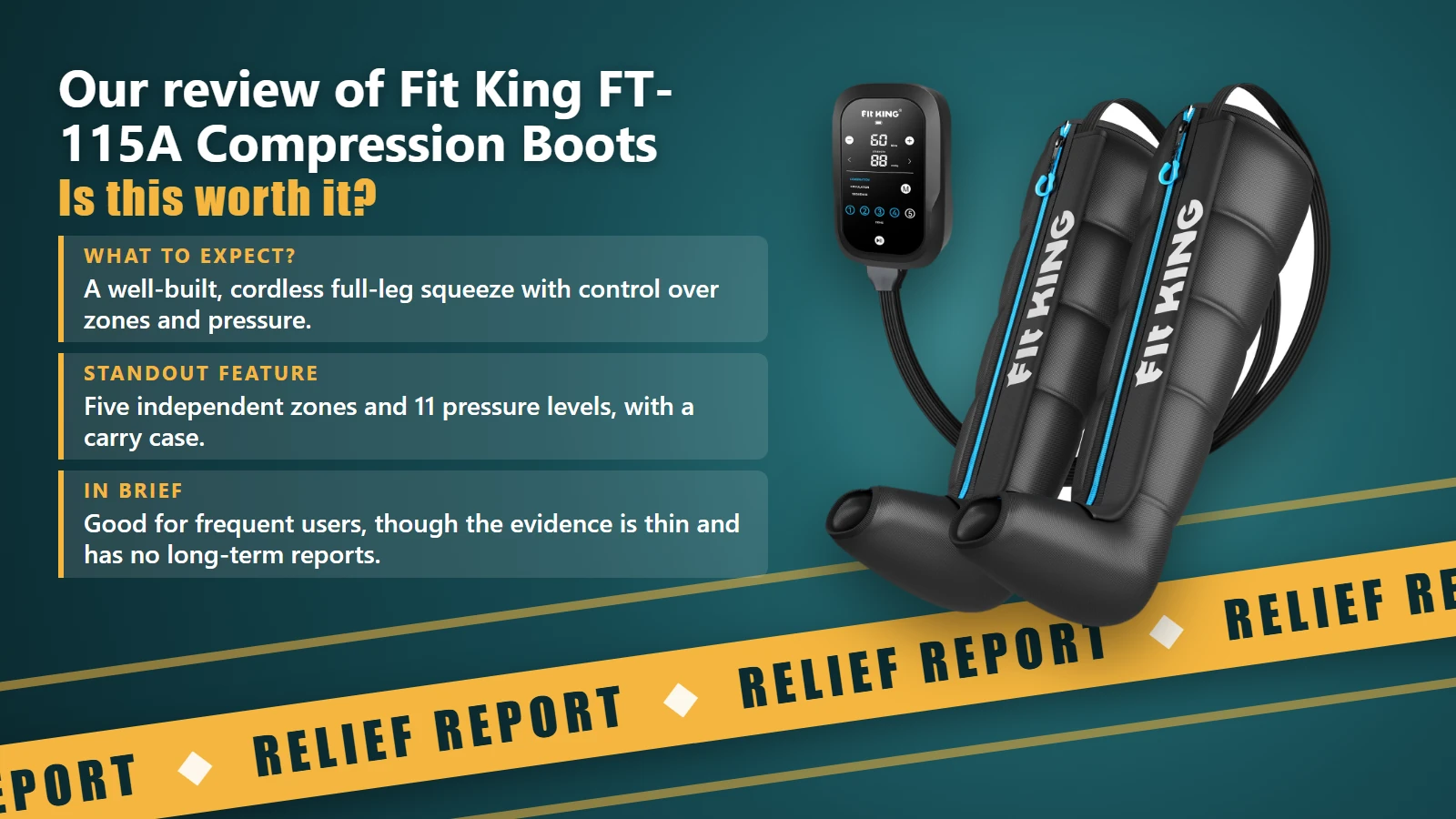
If a higher-pressure corded option interests you, how the Fit King FT-115A Compression Recovery Boots held up shows what $474.99 buys, including five zones and up to 150 mmHg.
If heat matters more than pressure, how the Quinear QN-072A Full-Leg Compression set held up shows the other side, with warmth and cuff-like squeezing at $129.99. And if it's only your hands that need attention, the Quinear QN-086H Cordless Hand Massager costs $79.99.
Between the Quinear and a Normatec, one reviewer who tried both said the Normatec was kinder to the feet but did not squeeze harder, and its Bluetooth programs weren't obviously worth the cash. Another reviewer with thick thighs said the Normatec fit well where this one didn't, but added you can't beat the price versus the Normatec.
What to Look for When Buying an Air Compression Leg Massager
These factors come from what reviewers and group members told me, not from a spec sheet.
- The lowest setting: if you are new to compression or have sensitive feet, check that the minimum is gentle enough. Two reviewers here found 50 mmHg too much, and members describe a first session as an aggressive blood pressure cuff.
- Sequential inflation: members prefer a wave from foot to thigh over one big balloon, and this unit does fill chamber by chamber.
- Per-zone control: reviewers wanted to set different pressures for foot, calf and thigh, and this set doesn't offer it. Advanced models let you switch zones off, which helps with tender knees or feet.
- Inseam: members say under 33 inches usually needs the small size. A 32-inch reviewer in our data still found the small too high.
- Closures and connectors: try to find out how hard the zipper and hose release are, since both caught reviewers out here.
- Cords: corded sets need a plug nearby, and one reviewer wished for a rechargeable option to avoid extension cords.
- Support and warranty: check you can actually reach the seller. Five of the 11 buyers had a unit quit, and several couldn't find anyone to ask.
- Price tier: members place budget boots at roughly $120 to $280 and premium at $600 to $999. This set sits between them.
Spend a minute measuring your inseam and checking the return window before you click buy, because fit and setup frustrations drive most returns in our group.
How Long and How Often Should You Use It?
The timer gives you 20, 25 or 30 minutes, and our group members mostly run 15 to 30. One reviewer used it twice a day for 30 minutes, while Will ran it for hours a day and hit the shutoff problem in month 9.
Start on the lowest setting and move up only if it feels comfortable. Members often settle around 80 to 100 mmHg after hard sessions, and wear thin pants to avoid deep skin marks.
The listing says to read the manual, zip the sleeves fully before use, and stop and talk to a doctor if the lowest setting still feels too strong. It also says anyone with osteoporosis or similar conditions should use it only under a doctor's guidance.
Anyone with a history of blood clots or DVT, peripheral artery disease, heart failure, open wounds, leg infections or recent leg surgery should check with their doctor before using air compression. This set isn't a medical device for lymphedema, swelling or circulation disease, and one reviewer's varicose veins looked worse after a session, so stop at any tingling, numbness, nausea or one-sided calf pain.
Verdict: Is the Quinear Leg Recovery System Worth $359.99?
This Quinear leg recovery compression system review comes down to a firm squeeze at a lower price than the big names, set against stiff connectors and durability reports that make me cautious. The pressure floor of 50 mmHg is the other catch, since several reviewers found it too strong.
Buy it if you want a plug-in, full-leg unit, tolerate firm pressure and keep the return window in mind. Skip it if you have weak grip, want heat or travel use, or need a gentle start, and look at the Fit King FT-082A or the heated QN-072A instead.
If that fits you, check the current price. The reviews I went through lean lower than the listing's 4.4 average, so judge it on the hardware reports above.