

Key Takeaways
- Three of our six clients had the lights fail on an $80.99 mat, anywhere from about three weeks to about six months in, so keep the receipt.
- The clients who felt a difference used one device daily for two to three weeks, and even they admitted time may have done some of the work.
- None of the four products we reviewed gives a light-strength figure we could verify, so "medical-grade" on the box is the seller's wording and nothing more.
- Eyes come first: members describe double vision, halos and blurry sight after sessions without goggles, so use them every time.
- Most of the evidence behind our four reviews is thin, and the $899.99 mat rests on one person's report.
Three of the six clients who tried an $80.99 red light mat had lights fail, from about three weeks to about six months in. It is a small sample, but it is the pattern we saw most clearly.
This guide pulls together what our four red light reviews and our Facebook group can tell you. The evidence behind those reviews is thin, and I will say so plainly where it is.
The short honest answer
At-home red light devices shine red and near-infrared light on your skin, and we heard some real comfort stories. Sore muscles can feel looser and tired joints lighter after a few weeks of regular use.
But the evidence on these mats and wraps is thin, and we have no long-term reports on most of them. Treat them as comfort tools, and check with your doctor first if you have arthritis, sciatica or any other condition.
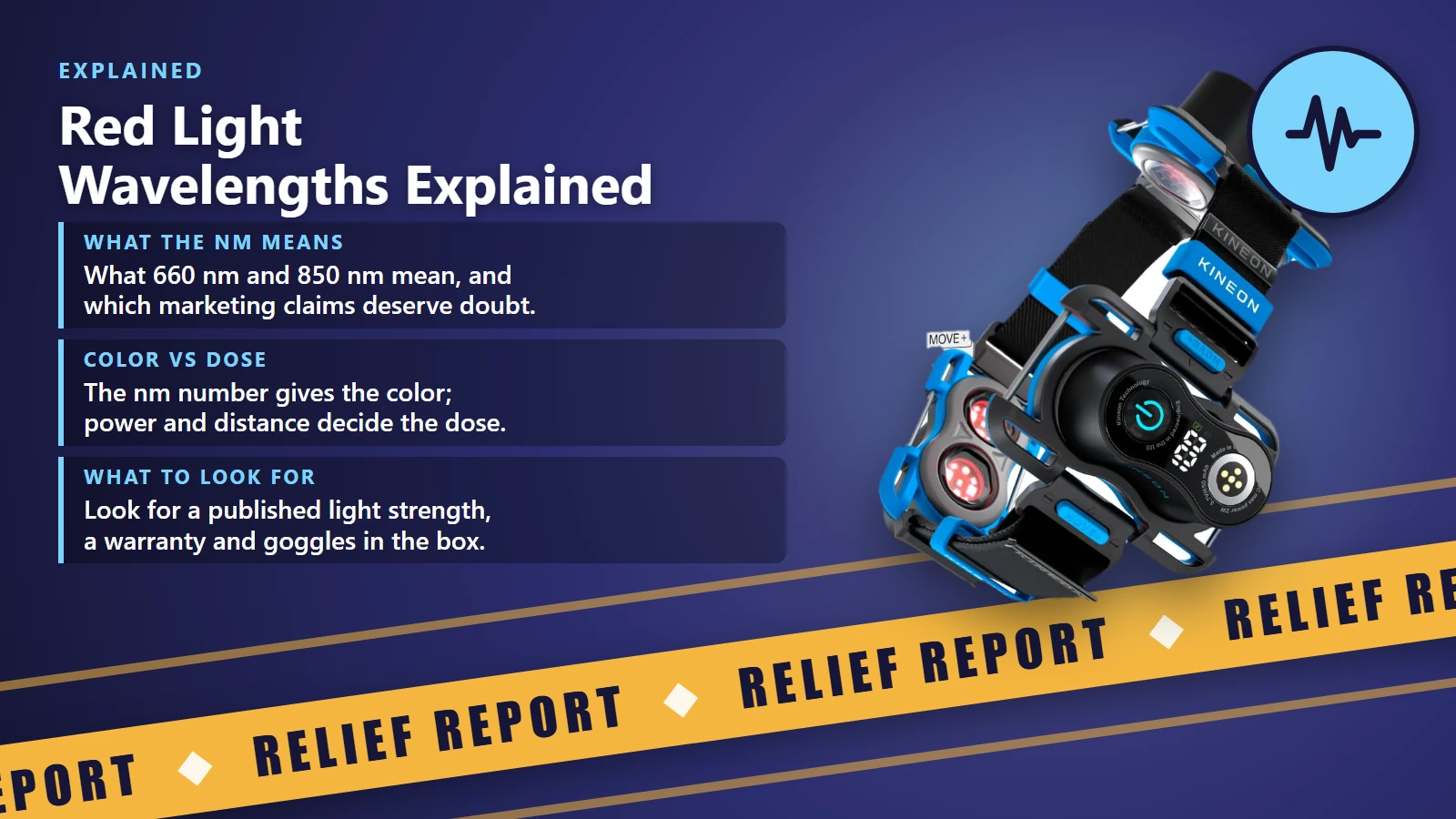
Our guide to red light wavelengths explains why the nanometer (nm, the number that names the color of the light) figure matters. The short version is that without a published irradiance (how strong the light is where it meets your skin, in mW/cm²), nobody can say whether a session is a real dose.
What users report
Our clients and group members have spent real time with these devices. The reports are mixed, and the hardware failures stand out.
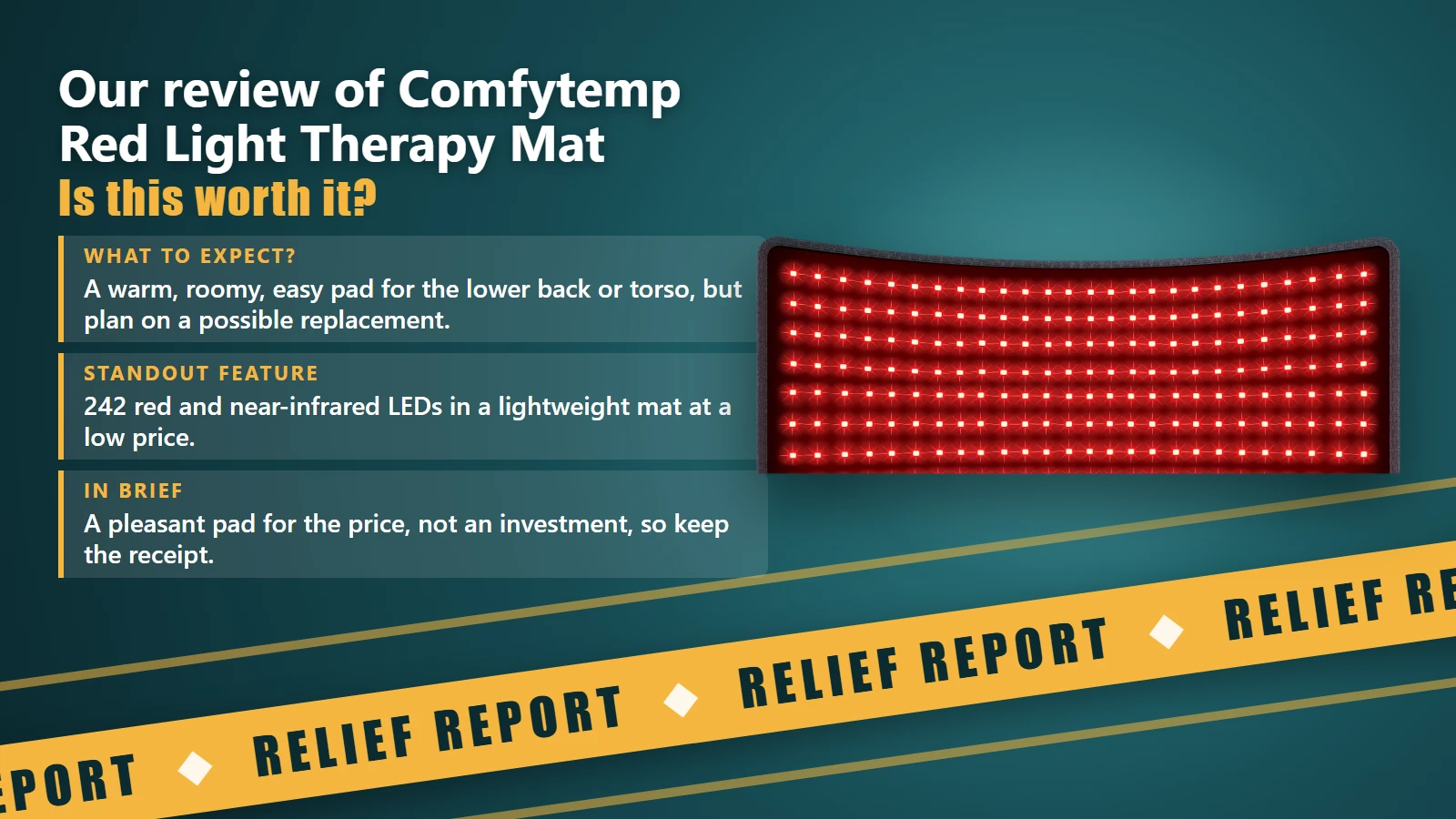
One client used an $80.99 Comfytemp mat for back spasms and long-running spine pain. After two 20-minute sessions in a row, the spasm calmed enough to walk outside, and the lights burned out at about six months.
Another client used the same pad every day on the shoulders and a recent neck injury, and it heated them well. Three weeks in, two thirds of the lights went out at once, and the client got a refund.
A third client needed the light over the left hip and low back, but the pad ships folded and the creases would not lie flat even after two sessions. It also smelled strongly of chemicals and had no timer, so it went back despite some relief.
A fourth client bought it with leftover HSA funds to add red light to a routine while traveling for work. After a couple of months of a few sessions a week, no recent flare-ups and nothing feels worse, though the client cannot say yet how much it helps.
One reviewer reported that the first session blistered the skin on the back. One buyer said that after a year the LEDs shifted and heated the black material so much that the pad was unusable after 10 minutes.
The Miceylive Full Body Red Light Therapy Mat costs $339.99 and offers 73 by 33 inches of lie-down coverage. An 81-year-old client has a family member carry the roughly 8-pound mat to the bed, and the usual routine is one 30-minute session at night.
Two reviewers describe a gentle warmth at skin contact, and one calls it soothing. A member who owned both this mat and a panel said the relief for back pain wore off within hours.
The Kineon Move+ Red Light Therapy Wrap costs $499.00 and uses three solid LED modules for one joint. A client with a bone bruise below the knee used it daily for about 2.5 weeks, and the pain eased until they were walking a mile a day without the cane they had used for three months.
That client admitted that not much else changed except time passing. Another client strapped it on the knee after workouts and liked it at first, but the strap holder was awful and one module died at six weeks.
A member with a ligament tear used it for two months and noticed only warmth near the end of a session. That is the honest middle of the pile: some people feel a lot, some feel nothing, and the evidence cannot tell you which group you will be in.
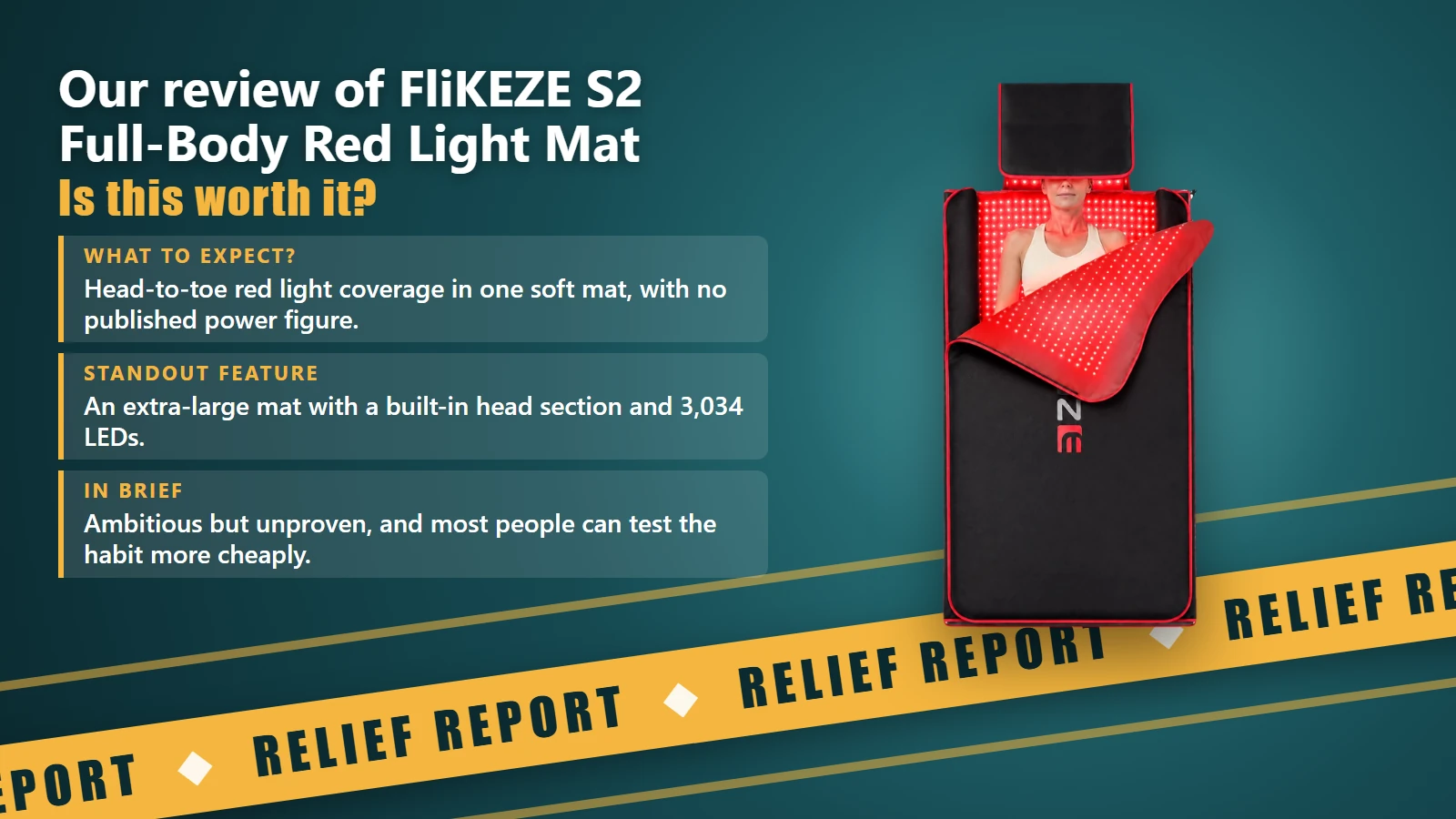
The FliKEZE S2 Full Body Red Light Mat costs $899.99 and has 3,034 LEDs. The one client we heard from uses it on the floor after workouts while stretching or relaxing, gave it 5 out of 5, and reported nothing negative.
With one report, I cannot tell you whether that client is typical or the happiest owner of the bunch. Group members agree that how you use a device counts more than the hardware, since expensive devices gather dust when sitting still for 10 to 20 minutes feels like a chore.
Where the hype goes too far
Many members and medical professionals first dismiss red light therapy as snake oil or an overhyped wellness trend. Some of that skepticism is justified.
Red light will not erase established wrinkles overnight, tighten a severely sagging neck, or remove extensive cellulite. It will not fix a mechanical disc problem without physical rehab either.
Small handheld wands that cover only a patch of the face in three-minute turns are widely called impractical toys. Members who spent $50 to $100 on generic wands or small bulbs got negligible coverage and no results they could see.
Here is how the claims you will see stack up against what our clients and members found.
| Claim you will see | What we actually found |
|---|---|
| "Medical-grade" | The seller's wording; nothing independent behind it |
| Thousands of LEDs (3,034 on one mat) | The listing publishes no light-strength figure, so the dose is a guess |
| Results in 2 to 3 weeks | A brand claim; one client noticed a change at about 2.5 weeks |
| Firmer skin in four weeks | A brand claim; nobody reported on skin results |
| Built to last | 3 of 6 clients had lights fail on an $80.99 mat |
| A mat does what a panel does | One member said mat relief for back pain wore off within hours |
| Small handheld wands work | Members call $50 to $100 wands negligible toy-sized coverage |
Two more problems come up in our Facebook group. Members who put panels with 1060 nm light (a long infrared wavelength that fat tissue absorbs strongly) on the face reported sudden deep lines and jowls, which they linked to facial fat loss.
Melasma (dark patches on the skin) is the other one. Panels without a separate near-infrared switch, or sitting too close to a strong light, made dark spots and melasma patches darker from the heat.
Customer service is a common regret too. Members report overseas or unresponsive sellers when mats failed, and some say companies charged cards twice, cancelled orders or refused returns without a five-star review.
Why consistency decides results
The brand behind the Kineon wrap says to expect results in 2 to 3 weeks, and that is a brand claim I would not plan around. One client noticed a difference at about 2.5 weeks, and another reviewer said it took about two weeks and was not earth shattering.
Consistency matters more than session length. The Miceylive seller suggests 10 to 20 minutes a session, 3 to 5 times a week, and reviewers ran 20 to 40 minutes, which is longer than the seller suggests but near the 15 to 30 minutes members say mats usually run.
The FliKEZE timer runs from 10 to 90 minutes, but more time is not better. Members call this a biphasic dose response (too little does nothing, and too much brings irritation instead of more benefit), and say pushing past 20 to 30 minutes per area gives diminishing returns.
Members who jumped into 30 to 45-minute sessions on high-power gear reported aches, fatigue and headaches. New users should start with 2 to 5 minutes and build up.
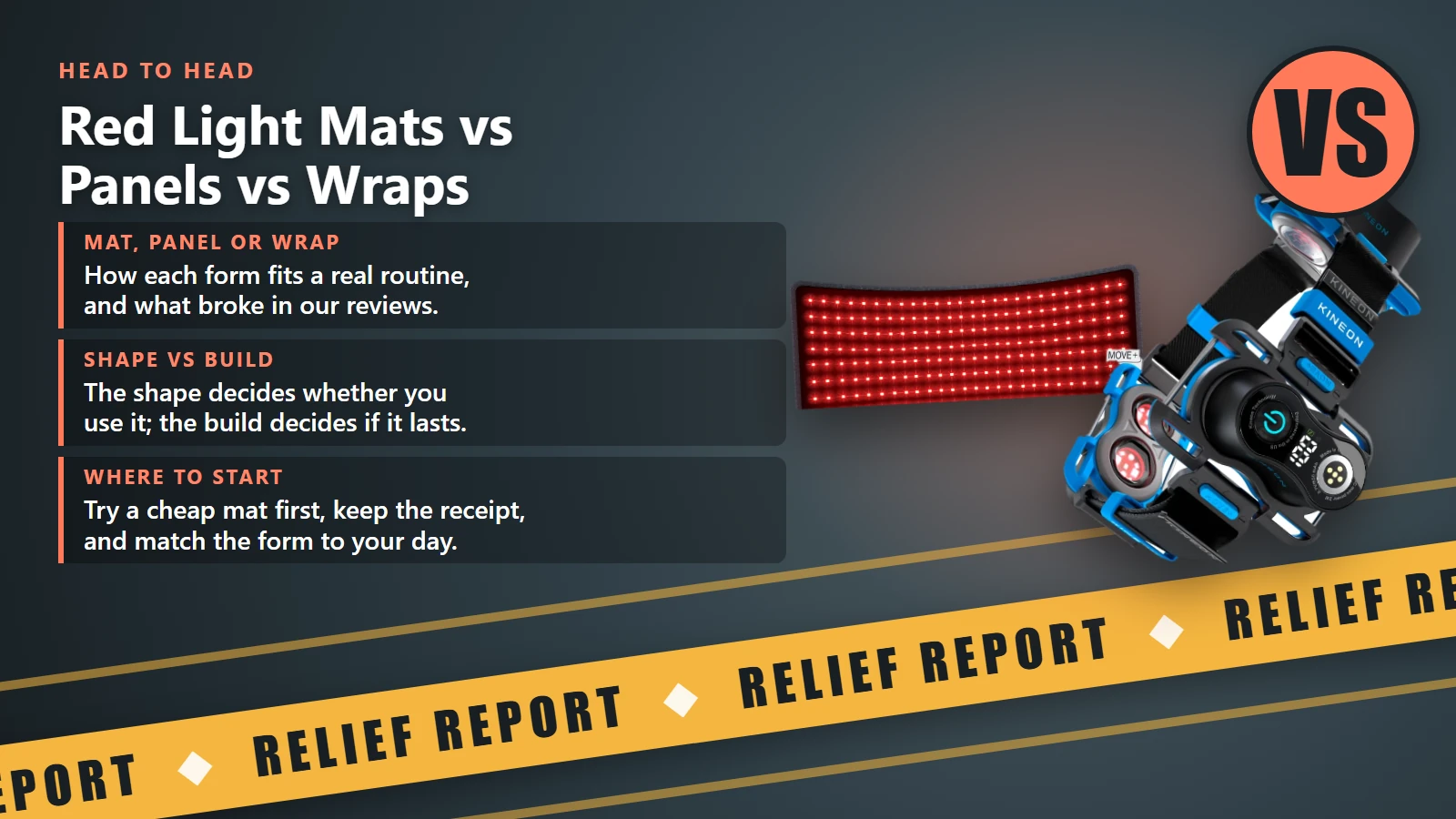
Boredom is the other enemy. Our guide on red light mats vs panels vs wraps helps you choose a form you will use, because the best device is the one you will actually use for months.
Is an at-home device worth the money?
The price range is huge, from $80.99 for the Comfytemp mat to $899.99 for the FliKEZE S2. The right pick depends on your goals, and for most people the cheapest test is the smartest.
The Comfytemp buys cheap, roomy warmth over your back, but not a pad you can count on past a year. Buy it as an inexpensive way to try red light and keep the receipt.
The Miceylive is a fair mid-range price for a comfortable, roomy mat. It suits a large lie-down session after workouts or shifts if you can handle 8 to 10 pounds, but I would pass if you need a warranty or long-term proof, since the listing states no warranty.
The Kineon makes sense only if you already know red light suits your knee or ankle, otherwise a cheap mat is the smarter first purchase. Knees and upper arms fit well, while shoulders and back need a $50 extender.
The FliKEZE suits someone who already lies on the floor to stretch after lifting, and it suits that person far better than anyone expecting a five-minute stand-up session. Its 3,034 LEDs are the headline number, but with no light-strength figure, how much dose you get is a guess.
Safety basics
Your eyes come first. Never stare into concentrated LEDs or strong near-infrared panels, because members warn that the light can heat the inside of the eye and contribute to cataracts, double vision, temporary blurring or blind spots.
One member got double vision and trouble focusing up close after six months of daily sessions with the eyes open. Another got halos and blurry vision from a panel without goggles, so use the included goggles every time, keep your eyes closed, and sit 12 to 24 inches away.
Near-infrared light and device heat can worsen melasma and sun spots on sensitive skin. Members affected advise turning off the near-infrared function and sticking to low-power red light at 18 to 24 inches.
Photosensitizing medications (drugs that make skin react to light) are a serious concern. Members say light therapy on top of drugs such as methotrexate or certain antibiotics can cause burns or rashes, so ask your doctor or pharmacist first.
Burns can also come from cheap, uncertified lamps or pads with no proper heat control. Anyone with reduced temperature sensation or neuropathy should take extra care with direct-contact pads, since one reviewer's first session blistered the skin.
Going in too hard is a risk too. New users who jumped into high-power full-body sessions reported waking with severe aches, fatigue, headaches, nausea or electric nerve buzzing.
Hardware matters for safety as well. Flexible mats are prone to solder fatigue (the metal connections inside breaking from bending), so lay them flat on something firm and do not crease or fold them sharply.
Questions People Ask
How long does it take to see results from red light therapy?
Our clients who noticed anything did so in about two to three weeks of daily use for joint comfort. The brand claims results in 2 to 3 weeks, but that is a marketing claim, and some people feel nothing.
Can red light therapy help with back pain?
It can help sore muscles feel looser, and one client calmed back spasms enough to walk outside after a session. A member said the relief wore off within hours, so think of it as a comfort tool and not an answer to a spine problem.
Is red light therapy safe for your eyes?
Not without protection. Members describe double vision and blurry sight after sessions with the eyes open or without goggles, so use the included goggles or keep your eyes closed every time.
Why do red light mats stop working?
Members blame bending and body weight on the thin wiring inside the mat. Three of six clients had lights fail on the $80.99 mat, some within a few weeks, so lay it flat and avoid sharp folds.
The bottom line
At-home red light can offer real comfort for sore muscles and tired joints, and people who use it consistently tend to report feeling better. The evidence is thin, and the hardware is where we saw the most trouble.
If you want to try it, start with the Comfytemp as a low-stakes trial and keep the receipt. Add a joint wrap only if a specific knee or ankle is the target, and skip the premium full-body mat until someone beyond a single client has reported on it.
Start slow, use eye protection, and check with your doctor if you take photosensitizing medication or have melasma. These are comfort tools, and your doctor is the one to ask about anything more.