

Key Takeaways
- The nm number on the box only names the color of the light, and the FliKEZE S2, Miceylive and Kineon listings all state no light strength.
- Red light around 630 to 660 nm is what people seek for the skin's surface, while near-infrared around 810 to 850 nm is the one they pick for joints.
- Members say a basic two-wavelength device used steadily matters more than chasing extra wavelengths.
- Prone to dark skin patches? Look for separate red and near-infrared switches, which the Comfytemp and Kineon listings do not mention.
- Never stare into the LEDs, ask a doctor first if you take photosensitizing medicine, and begin with 2 to 5 minutes.
You see "660 nm and 850 nm" on nearly every red light device box, whether it is a budget pad or a premium full-body mat. Those two numbers are the whole pitch, and most buyers have no way to tell what they mean for a sore back or a stiff knee.
This guide explains what the numbers tell you, what they leave out, and which marketing claims deserve doubt. It draws on what our clients reported after weeks and months of use, plus what members of our Facebook recovery-gear group posted about their own devices.
You will leave knowing what to look for on a spec sheet, what to ignore, and what to ask a seller before you spend anything.
What Does the nm Number Actually Mean?
The "nm" on a red light box stands for nanometers (the unit that measures the length of a light wave, which sets its color). A nanometer is one billionth of a meter.
Visible light runs from violet to red. Light just past red is called near-infrared (light your eyes cannot see but your skin may feel as warmth).
So when a device lists 660 nm and 850 nm, it puts out two colors: one you can see and one you cannot. The number tells you the color. It does not tell you how strong the light is, how deep it goes, or how much good it does.
That is where most marketing stops, and where most buyers get lost. Members of our Facebook group who have used these devices for years say a basic two-wavelength device used consistently matters more than obsessing over extra wavelengths.
Red (630 to 660 nm) vs Near-Infrared (810 to 850 nm): What Is Each One For?
Red light in the 630 to 660 nm range is the glow you see when you switch the device on. Members say it reaches about 1 to 2 mm of skin, so people look for it for surface concerns like skin texture, redness and collagen support.
Near-infrared light, around 810 to 850 nm, is invisible. Members say it reaches deeper, which is why people seek it out for joint aches, tendons and the spine.
One member with a ligament tear used a wrap with 808 nm near-infrared for two months and noticed only warmth near the end of a session. Some people feel a lot, some feel nothing, and the evidence we have cannot tell you which group you will be in.
For deeper still, members mention extended near-infrared wavelengths like 1060 nm and 1064 nm, which some say reach 15 mm or more into tissue. Members also caution that 1060 nm can trigger facial fat loss, so keep that wavelength away from your face.
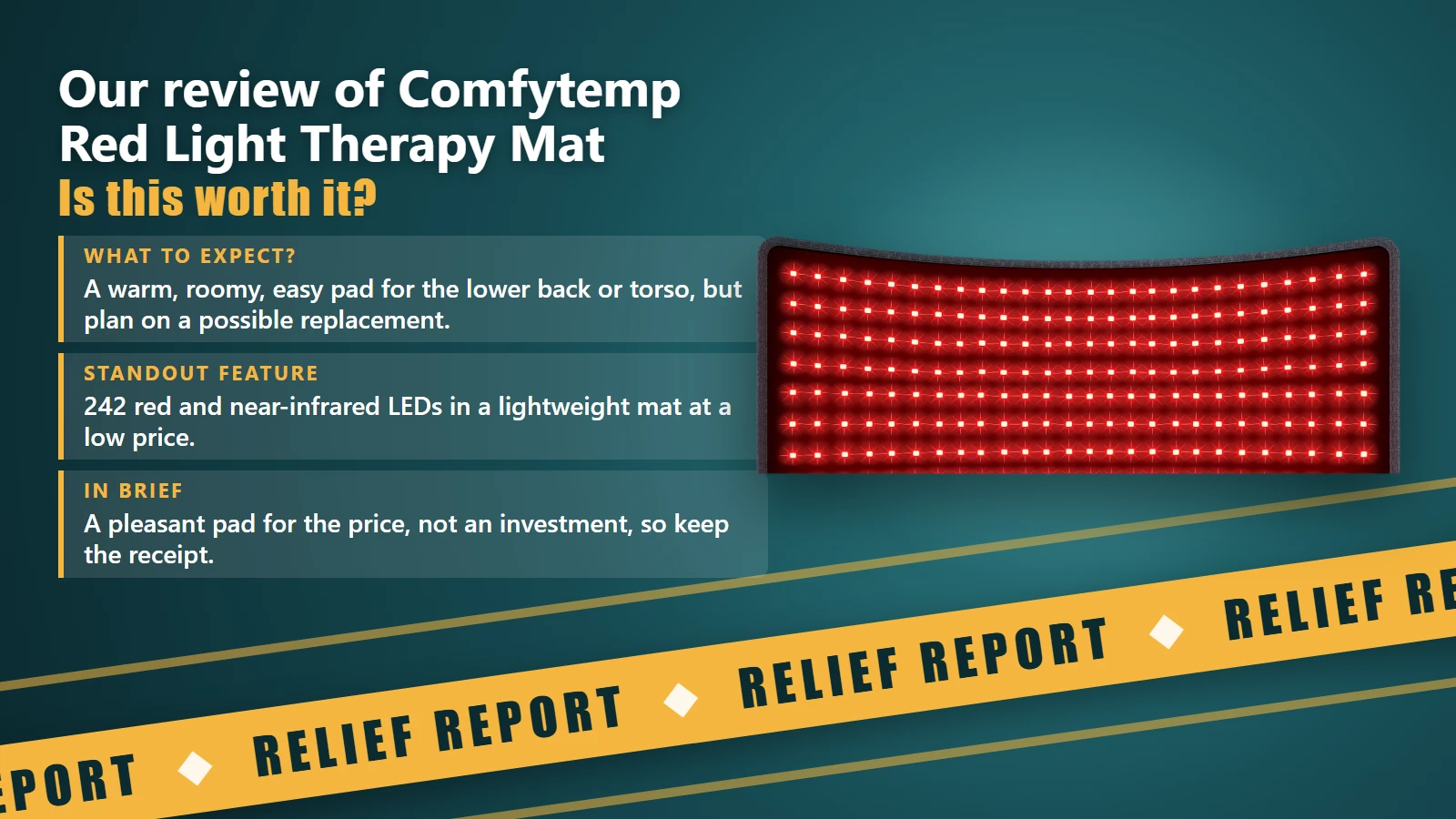
Most budget mats and wraps stick with the standard 660 nm plus 850 nm pairing. The Comfytemp Red Light Therapy Mat 24x12 review covers an $80.99 pad that uses exactly those two across 242 LEDs.
Our clients found it warm and roomy, but 3 of 6 had lights fail, some within a few uses and others by about 6 months.
| Wavelength | Color | What people use it for | Note |
|---|---|---|---|
| 415 to 590 nm | Blue, green, yellow | Surface skin concerns like acne and redness | Not part of the recovery mats we reviewed |
| 630 to 660 nm | Visible red | Skin texture, redness and collagen support | Members say it reaches about 1 to 2 mm of skin |
| 810 to 850 nm | Near-infrared, invisible | Joints, tendons and spine comfort | Some feel warmth, some feel nothing |
| 1060 to 1064 nm | Extended near-infrared | Deeper tissue, 15 mm or more by member claims | 1060 nm may trigger facial fat loss; keep off the face |
The table sums up what each range is used for, based on what members report. It is a starting point for reading a spec sheet, not a prescription.
Power and Distance Matter Just as Much as Wavelength
A wavelength tells you the color of the light and nothing about how much reaches your body. That second number is irradiance (how strong the light is where it meets your skin, measured in mW/cm²), and it is the spec most brands either hide or inflate.
Members warn that cheap brands inflate irradiance using solar power meters rather than calibrated lab spectrometers. Some also hide their real wall-draw wattage, so a device might claim 800W but draw only 200W.
High-output panels deliver 60 to 100+ mW/cm² at 6 to 12 inches, which allows short 5 to 10 minute sessions. Direct-contact mats and belts run lower, around 25 to 30 mW/cm², but they sit flush against the skin with no air gap.
Distance changes everything. A member of our Facebook group tried a red light panel and reported skin that felt like burning after 10 minutes at 8 inches.
Replies pointed out that tattoos and darker pigment can react, and suggested trying 12 to 14 inches instead. Another member with a high-power panel keeps it 6 inches or more from the skin and wears tanning-style glasses.
Too long at any close distance can give a sunburn feeling, even with a device that seems gentle at first. Start farther away than you think you need to.
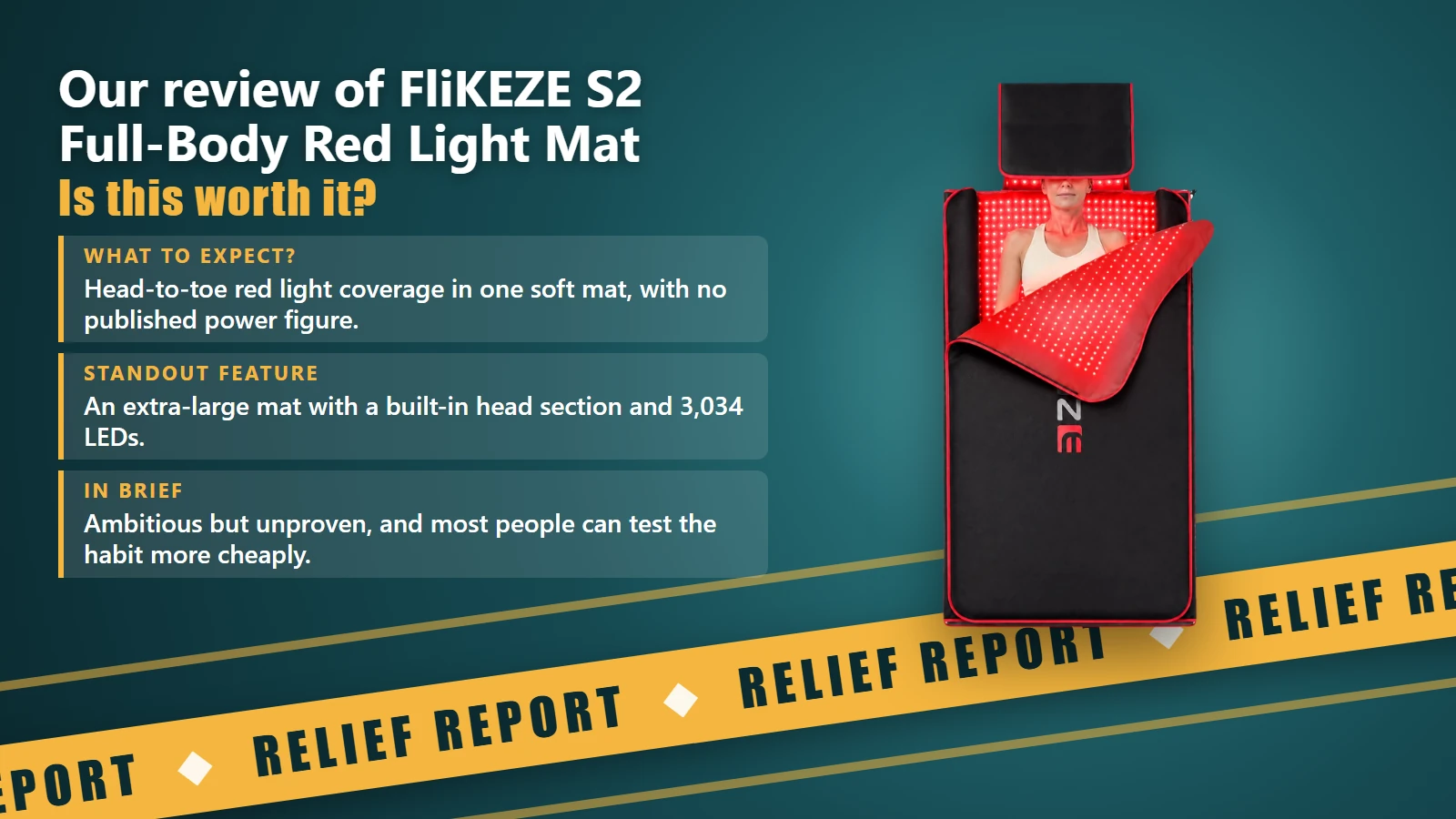
The FliKEZE S2 Full Body Red Light Mat review covers an $899.99 mat with 3,034 LED beads. The brand publishes no strength figure at all, so how much dose you get is a guess.
One client liked the full-body coverage, but with only one review behind it, every performance claim should be read as early. Mats also run lower in power than panels because they cannot use cooling fans.
A member who owned both a mat and a panel said the mat gave warmth and better sleep, but their back aches returned within hours. That is not a knock on mats, just what a flat pad with no active cooling can do.
Marketing Claims to Take With Salt
"Medical-grade" on the box
The Miceylive Full Body Red Light Therapy Mat review covers a $339.99 mat whose box says "medical-grade." That is the seller's wording with nothing independent behind it.
The surface is a TPU (a soft, wipe-clean plastic) that reviewers call soft and easy to wipe down, which is nice, but the label means nothing on its own.
Massive LED counts
A 3,034 LED count sounds impressive, but chip count alone tells you little. Irradiance is the number that matters, and if the brand does not publish it, the LED count is just a headline.
Members say multi-core LEDs that emit several wavelengths from the same point prevent dead zones. Single-core diodes spaced far apart can leave gaps where the wavelengths do not overlap.
Pulse modes for "stronger energy"
The Miceylive mat lists three pulse modes at 10 Hz, 40 Hz and an "H" mode, and the seller says they give "stronger energy." No reviewer mentioned noticing any difference.
The FliKEZE S2 also lists pulse modes, and with one client review behind it, those modes are unproven.
Certification labels
Members check for third-party lab verification and standards like CE, RoHS and IEC 60601. A device sold as a wellness tool is not the same as a medical device cleared for a specific condition.
Red light is comfort gear. It can help sore muscles feel looser and may help tired legs feel lighter, but it is not a medical device for any condition.
Low EMF claims
Some members look for lab results on EMF (electromagnetic fields, the invisible energy given off by anything electrical) showing near-zero readings at treatment distance. Without independent results, a "low EMF" line on a listing is just a claim.
Warranty silence
The Miceylive listing states no warranty, and our experience with it stretches only a few months. The Comfytemp at $80.99 had the company replace or refund without argument in three reviews, which beats silence.
Always look for a stated warranty and a seller that answers messages. For the bigger picture, our honest look at the evidence walks through what we do and do not know, and the short version is that the at-home evidence is thin even though some people report real comfort.
Eye and Skin Safety: What You Need to Know Before You Turn It On
Eye protection
Never stare directly into concentrated LED diodes or high-powered near-infrared panels. Strong near-infrared light can reach the eye and heat it, and members report temporary blurring, double vision and blind spots from overexposure.
Keep your eyes closed, sit 12 to 24 inches away, or use blackout or tanning goggles. The Miceylive mat includes protective goggles in the box, which is a good sign.
Melasma and dark patches
Near-infrared light and device heat can worsen melasma (dark patches on the skin, often darkened by heat and light) on sensitive or melanin-rich skin. Members report near-infrared flaring pigment patches after only a few sessions.
This is why separate red and near-infrared switches matter. Members prone to melasma turn the near-infrared off and stick to low-power red light at 18 to 24 inches.
The Comfytemp and the Kineon wrap do not list that option. The Miceylive mat does let you run near-infrared only, and one client used the remote to do exactly that for a nighttime session.
Photosensitizing medicine
Some medicines make skin react badly to light, which is called photosensitizing (light-sensitizing). Members say red light on top of these can cause burns, severe rashes or sudden irritation, and certain antibiotics are among the examples.
Check with your doctor before starting if you take any prescription medicine.
Burns from cheap or faulty gear
Poorly made infrared devices have caused skin burns for some members. Anyone with reduced feeling in the skin or neuropathy should be careful with any direct-contact device, because you may not notice overheating until it is too late.
The Kineon Move+ red light therapy wrap review covers a $499 device where one buyer with muscle spasms found the power-on beep loud and jarring. The manual also warns against fast chargers without saying what counts as one.
The "more is better" trap
Members describe a biphasic dose response (too much light gives you less benefit, not more). Past 20 to 30 minutes per area, or sitting too close to a high-powered panel, brings diminishing returns and irritation.
New users who jumped into 30 to 45 minute high-power sessions reported severe aches, fatigue, headaches, nausea and fast heart rates. Start low and slow, at 2 to 5 minutes, and build up over weeks.
Durability and wiring
Flexible pads and mats are prone to internal solder fatigue (tiny cracks in the wiring joints that grow worse with bending) and short circuits if bent, creased or laid on soft surfaces without hard support. The Comfytemp pad ships creased and stays stiff over a hip or knee.
Group members describe the usual failures as shorting out, losing rows of lights, or the cord connection giving way within days to months. We have no long-term reports on the premium mats yet, and no evidence they avoid this.
Questions People Ask
Do I need both 660 nm and 850 nm?
Most budget devices offer both because they cover two depths: red for the skin and near-infrared for deeper tissue. Members say a basic two-wavelength device used consistently matters more than extra wavelengths. If you have sensitive skin or melasma, you want separate switches so you can turn the near-infrared off.
How close should I sit to a red light panel?
High-output panels work at 6 to 12 inches for short sessions, though members report burning sensations at 8 inches after 10 minutes, especially with tattoos or darker pigment. Start at 12 to 14 inches, wear tanning-style goggles and never stare into the LEDs, because too close can give a sunburn feeling.
Are mats as powerful as panels?
No. Mats cannot use cooling fans, which limits their total power. A member who owned both said the mat gave warmth and better sleep but back aches returned within hours, while panels did more for deep joint and back aches, so mats win on comfort and lie-down convenience rather than raw power.
How long until I feel something?
Some people feel warmth right away and others feel nothing for weeks. Members report better skin texture and radiance within 4 to 12 weeks, and one client who used near-infrared for 30 to 40 minutes at night found joint aches eased over time. Start at 2 to 5 minutes and build slowly.
Bottom Line: Who Should Do What Next
If you are new to red light and just want to test the habit, start cheap. The Comfytemp at $80.99 is a warm, roomy way to try it on your back, but 3 of 6 clients and 8 of 16 buyers saw lights or wiring fail, so keep the receipt.
If you want targeted help for a specific knee, ankle or wrist, the Kineon Move+ at $499 has solid LED modules but an unreliable strap. You may need a $50 extender, and one client had a module quit inside two months.
If you want full-body lie-down coverage, the Miceylive at $339.99 gives 73 by 33 inches of comfort. There is no warranty information and no published light strength, though everyone who tried it gave it 5 out of 5.
If you want verified power numbers, skip the mats for now. The FliKEZE S2 at $899.99 publishes no strength figure, and the evidence is a single client review.
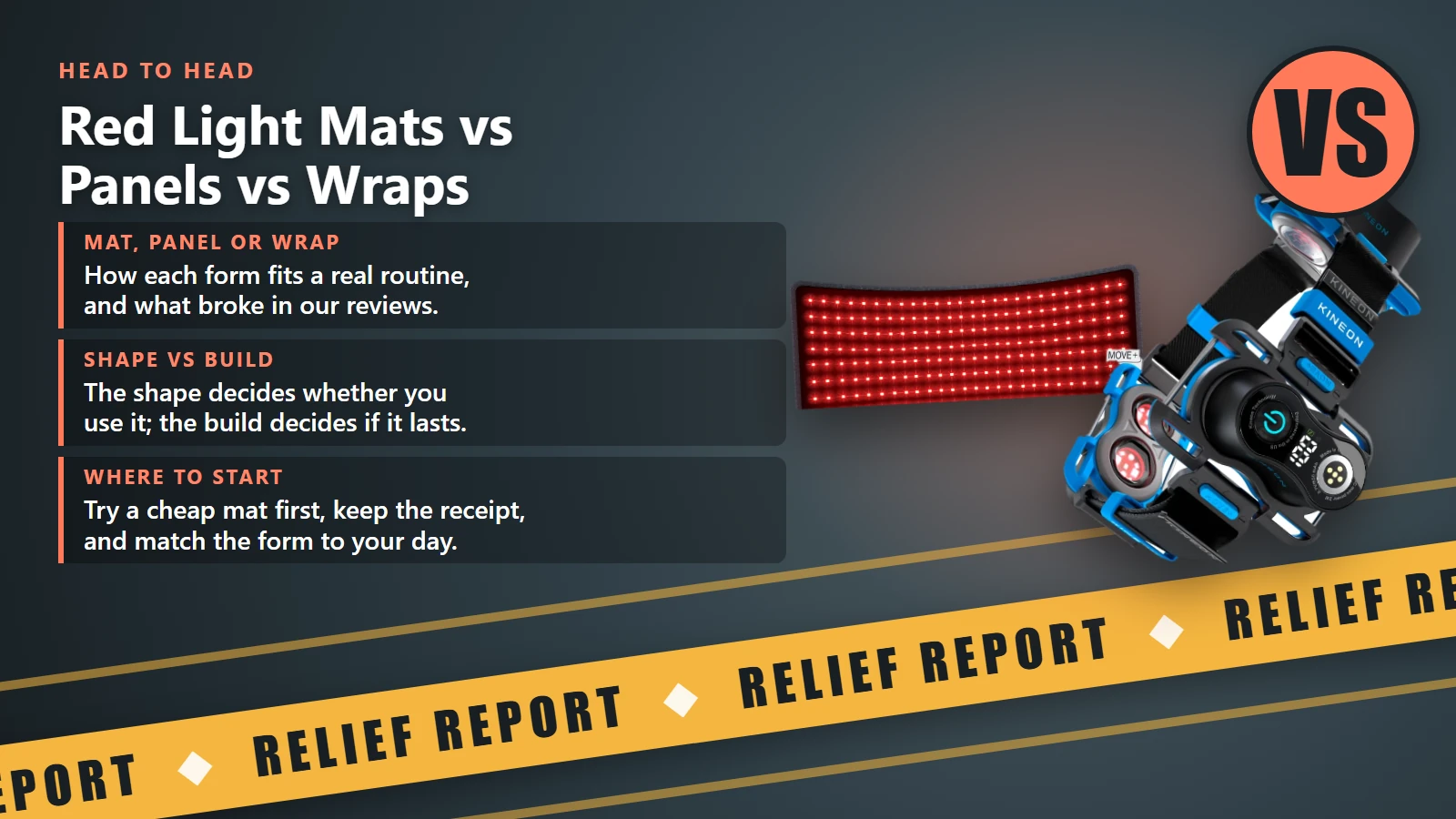
Members say high-power panels from brands like Joovv and BioMax deliver more for deep aches, but you pay panel prices and stand in front of them. Before you buy anything, check our guide comparing red light mats, panels and wraps to see which form fits your routine, because the best device is the one you will actually use consistently.